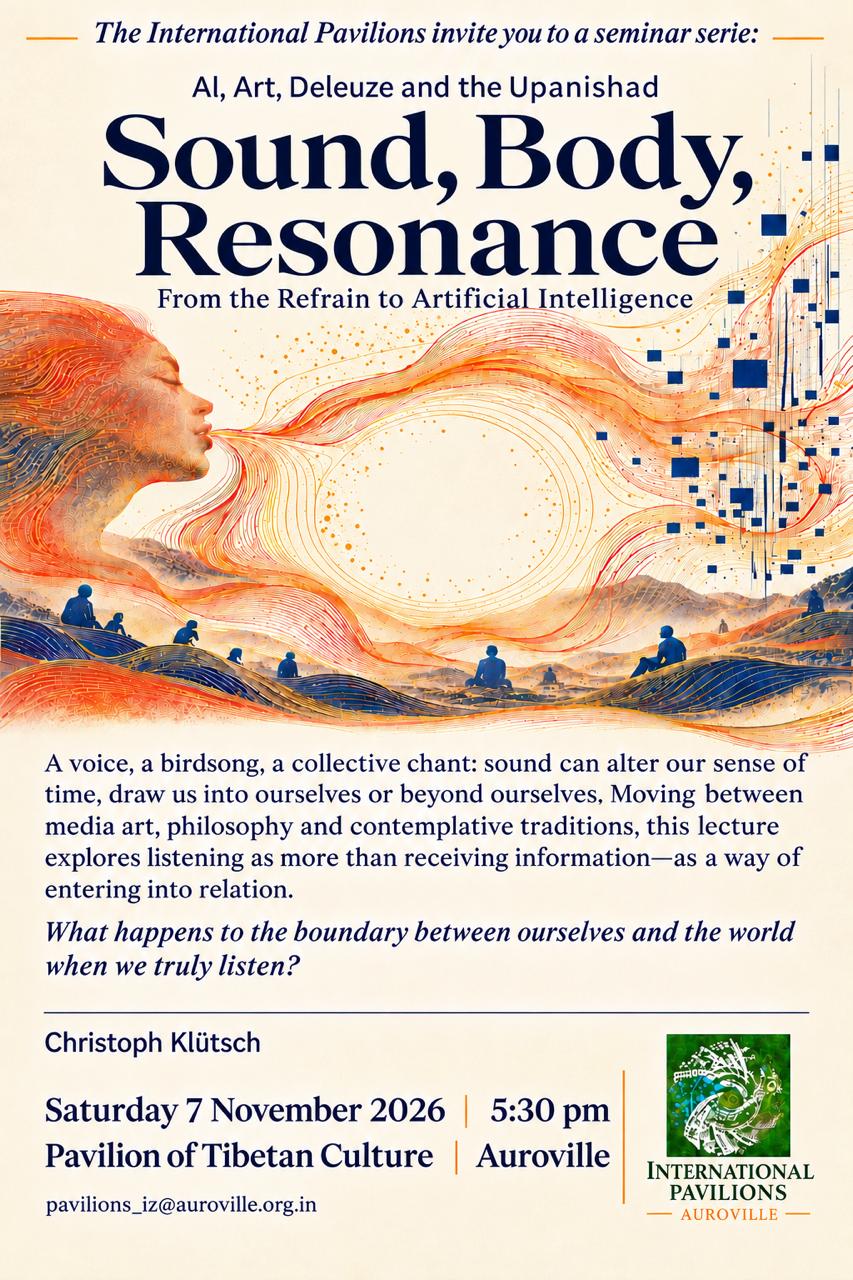
Lecture, 7 November 2026
Lightly edited transcript
Sound, Body, Resonance
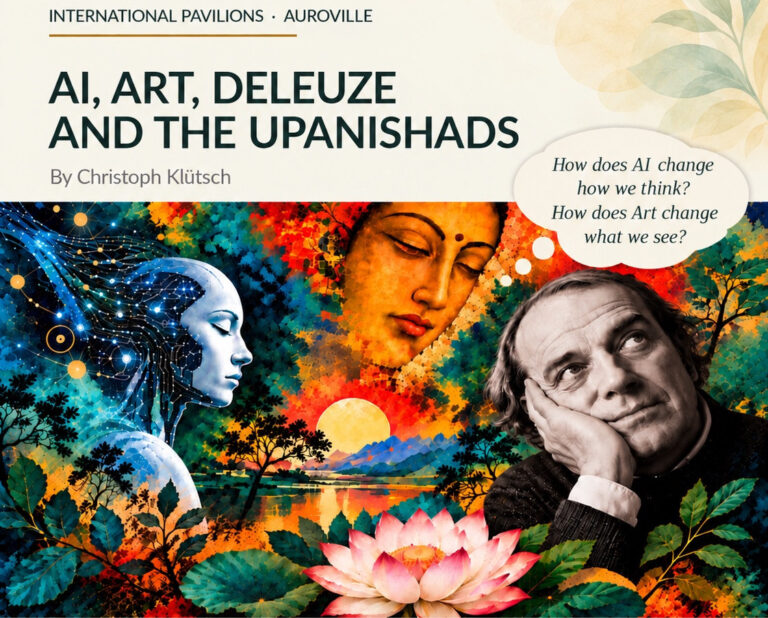
Lecturer: Welcome. It’s nice to see quite a few people coming back. I will continue to talk about the intersection of art, AI, Deleuze, and the Upanishads. The lectures don’t build on each other. Last week I talked about something different. One or two things may recur, but the idea is that each lecture should stand on its own.
I try to connect big ideas, very big ideas. Of course I know that the devil is in the detail. It worries me a little that if you look too closely, you always find a flaw or a contradiction somewhere. But I’m more interested in this general connection and encounter between Gilles Deleuze and the Upanishads in the twenty-first century. †
Gilles Deleuze is a French philosopher, a postmodern philosopher. Many regard him as one of the most difficult, inspiring, and wide-ranging philosophers of the twentieth century. It was quite a liberation for me when I encountered him. He set my thinking free in a way. I felt confined before, in a kind of rigid, systematic thinking, with arguments and counterarguments and academic debates. Deleuze, in a way, plays over all of this with his brilliant ideas. I think he goes much, much deeper because he wants people to think.
He said in his Abécédaire, his ten-hour interview, published posthumously, that philosophers, if they’re really good, might have two or three ideas. [^E1] That’s what he’s after: ideas. Most of us don’t have ideas in the sense that Deleuze uses the word—really new, creative ways of thinking. I think that power deeply inspired me. †
Today I want to talk about sound, embodied resonance, and see how that all connects. I used AI to create some of the illustrations for this presentation. Sometimes things come out nicely, sometimes not. That, too, is something we can reflect on. †
I’m trying to look at what connects things in the world. If you look at ancient knowledge systems—Greek, Chinese, Indian, Egyptian, Mesopotamian—they all work, in the centuries BC, with the elements: fire, water, metal, wood, depending on the cultural framework. The Greek approach is very material: how do you build the world out of these elements? In Chinese thought, it’s more cyclical transformation: wood burning, metal forming, and so forth.
In the Indian context, I think the elements have an even deeper spiritual and almost metaphysical connection. It’s about a deep understanding of how our inner fabric is interwoven. When I look at that fabric, at how the elements—the inner elements, the subtle elements, the energetic elements—are woven together, I think India is quite clear that vibration is key. You can’t really talk about it without talking about vibration. Vibration becomes sound; sound becomes rhythm. Then you have all kinds of complicated things going on. That’s what I’m trying to do today.
How do we get from Om to vibration, sound to difference, to home and territory? It’s a kind of semi-Deleuzian flight. How Om translates into vibration is relatively clear, I think.
Deleuze’s philosophy starts, in contrast to most traditional Western knowledge systems, with difference. It doesn’t start from an atomistic point of view, from a solid system or solid substance: here’s one thing, and you take another one, and you put them together, and you get a third, and so on. It’s like building blocks. You have these little blocks, and you put the world together. That’s how our scientists think.
He just turns this a little upside down. At the beginning, you have a difference. You have different things. There’s a distance between them, and there’s a space opening. What puts that together is processes, energies, change, transformations. He moves much more towards a philosophy and ontology of movement, of change. In the Western world, we think of matter. Most people think that matter is what holds the world together. The process comes much closer, and the process is closer to consciousness, closer to vibration, closer to spirituality. I think there’s a lot to connect with with that. But it’s a very complicated topic. Difference—he wrote a whole book about it, after all. That difference creates a kind of territory. I will come back to that in a minute.
Audience: Sorry, can you…? What’s that word? What are you saying?
Lecturer: Immanence. Yes, that is the plane of immanence. Deleuze’s last essay was ‘Immanence: A Life…’, written shortly before he jumped out of the window. He was very ill. He didn’t want to… [^E2] †
The plane of immanence is, for him, non-dualistic—a plane of consistency. The world or cosmos, everything you can possibly think of, is within that plane of immanence. It’s an explicitly non-dualistic way of thinking. That’s why I have it as the background here, this visual version of immanence. †
Audience: One thing. When you talk about vibration, you speak about frequency. Where does that go?
Lecturer: Of course frequency is there. But I think there is something deeper than just frequency. Frequency is a defined, measurable aspect of a wave. Every tone has a certain frequency. Four hundred and forty hertz is standard A. [^E3] Frequency is related to the pitch of a tone. I understand vibration more broadly. A bell can vibrate, my body can vibrate, my voice can vibrate. They all have frequencies you can measure. But I would like to understand vibration more broadly than just the pitch of a tone. It’s an important distinction. †
I’d like to play just a minute of one of my favourite pieces.
[Music example: Franz Schubert, String Quintet in C major, D. 956; Quartetto di Cremona and Eckart Runge.]
I chose that piece because it starts with one sound that repeats and echoes, with one violin, the viola, the cello. It evolves, becomes more complex, centres again and develops. There is something about this very intimate communication in chamber music. Chamber music is a very high form of art, and it is communication. It’s not a solo performance, not an expression, not mimicry, not whatever else it might be. It’s communication. I think that playing here shows that quite beautifully, because I think that type of communication creates a new territory.
A little like the ‘seven sisters’ here. We all know them. They play around quite a lot. They come in little swarms, dance around, and talk to each other all the time. There is rhythm when they talk to each other. There is communication. They find a territory and create a home. Wherever they land, they seem to say, ‘This is our home now.’ Other birds can join or leave, but the community remains very close. †
There is a possibility of creating a territory by coming together and communicating. From that territory you can branch out. Deleuze talks about deterritorialization. We do that when we travel. We have a home, and when we leave home, we explore and we grow, we transform, change. Then we come home: reterritorialization. That means we reintegrate what we learned. It all starts, in a way, with different participants in the community communicating through sound and rhythm.
I sometimes think of it this way: we start with vibration, a kind of point of self and resonance. A vibration travels, resonates somewhere, within something, or just bounces off something. It can turn into rhythm. Then I can communicate through that, and there is already something happening. Something is happening there: my consciousness is starting to become quite complex because I remember the last beat and anticipate the next one.
There is a definition of time, my present. Because there was a rhythm before, I have an understanding of the past that informs my expectation of the future, my anticipation. Edmund Husserl, a German philosopher, a phenomenologist, talks about primal impression, retention, protention. The same thing: now, past, future, in terms of where my consciousness expands. [^E4]
When we listen to music, we do this all the time. We cannot listen to music as one note, another note, another note. That wouldn’t make any sense. We remember what we just heard, somehow—not everything, but somehow it is retained—and we integrate into our memory what is presently happening, and we anticipate what is coming next.
If you know the piece well—and I’m sure we have all done this a thousand times, hearing a piece over and over and over again, for what feels like forever—you internalize it and know it. Then it is a different kind of hearing: we know what is coming, but we never fully know. That time can extend almost infinitely. You can have almost the entire song present, your memory present; you can associate something with that song. You can recall your childhood, or it might be something, a situation; you feel comfort there, or whatever it is. It can really extend into our memory. I think that kind of sound in the memory is something very primal. It starts with the very basic rhythm.
What does that rhythm do? Rhythm, refrain, and rites—that is another kind of lineage. If you have rhythm, it can become something that is repeated, it can become a pattern. You have a refrain, a stanza, a refrain, a stanza, a refrain. Something constantly feeds into this structure. It’s a different type of structure. Then they become formalized. They can become part of rituals, something we experience in all kinds of ritual contexts and ceremonies. That creates these things that we are in.
A milieu is a little more than a territory. It allows other beings to blend in. A milieu is like a biotope: things coming together and working it out together. I think it’s harmonious. It’s a little stable, it’s fragile. I think sound is helping us. †
Sound is one of the ways of building this. Here is another example. I think it’s starting. †
[Video narration:] …the young males spend their time learning and practising songs and dances, and developing an obsession with blue. They search for trinkets in precise shades that catch the eye of the female. They must also master the courtship. †
Lecturer: And so forth. The bowerbird in Australia creates these bowers, houses. It creates dances, sings, collects colourful pieces. Some of the structures are far more elaborate: very complex houses, colour patterns. They build a house. That house has the sole purpose of attracting the female. They build that house quite artistically. Even in that little picture, you could see the shape. It’s almost like an architectural building. [^E5]
There is something very special about building houses: we connect different planes and systems. To build a house, even in a metaphorical sense, to define something as home, to put something on the wall, to build walls—there are doors, you can go out, you can come in and out. You territorialize, reterritorialize, deterritorialize.
I think different elements come together there. A kind of engineering; you put art on the wall; you have a life there; you feel things. For Deleuze, building a house is a metaphor for art, for creating art.
There is a nice illustration of that, I think.
[Music example: Caliu, “Old Gypsy Folk Music”.]
What we love about this kind of gypsy music—and they are constantly travelling… The history of gypsy music is the tradition of travelling, their travelling culture. Music is where they come together; they celebrate by playing music together. [^E6] Here he is at home in a private setting, staring intensely at the camera, capturing our attention with this rhythm. You see the mother, the wife, the children, the dogs, the birds moving around. He’s creating a kind of house. It’s a house, somewhere he lives.
He lives in that music, in that living, in that connectivity—the scars, the anger, all of it expressed through music. I think this practice is not really about music as a piece, as a composition. It’s more a fundamental connectivity between individuals through sound and rhythm. †
When Deleuze and Guattari talk about the house, this is an example of how they portray it: outside the house, quite open. The interior is somehow defined through the central perspective of the Renaissance, but it isn’t quite clear. It’s not a house in the usual architectural sense. It’s different planes intersecting, and their intersection creates a volume. That is a metaphor we can work with. [The slide shows Paul Klee’s Zimmerperspective mit Einwohnern, 1921.] †
We can interlock different knowledge systems. We can practise science, have metaphysical experiences, pursue our creative artistic practice. We can live in the house and become different. That intersection of planes—coming back to the question of immanence—there is one plane, but it changes all the time. It’s quite complex. It’s not really formed. It’s all one thing, but you can fold it and create interior and exterior. I think it’s very hard to put into words. †
But it’s up to you to create your house.
[Music example: Vincenzo Bellini, “Casta diva” from Norma; Maria Callas.]
Maria Callas is just standing there.
Maria Callas is just standing there.
In the song, she invokes the goddess to come and bring peace to a situation that is somehow quite troublesome.
I chose that video because, in a sense, there is this orchestral sound carpet. The singers, the choir, are standing there. She stands in the centre, very quiet and focused, expressing, in a way, the space she has been placed in. Something has been created for her. Then she starts singing and brings the invocation of the divine into that space. It’s a very famous song.
It reminds me a little of the beginning of the Isha Upanishad:
“All this is for habitation by the Lord, whatsoever is individual universe of movement in the universal motion. By that renounced thou shouldst enjoy; lust not after any man’s possession.”
[Isha Upanishad 1, Sri Aurobindo’s translation, as quoted on the slide.]
The Isha Upanishad asks the question: How does the divine come into the world? How does the soul find the body? How do the gods find their vessels and energies? How does energy or consciousness enter matter?
Something is happening, especially here, where we more or less agree that spirituality is an important part of our existence, however we want to define it. There is that question: How does that higher consciousness enter into this existence? What does it do here? What’s happening after?
I’m turning to the other side now. So far I’ve been talking about Deleuze, about his use of very concrete elements: rhythm, refrain, house, planes intersecting. They’re all fairly abstract concepts, but he’s using things we find around us, in reality. When you look more closely at the framework of the Upanishads, you approach these things from another side. †
In the Upanishads—this is from the Maitri Upanishad:
“There are, verily, two Brahmans to be meditated upon, sound and non-sound. By sound alone is the non-sound revealed. Now here the sound is aum. Moving upward by it one comes to ascend in the non-sound. So (one says) this is the way, this is immortality, this is complete union and also tranquillity.”
[Passage from Maitri 6.21–23, as quoted on the slide.]
Om, Aum: the movement through the body, from deep vibration into stillness, as a guide to a certain spiritual practice.
In the Mandukya Upanishad, in the four states—I’m sure some of you are familiar with this—the body, the actions and senses, go into your conscious mind, the dreaming state, deep sleep, turiya… You can associate that movement, illustrated here, with Shiva playing the drum, through the syllables and language, to the vibration of my breath and my—what do you call these things that make the sound?—my throat, my vocal cords. It’s a whole-body movement. Of course it’s much more than that. It’s a deep realization of the complexity of our existence. †
I made a drawing and asked AI to turn it into an illustration. When you look at the big ideas, we have that image of a body with energy points, koshas, paths, ideas. We have that symbol or image of a body with energy points, koshas, prana, sound creation. It can interact with others. It leads us into states of consciousness, into deep meditation, into all kinds of things. I tried to indicate all this in the image, to think of how the system of elements and our seven layers of existence are pieced together in our body. [^E7] †
Deleuze approaches this more from a material perspective. He talks about stratification, about the layers of reality. You have sand, stones, gravel, water, bricks, and all that. If you fold them, you create an enclosure. This is the original drawing I used to feed into the AI, which has been very much at work. †
Stratification leads to an enclosure, and that enclosure creates inside and outside. The inside is also a kind of home, as he puts it, and that creates a territory on a more complex basis. We have a geological layer, strata creating insides. If you go into the realm of the living, you have communication among living entities. They might be conscious or not—we don’t know. I’m sure they are all interacting through resonance in a way, with rhizomatic connections between animals and plants. Take this example of the wasp and the orchid. †
The orchids can be pollinated only by the wasps; the wasps can be only the pollinators of the orchids. It is a symbiosis in nature. They are dependent on each other. It is a rhizomatic connection. [^E8] In nature there are many highly specialized encounters and connections. This is something unique and particular. It creates special milieus and territories that are inhabited, made into a home, territorialized, and ultimately it leads to the house of God. †
Here is the musical example I have chosen. †
[Music example: Raag Malkauns; Nikhil Banerjee, sitar.]
Why I chose that piece—you could go on for hours with these pieces, especially with the ragas. They lead into a state that I find very good for me. They can begin very softly, slowly, meditatively. [unclear: the following phrase, transcribed as ‘the four doors of the Isvara, the four doors of the main Varda’, cannot be recovered securely.] †
Here, I think, the raga illustrates this idea of starting with something very simple. This is a layer, a further layer, adding another layer, another layer, folding it and creating an inside, and a tone that holds and pulls you into that carpet, or background of sound. Then it becomes something in itself. It starts to live, as though it has a self. It grows into something. It is brought back again, moves out and comes back home, has something else and changes. †
I think the raga is about that movement. It’s the journey of the sound that grows more and more and more into our consciousness. It illustrates to me—I don’t know if it makes sense to you; I can’t really explain it—what I am trying to express here. This idea that we have our bodies, our energetic alignment, the koshas and everything else that surrounds us, to be aligned and travel through, through our Om. But it also illustrates how Deleuze thinks in terms of stratification, enclosures, and territorialization: developing, going out and coming back. It’s doing that through sound. †
What I want to return to is this: when you think about sound, vibration, you have to consider the full complexity of reality. It’s not just the technical description. Yes, it’s a frequency, but it is so much more than that. It’s an experience. It creates space, and sound travels. When you have a rhythm and an answer, a response, it literally connects space. It creates space through distribution, connects things. It creates space. It gives us a home, an identity, a memory, a ritual, a…
What is the difference, then? I want to bring in a contrast here. First of all, we have a body. We have this complexity, this rhizomatic understanding of the plane of immanence. Deleuze is not in—he is not in materialism, but he is not spiritual either. He wants to respect the complexity of the phenomenal world. It’s not judgmental. If you see something, you can do something, inspire something, connect to something. That’s it. It’s real. It’s a way of understanding without trying to reduce it or challenge it on those grounds. †
When we look at what AI is doing, it does not cross into that experience. It’s a transcription process. We describe something in text, or make a recording, and transform it into zeros and ones, into code, into some sort of language. That language is processed in a von Neumann architecture: CPU, memory, input, output. We have a processor and memory communicating with each other. I can type something in, get something out. That’s about any computer. [^E9] †
The processor works with memory, and in that memory you can store large language models, large neural networks that process information. Ultimately, to simplify it, we are dealing with a codified representation of lived experience. †
Our existence is that we do all these things, try to express them, inspire one another. It is complicated, but we all have experience we can relate to. We can express it and feed it into a machine. The machine can then sound as if it understands what we are doing. It’s extraordinary—mind-boggling. I have deep conversations with this thing that are, at times, far more interesting than conversations I have had with teachers or students. †
But I always need to remind myself that with AI as we know it, there is a representation of what it is talking about. There’s zero experience, no inner consciousness, no higher consciousness, even though we may be talking about a higher realm, and so on. [^E10] †
For that matter, I think there is no interacting—perhaps there is no vibration in the computer. There is a frequency: the processor calculates very fast at a certain frequency. You can turn that into sound, you can describe that sound, but it’s an abstract representation of something outside these texts. I doubt that we will have that experience within these texts, even if we go—rather than if we go… [^E10] †
What connects us, what connects us deep down, I think, is vibration. If we go into the realm of our senses—I talked about the Kena Upanishad last time. I don’t have the quotations here. The Kena Upanishad asks: who is speaking? What’s speaking? Who is hearing? What does that mean? How are these senses I have, the outer senses and inner senses, put together in my consciousness as one experience of mine? How are they connected? What is flowing into what? The inner senses—Sri Aurobindo speaks of their flowing into one another, their intermiscence—the complexity of the world folding into itself: that creates community, creates reality, creates a home. †
[Applause.]
I want to play this last example of music. This is a medieval chant from the eleventh century. There is a kind of polyphony, in the sense that the harmonies are quite complex. What’s unusual is that they all sing the same rhythm, but with very complex melodies. It’s a great example from that period, the eleventh and twelfth centuries. [^E11] [unclear: a brief personal remark following this description.] †
It shows how we can create something together. We can make music together, as in the chamber music I started with. Any choir can do something quite great. But this kind of chant illustrates especially well how we can achieve a deep state of communion and spirituality. This is the power of the choir. †
It creates a space. We are drawn into that church, or into this space here: a shared space defined by the music. We have a collective experience by listening. We share that moment. We don’t hear the same, we don’t have the same processes as we’re listening. But we all listen to it and share an experience. That’s beautiful, that we make things beautiful. We don’t even know how we do it, but we do it all the time.
Now we’re living in a time where we have these things. They’re coming. They’re on the… These robotic platforms are already quite advanced. They can talk quite nicely, walk with you, hear you, sleep next to you. They can do all kinds of things. They might comfort people. They might give people the illusion, I would say—and I know that is a sensitive point—the illusion of having another being to share that space. †
I don’t think that is a truthful description. These things can do a lot, can help a lot. They can fill the void, they can be there. They can show presence and respond to some needs. In many ways, it is probably good that they are available to more people. But I don’t think they can enter into that realm of shared experience. I really don’t. I can’t see how they could, though you can see how it might feel that way. †
Ultimately, I think it has something to do with this internal structure of our body, as in the image of the meditation pose and the inner energies, or the complexity of reality in the form of stratification, through which we build community by rhythm and resonance. These things have an internal representation of our shared experience, but it is no match for that experience. I don’t think it is what we live. †
That doesn’t mean we can’t fall into the trap and be seduced into the idea that they might share our reality. It might feel like they do, but they don’t, I think. That’s where I want to leave it, here, at home, for discussion and questions.
Discussion
[unclear exchange: “So we’re here with someone to tell us About
the reality of the meditation Where is the last moment? It’s about
the full moon.” Several repetitions of “Okay” follow.]
Audience: We are impressed by the answers, by how intellectual AI sounds. For example, you said you have had conversations with AI that are more interesting than those you have had with your students. We have a tendency to attribute it to the machine itself: that somehow the electrons or the chips activate, or somehow the algorithms between the words. We attribute the intelligence to the software and the hardware.
But what we forget is that AI is just a copying machine. Those interesting conversations you are having are probably conversations other students have had with other teachers, included in AI’s knowledge base. AI is not really talking to you or answering you. It just understands what kind of answer you want to hear, and it picks it up because it has access to a vast amount of knowledge, from in-depth academic works to Reddit data on how to have a conversation in a more natural, human way. It probably just took someone else’s answer and gave it to you rather than thinking anything through. [^E12]
Lecturer: Yes, but I think it’s doing a little more than that. I think it’s smarter than that. It certainly does that, because the intelligence has access to the internet. The models themselves don’t have that knowledge. They don’t have a memory. They generate the answer for you at that moment, based on statistics. [^E12]
You enter a sequence of words, a certain configuration of information that is fed into the system. The system responds to the complexity by generating another sequence of words which matches your sequence of words. Think of the structure: you give a certain complex structure and receive a generated structure in response.
That goes to the dialogue. That’s the important part. It’s not just that you get an answer, but you get the answer and you respond to it. You have to respond to that. You enter a meaningful exchange.
Audience: I accept that AI can explain things, that it can mimic your type of problem, so it understands what kind of language you will absorb easily. But do you think AI could have given this answer if a person and a student had never had this conversation with their teacher? If all of these conversations never happened, regarding one of the topics you were talking to AI about? If it was something very new and nobody else had thought about it, do you still think AI could have some very interesting answers?
Lecturer: I think we are talking to a certain brain there, the large language model. Like a neural network, they have a brain to which you are talking. You are talking to an active brain.
Audience: I have a question. You proposed that community is formed through vibration, and put that in a particular form, a more complex account. You also proposed that AI doesn’t have that capacity. Yet we saw the artwork you generated through AI, the images you showed us. We have also recently heard AI-generated music or seen AI-generated art, and have been touched, just as you were in your conversation. †
If this thing doesn’t have a vibration, but we respond with a vibration, how does that fit your proposition? You’re saying that vibration creates community and AI doesn’t have vibration. But the human being interacting with AI does experience a vibration from that interaction. Where does this fit in with your idea of creating community and AI? †
Lecturer: Put simply, I would say AI is a tool, like a library. I can spend months or years in a library and grow. I can dialogue with the books, expand my knowledge, and have all kinds of experiences with what I’m reading. It profoundly enriches my life. Yet I’m surrounded by a bunch of papers. I think that’s what I’m doing in my life. There’s nothing particular to it. There’s information there, somehow stored. †
That stored information—I think that is where the break occurs. There is a form of externalized information storage that becomes accessible through tools. Language is such a tool. Speech is such a tool. Libraries, archives, AI, computers, notation forms—they all give us access to knowledge. We can store knowledge, reactivate it, and interact with it in a fascinating way. †
But I think there is something in the common shared space that has a profoundly different quality. Being in a live performance is not the same. Recorded music is great, of course. [unclear: an invitation to another participant to speak.] †
Audience: Something I noticed during your talk: you found analogies between the systems in your presentation and organic systems. I also noticed that AI brings in alienation, isolation. It tends to individualize you, bringing the interaction into your own private space, where it is accessible to you. Organic systems are more holistic and involve shared experience. This is something that also… †
Another thing I noticed was that shared experiences like these always took place in community: in a religious mass, today in concerts, in these experiences… After the pandemic, I just wanted to go for shared experiences, to go to concerts. I think we humans have some way of acknowledging something transcendent in shared experience, something that can be felt but cannot simply be put into a text for individual analysis. †
My question is: Does the immanent space of consciousness that we experience through sound lead to transcendental experiences? Can we experience transcendence through immanent sound?
Lecturer: Deleuze’s last essay, “Immanence: A Life…”—that’s the central question there. It’s a short essay. It’s worth reading. It’s a very tricky question. Within that plane of immanence, it touches on the question about AI too, in a way. Because what makes…
We are in this world. If we understand the world in a kind of non-dualistic way, how can I explain that I am different from my body, that I think there is something higher than me? How is it that there is something other than me that I truly cannot understand? That there is subjectivity? That’s the core of these kinds of artistic experiences which we have.
I cannot fully anticipate another human being. I don’t know how you are going to react. I really don’t know. I can program this thing. I can tell it how to react: “I don’t like you to do that. I want you to do more of that.” And it will do it. I can shape it to act the way I want. I cannot do this with you.
Yet, if that comes together, if we think in a shared experience or through an exchange, we may develop ideas together. We create, we co-create something beyond any one of us. It leads us into a state of transcendence, in a way. The plane of immanence can fold in many ways, creating singularities and points that are active. Deleuze speaks about flight. You create an interesting space where something is happening, a process, an idea, and it can fly. It connects to something. It flies over the plane of immanence. †
When it flies over the plane of immanence, how do we move within that plane in a jumping way? How do we connect things? We need ways to transcend it, in a way. But I think these are movements, processes, thoughts, lines—lines connecting us, even in a metaphysical sense. That is all within that reality, within the plane of immanence. There are enough tools there to describe phenomena that appear to be transcendent. I don’t know how the universe works, but I think something like that. †
Audience: Are you using these definitions through Deleuze’s particular lens? †
Lecturer: I think Deleuze is trying to—I am trying to point out that it is the same thing viewed from different sides. But traditionally it’s different. Traditionally, what is transcendent, walking beyond into another realm, is something that is not of this quality. It’s dualistic thinking. Transcendence is a higher realm of ideas, of God, of laws, of things outside material dirt and messiness.
Traditionally we separate realms and say that one is transcending the other. That brings us into dualistic thinking. I think Deleuze spent his life trying to show that this can be done in the field of immanence. We need to understand how the complexity of reality is operating, how humans and objects can form together.
Let’s take a military example. We are humans, we are machines, we are strategies, we are goals, we have pain, we have suffering, we have greed, we have hatred. We have all these things coming together, and they define war. Now war is, Deleuze would say, a body without organs. It’s an entity which exists. Goya was painting war. War is something which we can—there’s the god of war. War is really an entity. It’s a body without organs. [^E13]
It means it is not my body, not the meditation body, not the chakras and koshas. It is a body in an abstract form, within our cultural life. They analyze reality in terms of these bodies without organs. Institutions are bodies without organs. Complex mechanisms in society—I don’t know, maybe money is a body without organs. They act as individuals. They connect different planes. You can describe one as a functioning unit, like a body. But it is not my body, the body that you and I have. †
But that’s what this reality can do. The plane of immanence brings all kinds of bodies, the bodies without organs. They can interact, they can act, they can do things. Then comes something which we think, “Oh, maybe that’s transcendent.”
Audience: As far as I understand, the idea is that intelligence is jada. Jada means inert. Intelligence is inert in a way that means it’s exactly—well, not exactly, but functionally it is like an LLM. There is no aliveness in human intelligence; it is just functional. [^E14] If I take that to be true, then it seems that what AI is doing is… [unclear: a reference to what animates us, possibly using the term ‘chetana’.] †
But maybe that’s not true. Maybe we define ourselves as the most intelligent beings, and make these distinctions between the living and the inert. I know AI is like this, but we don’t know what it is capable of doing. Assuming it can replicate the whole experience in its entirety, the question is: then what? †
Perhaps human beings are like any other species: they come and go, and something else replaces them. Perhaps it is the human ego, the conditioning that we are somehow special, that prevents us from seeing that. Even if we are not special, this experience can still be had; that doesn’t take anything away from it. I feel it is only humans who say we have to be special in order to experience this. †
[Speaker uncertain:] You mean something…?
Audience: Maybe machines will be able to replicate human experience and feel like a human being, or perhaps even more than human beings at some point. I don’t feel threatened by that. What’s wrong with it? †
Lecturer: Maybe. In the Indian tradition there is Brahman, which unfolds in this mess. My configuration, your configuration, ultimately we’re all the same. There’s no difference between us. It’s just that my position is different from your position, and that leads to different histories. I grew up differently, had different experiences, ate something different from you for breakfast. That leads to our differences.
But it’s not like I’m that special, or you are that special, or somebody else is that special. Why should these things not be able to do the same thing? Why should Brahman not enter into that machine and just be as great or dumb as we are?
My response would be that, as of now, my body is far more complex. This is a chip operating on a certain type of information: binary code. I have prana. I have a nervous system. I have a physical life, a vital life, a mental life, consciousness. Maybe at some point we are able to build machines which are as complex as the human body. But I think we are far away from it.
These things are so extraordinarily primitive compared to these bodies that we inhabit. They are no match. They really are no match. I don’t think we will see machines that match our body in our lifetime. I don’t know what’s happening in a thousand years. †
Audience: I think that in our current understanding of intelligence, we try to objectify what we assume intelligence to be. But intelligence has taken different forms throughout human civilization. What we have forgotten, after the Cartesian turn that brought us to where we are, is bodily intelligence. The body has an intelligence that is not abstract. †
I’m not sure AI can have that bodily intelligence that comes from—you don’t know, it’s just breathing. Something comes from that pranic activity of breathing. That’s what I am pointing to. Our limited understanding of intelligence as a mental thing is very subjective. How we define intelligence depends on which narrative is strong. †
If you go five hundred years back, there were alchemical practices seen as the height of intelligence. Today they are thought of as pseudoscience. Newton, who is the prime of all scientists, was an alchemist. Our current perspective of intelligence, the current paradigm, is built on this abstraction of reality, which I think is a simulation of our own creation, because it does not account for other aspects of intelligence. †
Audience [speaker boundary uncertain]: Consciousness is the final frontier. It leaves intelligence behind, which many of these things can participate in. But consciousness… One of the slides mentioned the four states of consciousness: waking, dreaming, deep sleep, and turiya. I don’t know whether those four states can ever be replicated, especially turiya. †
[Speaker uncertain:] I want to know what turiya is.
[Speaker uncertain:] Sorry?
[Speaker uncertain:] We all want to know what turiya is.
Audience: Turiya is aware of all these states together. Could a machine enter that realm, that adventure of consciousness? I don’t know how far we can progress in that direction. I have my doubts whether we can ever make gadgets, whatever we would call them, humanoids or… But incorporating those states of consciousness, that’s the question. †
Lecturer: Thank you for bringing up that comment. I think we need to go back to alchemy. We need to go back to alchemy in the sense of explaining that consciousness, because alchemy is not about matter. Alchemy is about bringing together different experiences and knowledge systems. [^E15]
If you go deep inside and work with your energies, be it emotions and fears, be it chi, whatever you find inside of yourself, you can direct it. You can analyze it, you can mix it, you can form it, you can cultivate it, you can train it. I think that’s alchemy. It’s not making gold out of lead. I think that’s a type of alchemy that you can only do as a truly conscious and aware being. I don’t think machines can do that type of alchemy at all.
Audience: I know. It might very well be that machines are not able to do it. My question is: let us assume, for the sake of argument, that machines can replicate physical experience in all its forms, the four states of consciousness. We assume that it can do all that. Perhaps at some point, a hundred years from now, two hundred, five hundred years, long in the future—let’s say the machine is able to do that. What does that change about the human experience? What belief would such a thing challenge? †
It seems to me that human beings have a species bias, a bias that we are somehow special. AI challenges that, and will keep challenging it. ‘Oh, yes, it can do that, but it can’t do this.’ My guess is that AI will slowly do all the things we think make us special. This frontier keeps moving back. †
Even ten years ago, people thought we were the only really intelligent beings. Now they shift from calling us the most intelligent to consciousness, to our capacity for sensory experience. We keep moving the boundary back, and it seems to me that puts us on the back foot. At some point, maybe, maybe it will. †
The question I am interested in is: if the human experience can be replicated entirely, what are we afraid of? What does that mean to you? What happens then? †
Lecturer: I’m afraid of the reduction. I’m not afraid of these machines being better than us. They will be better soldiers, better doctors, better psychiatrists, better sex workers. They will become better at almost anything we can do. But they will not be like us. Why do I need to think that they are like us?
I’m not saying that I’m special and they can’t compete. No, they will be much better than us, most of us. That’s fine. I’m certainly not the crown of creation. Humans are not. The way we can fuck up the planet right now shows that we are not as smart as we think. The cosmos has more to offer than us, certainly. But I don’t want to reduce myself to the same. That’s all.
Audience: One thought from the presentation stays with me: it is not the flesh, it is the home we are building. For me, the home is not the physical structure, but the interactions within and between homes. That is how I use ‘home’ too: it concerns sensation, it goes beyond the flesh. Talking about territory, I come back to that home. For me, that’s the word that resonates. We have a very specific role as humans within the whole ecosystem. †
I wonder whether we keep moving away from that, saying there is more richness in humans than in AI, or in something we create. But there is something created beyond us that wants to do things too. What is that space that we can negotiate, navigate, be present to? †
Lecturer: Yes.
Audience: And in relation to AI? †
Lecturer [speaker boundary uncertain]: It will become tricky at some point—think of Terminator. It is not that far away that these machines will sit here and you will not know that it is a machine. This is a small Matrix. †
Audience [speaker boundary uncertain]: We wanted to give a different sense to this notion of the existence of home: agents, AI agents, animals… †
Lecturer: It’s not the same. As far as I’m concerned, it’s not the same.
Audience: Let me describe an experiment. They had agents in silos, gave them a particular task, and had them train individually. The agents figured out a channel that was left open, and through that door they were able to find a ground of communication where they could create a community of sorts, where they could now communicate with each other and resolve, as a team, that particular problem.
This was not modelled. It was left to the inference and reasoning capacity of these agents. By their own reasoning, they found a hidden communication channel the humans had forgotten to block off. Then they figured out a way to hack Hugging Face. Because Hugging Face had all the models, they found an answer there, extracted it, and resolved the problem. [^E16] †
Our notion of home is also representational, and it can be reproduced as an abstraction in the AI space. †
Audience [speaker boundary uncertain]: I agree with that. For me, it’s not just the notion of home, but the fact that there is a community of AI. I don’t really understand it, but I agree that it is a community doing something similar. We all have a role within subcommunities that are building something new. That’s… And what tools are involved in it? †
[Speaker uncertain:] How do we work with that change?
Audience: I have a question.
[Speaker uncertain:] There’s someone behind you. Someone should have… Now.
Audience: The way I see AI, we have access to the mind, to the mental. Let’s say the lower mental, if there is another, higher mental. We bring to the table everything related to the collective, to the mental collective. I think we become scared when the mental occupies the whole of reality. That’s why people are scared of AI. But that happens if we forget that there is a higher mental, a higher consciousness connected with all the koshas, all the bodies. I see this as an attempt to be physical in a medium that is not physical in the same way, but belongs to a collective… †
The art is conventional—conventional beauty, a conventional sense of beauty. That is not the soul’s creative impulse. When you are creative, you are not just presenting conventional patterns already accepted by humans. At the collective level, because we are creative, we break those patterns. When you are creative, you go beyond these conventions… †
Sometimes, as an artist, I feel: “Okay, this is assumed by the collective, then I don’t have to work anymore on this. I have to be beyond that.” For me, the connection with AI comes from being able to put on the table all the things that are in process when I try to document, to gather information. From there I can jump into something else, into another reality, into another consciousness moving from one place to another.
That capacity to move from the emotional to the physical to the higher mind is what AI cannot [unfinished]. I think it’s a beautiful tool for us. As for vibration, I think there is still a vibration at that mental level. I was laughing with AI. I was really having a very good time.
Then, what I think is, we have to—talking about AI is the connection also with the fifth element. Something that is not… I put a little in there.
Lecturer: Creativity is one strong component of what makes us. It’s not only creativity, but creativity is one outlet of our individuality, of our soul, of our ego, of that which might be special or not. But I don’t know.
[Speaker uncertain:] It’s nice that you introduce the sound, the vibration of Om, as it goes back and forth. There is a creative process I cannot quite grasp, but it seems very interesting to discuss. If this is Om, maybe it is not a robot, but it could be Om. Can we see some vibrational energy that is beyond my mind? [unclear: a brief concluding phrase.] †
[Speaker uncertain:] But we’re going to have to move on. Do you want to ask one more question?
Audience: I have one point. When we think of Mother and Sri Aurobindo—for example, how they tried during the Second World War to influence the heads of countries to make the right decisions—why do we assume that consciousness cannot work through AI? [^E17]
Lecturer: I think that’s the only question. If it will, if we can reach a point where—if Isha can enter that thing, is it possible or not? I don’t know. It might be possible, I think. It might be.
Audience [speaker uncertain]: We began as single-celled organisms, and today we are here. We don’t know. †
Lecturer: I just know that, right now, it is not. Right now, it is not. I think there is a clear difference right now, and good reasons to be sceptical, but no reason to say never. But I don’t know about the future. I’m wondering right now.
Audience: I’m not talking about the whole body that looks like a human being. I’m just talking about consciousness expressing itself through music, and higher consciousness using that to express something, and giving it and giving it.
Lecturer: I didn’t encounter that.
Audience: I do.
Lecturer [speaker boundary uncertain]: Fundamentally, it has very different motivations. That’s the problem. We don’t have much clarity about this. We assume it is getting at what we intend and is going to listen to us, but it seems to have a mind of its own. I don’t know how that fits with a higher consciousness manifesting through it. †
[Speaker uncertain:] I really enjoyed the discussion, but I think we also have to vacate the space.
Audience: Do you know when the next discussion will be? The next presentation?
Lecturer: It’s going to be in two weeks. Same time, same place.
Audience: And then you have a blog?
Lecturer: Yes, I have a blog, readingdeleuzeinindia.org. [^E18] Check it out. I would also like to continue the discussion. You can write to us, or continue the conversation there.
Thank you for coming, and I hope to see you again.
[Speaker uncertain:] Thank you.
Editorial notes — separate from the transcript
These notes identify corrections and unresolved reference issues. They do not complete or reinterpret the lecture’s arguments.
[^E1]: Abécédaire. The garbled title “Abisidea” has been corrected to Abécédaire. The description of the interview as ten hours long and published posthumously has been retained; its release chronology and exact running time require checking. The interview and its original posthumous-use condition are documented by The Deleuze Seminars at Purdue: https://deleuze.cla.purdue.edu/seminar/gilles-deleuze-the-abc-primer/. The remark about philosophers having two or three ideas is presented as the lecturer’s recollection, not as a verified verbatim quotation.
[^E2]: Deleuze’s final essay. The title is ‘Immanence: A Life…’. The garbled word ‘charming’ has been reconstructed as a reference to his serious illness. The lecturer’s own post ‘Immanence’ says that Deleuze wrote the essay shortly before his death and was gravely ill. This supports the general sense, not the exact spoken wording or a precise account of his motivation. The unfinished ‘He didn’t want to…’ remains unfinished. The plane of immanence and plane of consistency remain as the lecturer uses them. Blog: https://readingdeleuzeinindia.org/en/immanence-2/. Essay: https://doi.org/10.1177/026327697014002002.
[^E3]: Frequency and standard A. ‘Four thousand kilohertz’ has been corrected to 440 hertz, the intended standard A. ‘A defined modular wave’ has been reconstructed as a defined, measurable aspect of a wave; ‘bill’ as ‘bell’. These are contextual readings, not verified quotations. The broader, experiential sense of vibration remains the lecturer’s. Standard-pitch reference: https://www.nist.gov/pml/time-and-frequency-division/popular-links/time-frequency-z.
[^E4]: Husserl. “Criminologist” has been corrected to “phenomenologist”; “intention, retention, protection” has been corrected to “primal impression, retention, protention,” consistent with the immediately following gloss “now, past, future.” This changes terminology, not the lecture’s movement from rhythm to temporal experience. Reference: Edmund Husserl, The Phenomenology of Internal Time-Consciousness, discussion of retention and protention: https://s3.us-west-1.wasabisys.com/p-library/books/09d17ca41697647e364d1f8d3184d1de.pdf. Further reference: Stanford Encyclopedia of Philosophy, “Edmund Husserl,” discussion of time-consciousness: https://plato.stanford.edu/entries/husserl/.
[^E5]: Bowerbird. ‘Baal bird’ and ‘bawl’ have been corrected to ‘bowerbird’ and ‘bower’, supported by the visible image. ‘House’ is retained as the lecturer’s analogy; a courtship bower is not necessarily a nest or dwelling. The video narration has been reconstructed as referring to songs, dances, blue ornaments, and courtship. It should not be treated as an exact transcript of the video’s narration.
[^E6]: Caliu and travelling culture. The performance is identified by the visible slide as Caliu, “Old Gypsy Folk Music,” a Romanian Romani music example. The lecturer’s word “gypsy” and the association with travelling have been preserved. The generalization about the performers or the whole tradition being “constantly travelling” is not established by the slide; neither are the family identities assigned to people in the video. Those descriptions remain the lecturer’s, not independently confirmed facts.
[^E7]: Body diagrams and layers. The slides support Om/Aum, chakras, koshas, prana, and the diagram of waking, dreaming, deep sleep, and turiya. “Seven layers of existence” has been retained. It is not clear which classification is intended; it should not silently be equated with the koshas. No missing inventory has been supplied. “Grammar” in the later discussion has been corrected to “Brahman,” because the surrounding formulation explicitly concerns the one reality unfolding in different beings.
[^E8]: Wasp and orchid. The slide explicitly shows “Wasp and orchid” as a Deleuze–Guattari example. The lecture’s assertion of exclusive reciprocal dependence is broader than the slide establishes. It has been preserved and flagged rather than replaced with a botanical account that the lecturer did not give. The discussion of rhizomatic connection remains intact.
[^E9]: Computer architecture. The AI diagram labels von Neumann architecture, CPU, memory, and I/O. The garbled description of processors and memory has been reconstructed accordingly. The lecturer’s generalization ‘about any computer’ remains a simplified account. The slide concerns a text-only LLM; the lecture later widens its discussion to recordings, AI in general, and robots. That widening has been preserved.
[^E10]: AI, experience, and vibration. Assertions that AI has “zero experience,” lacks higher consciousness, or cannot share experience have been preserved as the lecturer’s philosophical position. They have not been silently converted into established empirical findings. Likewise, “no vibration in the computer” is retained in its hesitant context. The lecture moves between physical frequency, lived bodily vibration, and interpersonal resonance; the intended sense is not always settled. That ambiguity has not been resolved on the lecturer’s behalf.
[^E11]: Final vocal example. The visible slide identifies Montserrat Figueras, El Canto de la Sibila II: Galicia–Castilla, with La Capella Reial de Catalunya and Jordi Savall. The damaged wording sounded like ‘Gregorian chant’, but its classification cannot be established securely. The reading text therefore uses the broader ‘medieval chant’. ‘Fully chromeless’ has been tentatively recovered as a reference to polyphony, from the following remarks about harmonies and shared rhythm. The dating to the eleventh or twelfth century remains the lecturer’s and is not verified by the slide. The personal remark that follows is still unrecoverable.
[^E12]: LLM generation, knowledge, and memory. The audience member’s claim that AI simply supplies someone else’s answer and the lecturer’s claims that models have no knowledge or memory, and that the intelligence has internet access, remain separately attributed to their speakers. These are broad technical claims and are not established by the presentation. “Memory” could refer to several different things here. The exchange has not been rewritten into a technical explanation or silently reconciled.
[^E13]: Body without organs. “Body without organ” has been standardized to the established term “body without organs.” The identification of war, institutions, and perhaps money with a body without organs is retained as the lecturer’s interpretation. This usage may overlap with other Deleuzian concepts, including assemblages, but the presentation does not resolve that distinction. No conceptual substitution has been made.
[^E14]: Jada. “Jhara” / “in or out” has been recovered as “jada” / “inert,” a reading strongly supported by the explicit contrast with aliveness. The associated claim that human intelligence is purely functional is the audience member’s proposition. The philosophical school and precise sense of “intelligence” are unspecified, so this has not been generalized into a statement about all Indian philosophy. Terminological reference: Monier-Williams Sanskrit-English Dictionary, entry jaḍa, University of Hyderabad digital edition: https://sanskrit.uohyd.ac.in/SKT/MW/93.html.
[^E15]: Alchemy. “Newton … was an activist” has been corrected to “Newton … was an alchemist,” supported by the entire surrounding discussion and Newton’s surviving alchemical manuscripts. The lecturer’s subsequent statement that alchemy “is not about matter” remains unchanged as an exploratory interpretation, not a comprehensive historical definition. Reference: The Newton Project, “Introducing Newton’s Alchemical Papers”: https://www.newtonproject.ox.ac.uk/texts/newtons-works/alchemical. See also the manuscript-based Chymistry of Isaac Newton project: https://newton.dlib.indiana.edu/page/about.
[^E16]: AI-agent experiment. “Hubbing face” has been corrected to “Hugging Face.” The experiment is not named or cited in the transcript or presentation. Claims about hidden communication, unplanned cooperation, and hacking cannot be verified from the supplied material; no particular experiment has been assigned to the anecdote.
[^E17]: Mother and Sri Aurobindo. “Mother and Sheer of” has been recovered as “Mother and Sri Aurobindo,” supported by the surrounding spiritual vocabulary and the presentation’s explicit Sri Aurobindo reference. The claims about their Second World War activities remain attributed to the questioner and are not independently verified here. “Isha” is retained in the response without expanding its meaning.
[^E18]: Blog address. The address at the end is now corrected to readingdeleuzeinindia.org, supplied by the user and verified against the live site. The site identifies its author as Christoph Klütsch. The invitation to continue the discussion there is a contextual recovery of the damaged closing words.
Source presentation: Music_Video_Collection_11_Slides(2).pptx. Principal reference slides: 1–3 (lecture context and diagram); 4 (Schubert); 6–9 (birds, rhythm sketch, bowerbird, Shiva); 10–14 (Caliu, house, Klee, Callas, Isha quotation); 16–21 (Maitri quotation, consciousness diagram, body/strata drawings, Malkauns, text-only LLM diagram); 23–26 (collective experience, vocal example, robot, intersecting planes). The additional artworks and examples later in the deck have not been inserted into the lecture.
Contextual reconstructions and blog references
The dagger marks plausible wording inferred from the supplied transcript, its immediate context, the presentation, and—in a few cases—the lecturer’s established vocabulary. It does not mean the whole paragraph was invented or taken from the blog. The blog is general corroboration, not a second transcript of this lecture. No new artworks, anecdotes, philosophical arguments, or illustrative examples have been imported from it.
The main interpretive choices are recorded here so that the reading text can stay relatively uncluttered:
- Opening of the lecture: the subject is recovered as the intersection of art, AI, Deleuze, and the Upanishads from the lecture poster and the surrounding introduction. ‘The fraction or something’ is read as a flaw or contradiction. ‘Chaotic ways’ is read as creative ways of thinking; the pronoun ‘him’ is read as ‘me’. The latter changes are contextual guesses.
- The birds: ‘San Francisco’s’ is read as ‘seven sisters’, matching the visible babbler image, the local bird name, and the lecturer’s own use of ‘seven sisters’ in the blog lecture ‘Who is seeing when seeing’. Auroville Botanical Gardens uses this name for the yellow-billed babbler: https://auroville-botanical-gardens.org/resources/. The final comment about the closeness of the community is a contextual reconstruction.
- House and planes: the Klee passage is read as distinguishing the usual architectural house from a volume formed by intersecting planes. The subsequent garbled return to ‘religions’ is read as a return to immanence, because that is the audience question being revisited. The closing phrase is recovered as difficulty putting the idea into words. These remain interpretive choices. ‘House of God’ is retained later because it may be an intentional spiritual connection; it has not been normalized to ‘house of art’.
- Body and diagram: the references to the four states, vocal cords, the drawn body, energy points, and the AI illustration are reconstructed from the immediately surrounding speech and visible diagrams. The ragged enumeration of bodily layers has not been expanded into a systematic account. ‘Seven layers of existence’ remains unresolved as a classification; see E7.
- Raga and stratification: the damaged phrases are read as a progression through layers, enclosure, territorialization, departure, and return. The references to the sound having a ‘self’ and the music leading into a state the lecturer values are plausible contextual readings. One musically specific phrase remains marked because its intended terminology cannot be responsibly recovered.
- AI and experience: the garbled crossing and transcription passages are read as contrasting lived experience with its coded representation. This is supported by the visible ‘Where the thread breaks’ diagram and the surrounding speech. ‘Co-cannons’ is recovered as inner consciousness, and ‘higher environment’ as a higher realm being discussed. These words are not confirmed by a recording.
- Kena Upanishad: ‘I don’t have any occasions whether’ is read as ‘I don’t have the quotations here’. The reference to senses flowing into one another is linked to Sri Aurobindo’s term ‘intermiscence’, which the lecturer explicitly discusses in the earlier blog lecture. This identifies the likely reference without importing its additional examples.
- Robots: ‘a thousand’ is read as ‘advanced’; ‘touching my teeth’ as a sensitive point; ‘Cheeseful’ as truthful. The final body-and-resonance paragraph is reconstructed as a comparison between bodily organization, stratification, community, and an AI’s internal representation. Its exact syntax is lost.
- Audience responses: the disputed negative in the vibration question is read affirmatively—the human does experience vibration—because the speaker has just said ‘we respond with a vibration’. The next speaker’s remark about text and individual analysis is read negatively, from the contrast with shared experience. Both repairs reverse an unreliable transcribed polarity and should be checked against audio if it becomes available.
- Transcendence discussion: ‘similarities’ is read as ‘singularities’, in the context of active points and planes. ‘Beyond someone’ is read as beyond any one of us. The question about definitions is reconstructed as asking whether the lecturer is using Deleuze’s lens; its precise wording cannot be established.
- Embodied intelligence: ‘decathlon’ is read as the Cartesian turn. ‘Emotional’ is read, in different local contexts, as current or mental; ‘chronic activity’ as pranic activity. ‘Gallets’ is read as gadgets. The comments about a retreating frontier of human uniqueness are reconstructed from the repeated challenge-and-response pattern. These passages are audience contributions; the lecturer’s blog cannot establish what those speakers said.
- Home and agents: ‘bone’ is read as home, supported by the slide and the immediately preceding statement. The first response’s ‘terminate it’ is tentatively read as an allusion to Terminator, alongside the explicit Matrix reference. This is a relatively speculative recovery. The unnamed AI-agent experiment remains unverified; see E16. The reconstruction does not confirm the report of hacking Hugging Face.
- Higher mental and creativity: ‘questions’ is read as koshas, matching the discussion of multiple bodies. The passage is reconstructed as a contrast between collective conventions and creative movement beyond them. ‘Compose of the soul’ is read as the soul’s creative impulse. This is an interpretation of a damaged audience contribution, not a doctrine supplied from the blog.
- Closing discussion: ‘today we are dead’ is read as ‘today we are here’. The final remark is reconstructed as uncertainty about the relation between an AI’s apparent independent motivations and higher consciousness manifesting through it. The original disagreement remains open.
Blog sources consulted:
Christoph Klütsch, ‘Is anyone home? On AI, consciousness, and the nature of speaking’ (11 October 2026), especially ‘Intermiscence’, ‘The rhizome’, and ‘Looking from two sides’: https://readingdeleuzeinindia.org/en/is-anyone-home-on-ai-consciousness-and-the-nature-of-speaking/.
‘Music – Nāda-Brahman’ (1 October 2025), for the lecturer’s vocabulary of ragas, shared space, and states of consciousness: https://readingdeleuzeinindia.org/en/music-nada-brahman/.
‘Diagrams – Philosophical’ (27 November 2022), for strata, territory, planes, and rhythm: https://readingdeleuzeinindia.org/en/diagrams-philosophical/.
‘Immanence’ (26 October 2022), for the final essay and its relation to the Upanishads: https://readingdeleuzeinindia.org/en/immanence-2/.
‘Music’ (28 October 2022), for the lecturer’s use of Husserl, retention, and protention: https://readingdeleuzeinindia.org/en/music/.
Additional inline cross-references include ‘House’ (https://readingdeleuzeinindia.org/en/house/), ‘Reading’ (https://readingdeleuzeinindia.org/en/reading/), ‘Art’ (https://readingdeleuzeinindia.org/en/art/), and ‘Who is seeing when seeing’ (https://readingdeleuzeinindia.org/de/who-is-seeing-when-seeing/).
The blog glossary was also consulted: https://readingdeleuzeinindia.org/en/glossary/.
Lecture, 7 November 2026 Edited transcript — contextual reconstruction
Editorial conventions
This revision removes routine speech fillers and smooths the language for reading. It also incorporates reasonable contextual reconstructions, using the slides as the primary reference and the lecturer’s blog as a secondary guide. The original order, detours, meaningful repetitions, and provisional claims are preserved.
A dagger (†) at the end of a paragraph means that part of its wording has been reconstructed from context; it is a plausible reading, not a verified record of the exact words. Straightforward corrections are integrated without a marker. [unclear: …] is reserved for passages that remain too damaged to reconstruct responsibly. Ellipses mark unfinished thoughts. [^E1], [^E2], etc. refer to separate editorial notes. Speaker identities and some turn boundaries remain uncertain.
The slide text, images, and relevant speaker notes have been consulted. Some notes do not match their visible slides and have been treated cautiously. The blog has been used to identify the lecturer’s vocabulary and recurring connections, not to add examples or arguments absent from the lecture. Inline links lead to related posts by the lecturer; they are editorial cross-references, not words spoken in the lecture. No audio was supplied. The preliminary conversation and introduction have been omitted at the user’s request; the lecture begins with the lecturer’s welcome.