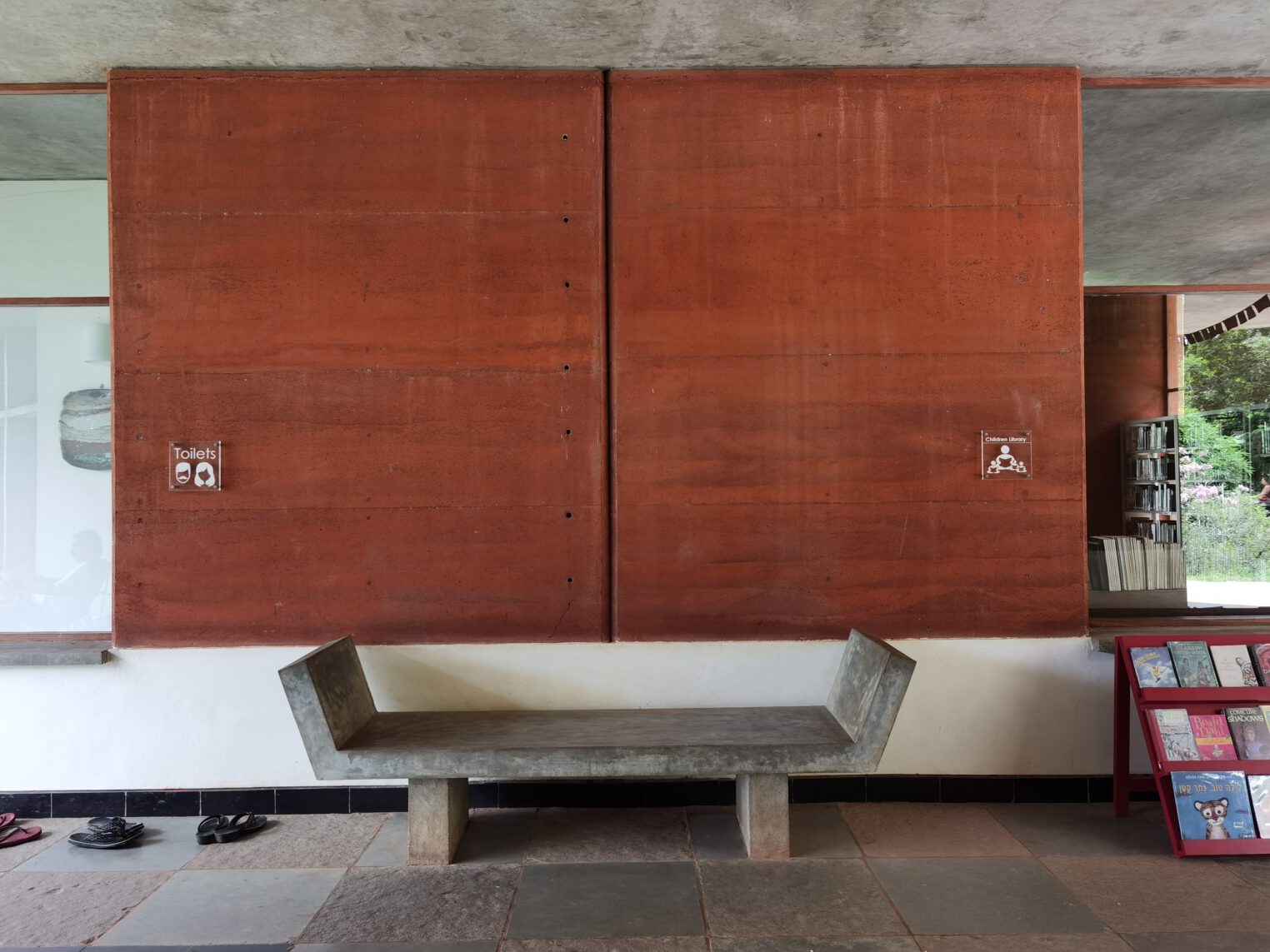
For three weeks now I have been reading in India: Deleuze, Upanishads, Sri Aurobindo. In between I sometimes meditate. The rest is still a remnant of everyday life in the New World. Reading the news, consuming entertainment media, organizing things that have no real significance here but need continuity so that they do not fall apart in old Europe and the New World.
Reading, then… It seems to me that I have spent decades preparing to read here. My thinking oscillates between Deleuze and the Upanishads. This wisdom in India, that everything is one, and that the entire universe exists only because the Self wants to know itself, is so incredibly strong that I still only sense how deep this thought is. Schopenhauer’s title ‘The World as Will and Representation’ is beginning to make sense; Deleuze’s reference to Spinoza as a spiritual thinker of immanence makes sense too. I do not yet dare to reread Deleuze’s book on immanence. Instead, 1000 Plateaus… This book, which is not a book at all but a machine, a thinking machine (Professor Dr. Dr. Dr. Augustus van Dusen, also The Thinking Machine sends his regards)…
I have shaped seminars with this book without ever having properly understood it. It can hardly really be read either. It is more of an instrument. The attempt to think the world in a fundamentally different way. On any arbitrary page, conventional capitalist, dualist, categorical thinking is challenged. I have always wondered how Deleuze and Guattari reached such a plane of consciousness. How did they do that, move so far out of the prevailing ideology that they seem like prophets of a more inclusive thinking? I wanted to find this out together with my students. We failed, of course, but beautifully, and afterward we saw the world with different eyes, and that is what a university is about, is it not?
Deterritorialization
Now, however, the worlds of thought are connecting. The biological references, the central position of art (which is much more exciting in animals than in humans), thinking in immanence, the flying lines, territories and abstract machines. For me, all this can really only be understood from the Upanishads. And today I found a quotation I want to share. It is about Deterritorialization. A complicated concept built on many other complicated concepts. But the basic idea seems to me to be that the world is composed of its elements. These first take shape in strata/layers (geological layers, for example). Within these layers, the elements resonate with one another; they form a rhythm and thus create a milieu. This is quite easy to imagine in the animal kingdom, birdsong, for example; there are refrains and rites… This milieu creates a territory, a home. The Self in this territory, where it is at home, is shaped by the layers, milieus, rhythms and so on… and creates a home by creating art, for example. It expresses itself, produces signs and symbols; it becomes semiotic and enters the realm of art (this can be the pattern of a butterfly, the house-building of a Bowerbird, a house. Within this territory there are then movements, including movements of thought, that lead out of it. Life, thoughts, the earth—they deterritorialize. Now, then, the quotation in a DeepL translation of the English original (D stands for the function of Deterritorialization):
“This is already evident in the mystery of ‘birth,’ in which the earth, as a glowing, eccentric or intensive focal point, lies outside the territory and exists only in the movement of D. More than that, the earth, the glacial land, is deterritorialization par excellence: that is why it belongs to the cosmos and presents itself as the material through which human beings tap cosmic forces. One could say that the earth, as deterritorialization, is itself the strict correlate of D. This goes so far that D can be called the creator of the earth—of a new land, a universe, not merely a reterritorialization.
This is the meaning of ‘absolute.’ The absolute expresses nothing transcendent or undifferentiated. It does not even express a magnitude that would exceed all given (relative) magnitudes. It expresses only a kind of movement that differs qualitatively from relative movement.”
I will spend the next few months understanding what this really means.
Here is the English original:
“This can already be seen in the mystery of the “natal,” in which the earth as ardent, eccentric, or intense focal point is outside the territory and exists only in the movement of D. More than that, the earth, the glacial, is Deterritorialization par excellence: that is why it belongs to the Cosmos, and presents itself as the material through which human beings tap cosmic forces. We could say that the earth, as deterritorialized, is itself the strict correlate of D. To the point that D can be called the creator of the earth—of a new land, a universe, not just a reterritorialization.
This is the meaning of “absolute.” The absolute expresses nothing transcendent or undifferentiated. It does not even express a quantity that would exceed all given (relative) quantities. It expresses only a type of movement qualitatively different from relative movement.” Deleuze 1000 Plateaus p. 509
Leave a Reply