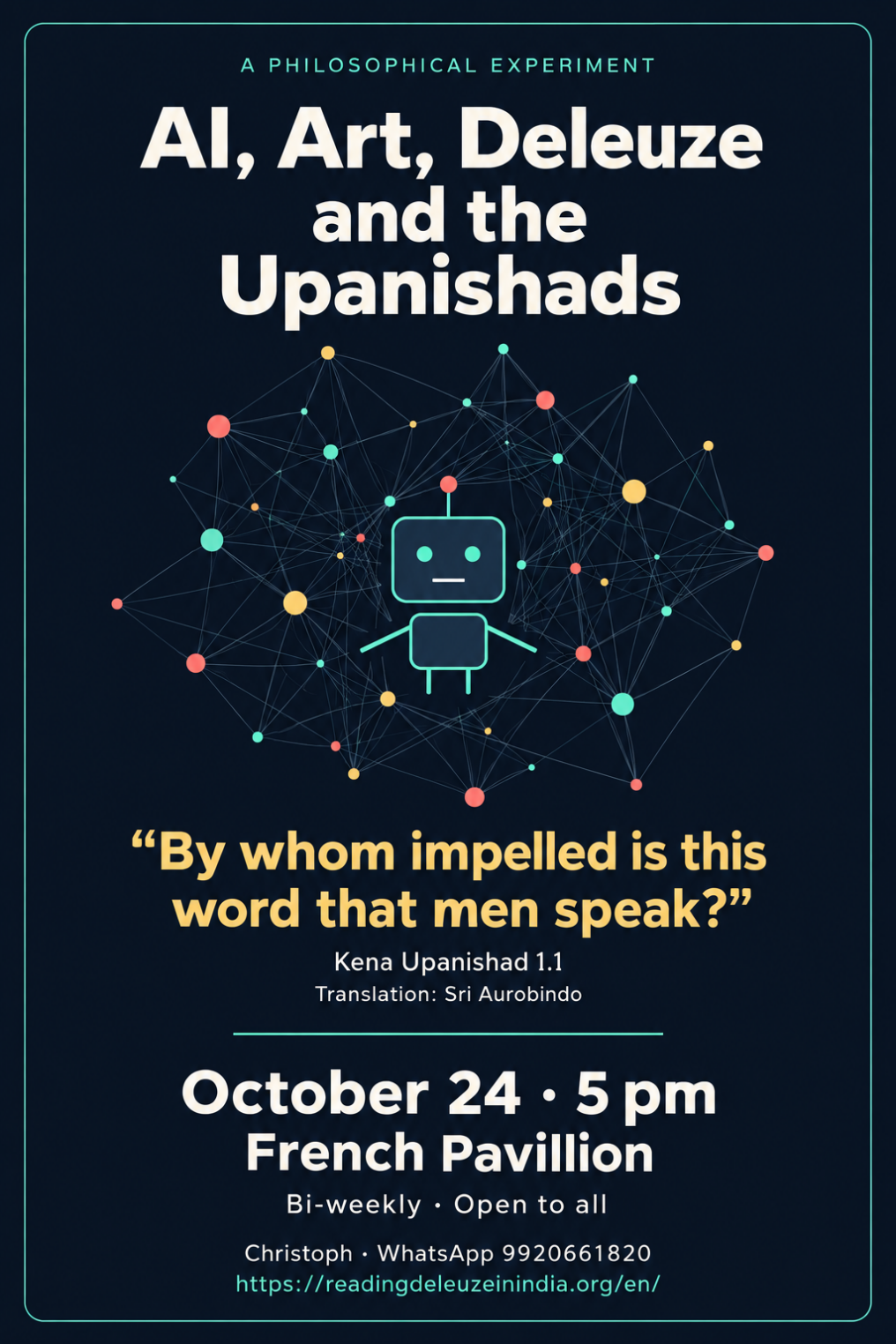
AI as a conversation partner
Recently, AI language models have reached a level of quality that allows for a real conversation about difficult philosophical topics. In the 1960s, Joseph Weizenbaum wrote a program he called ELIZA. In one well-known application, it responded to input with simple feedback, often by asking further questions, along the lines of: “What do you mean by x?” or “Who is x? What is your relationship with x?” Some users felt understood and confided personal things to the program.
This kind of feedback can give us the impression of being seen and receiving responses phrased specifically for us. The AI models of recent years can also create this impression, although they work differently. Their responses are no longer based simply on a selection of phrases or keywords, but on learned patterns of language. Linguistic input is processed by a neural network that uses learned patterns to calculate probabilities for what comes next and gradually generates output from them. This happens inside a black box whose inner workings we do not fully understand. We know the architecture of the neural network, but cannot fully trace in detail how a particular response comes about.
Language models and their context
Now many additional programs and agent systems have been built around these language models. Some can search the internet or other databases, others are designed for particular tasks, and still others can work iteratively, allowing them to plan and carry out complex steps. Language models have been given additional possibilities for action and access to information. The surrounding programs process the input and output. At their core, however, the workings of the models remain partly opaque, even though we know they calculate probabilities. This raises the question of how arguments are analyzed, processed, and generated by an AI.
How do we think?
This raises the question of how we as human beings reason and produce knowledge. In Western modernity, the emphasis was placed on rationality, that is, on logic, scientific work—for example, the principle of falsification in empirical research—or reasoned consensus. But our thinking certainly has other modalities too, such as intuition, emotion, introspection, experience, and individuality. In the 20th century, we built various theoretical frameworks to investigate qualitatively different forms of knowledge according to scientific standards. Yet it remains unclear in what way such modalities and principles are found within an AI black box. There, learned patterns are processed and probabilities calculated; the output can then be checked by additional programs and, if appropriate, fed back in as input.
So when I say that I can talk with an AI about complex philosophical problems, the question is really less whether the machine seems intelligent than how thinking works. It would be presumptuous to say that we as human beings understand our thinking, or that I understand my thinking. Much is not entirely clear to me either, but I have insight into my world of thought. I can share it and explain it when asked. I can explain why I cannot explain myself. I have access to my inner experience, and I assume that when other people speak of their inner experience, it is sufficiently similar to mine for me to understand it. Of course, I cannot be entirely sure of this, and this has given rise to a long tradition of philosophical debates. But on the level of my everyday existence, I do not really question this assumption.
Who thinks what?
We often have the naive idea that our thinking is what we can say. When we do not speak about it, we often experience it as an inner dialogue: thoughts in the form of sentences run through our heads. These thoughts are often colored by emotions. Yet our thinking is fed by our senses, embedded in memories, and measured against expectations, goals, and personality structures. Over time, a personality, a character, an I takes shape. The constitution of this I is a mystery, a wonder. I can reflect on myself and integrate my experiences. I can become conscious of myself; my I becomes an object of my consciousness.
The ground of consciousness
More fundamental than this, however, is the general capacity for conscious experience. Here we enter the mystery of our existence, for the fact that I am conscious of my existence presupposes consciousness. This in itself says nothing about its possible material prerequisites. What is immediately given to me is inner experience, even before I think about an external world. It seems to me that the stuff consciousness is made of cannot be described by the laws of matter alone. Perhaps something in us can be experienced as pure consciousness. It may be this state that we seek in meditation, experience as bliss, and that some spiritual paths aim toward. It is the black box of our existence.
Through introspection we can shed some light on this black box, but may never reach its ground. At its limits stand questions of death and birth, of the intersubjective, and of emptiness. From a Kantian perspective, time and space are given to us a priori as forms of intuition; they structure our experience and cannot be experienced in the same way as its objects. As we approach the ground of this black box and its limits that extend beyond experience, we are confronted with something that, for some, can only be described as spiritual experience. This can be understood as an experience that is not bound to our little I, but draws from an ocean of consciousness of which various spiritual and philosophical texts speak. In this interpretation, what thinks here, or experiences its pure existence, is not my little I. It is something greater than I am, and I am part of it. I cannot fully analyze or understand it; it is an approach to pure existence.
Who speaks?
In some currents of Western philosophy, subtle distinctions on the subjective level are neglected. I would like to ask, for example: What is the difference between thinking and speaking? I do not think that speaking is merely an expression of thinking. When we speak, something in us speaks. Our body carries out the speaking: my mouth, my breathing, my vocal cords, my tongue. But my body language, my gestures, my facial expression, and my gaze are also part of speaking. Some of this is lost in telecommunications. But that does not mean it is not part of speaking.
Speaking is not merely an exchange of information; it is a form of being, an activity, a process. When we speak, we do not necessarily know what the next thought we express will be. We enter a mode of being in which we communicate ourselves and also discover ourselves. We speak to others just as we speak to ourselves. We sometimes speak unconsciously, even, at times, in sleep, in dreams. Speaking can include thinking, thinking can be an inner speaking; but neither can be reduced to the other.
Above, I tried to shed light on thinking by comparing human beings and AI. Does an AI speak? Can it speak? This seems doubtful to me. Perhaps the distinction between thinking and speaking cannot readily be applied to an AI. An AI’s linguistic output can be made audible. But that is not necessarily the same as speaking in the sense described here. Perhaps robots will someday be able to speak in this sense. But that would have to be more than what is called speech output. It seems to me that this distinction still receives little attention in public discussion.
Speaking as self-realization and resonance
Speaking thus points to something essential in our being. What speaks is neither my thinking alone nor a finished self that simply expresses itself. Rather, I understand speaking as autopoiesis in a figurative sense: as self-realization. By this I do not mean identity, ego, I, person, or other concepts that try to define us. I mean a deep Self, the soul, the ground of consciousness: a resonance and vibration that expresses itself, among other things, in the production of vocal sounds. Speaking is vibration, one might perhaps say figuratively: vibration of consciousness, of thinking, of the body, of the surroundings, of the listener, of their consciousness and their body—a resonance in language, in the context of being.
I sometimes have the feeling that there is a cosmic consciousness, an Akasha archive, an immanent field in which everything is embedded, which could explain the cosmic interaction of quantum mechanics, but could also explain how consciousness can connect with other consciousness, perhaps even merge with it in states of ecstasy, rapture, in the collective, or in connectedness with nature—a state of the sublime. On this level, Deleuze’s rhizome is interesting, because here many things can connect with many different things and allow something new to emerge. For me, the focus here is less the point of connection than the becoming of something new, the growing of one from many. Perhaps at the beginning, at the very beginning, there was not something, but many things that increasingly take concrete form. Within such an image of a cosmic rhizome: Would it not also be possible to imagine a connection in which our spirit, my soul, wet consciousness, that is, biological consciousness, connects with a knowing, a thinking, and a generating of new states of information based on machines and information architecture? Would it therefore be possible to accept that what is so different from what I can understand has a quality that allows me to connect on a deep level?
Further reading: Maurice Merleau-Ponty, Phenomenology of Perception (1945), especially the distinction between parole parlante and parole parlée.
1 Tiefgründige Gespräche mit KI – Wer spricht-1791738836752.webp1 Tiefgründige Gespräche mit KI – Wer spricht-1791738836750.webp
https://www.tldraw.com/f/GI4B95lICrM8knejdtB2K?d=v-2475.-446.5583.3042.page