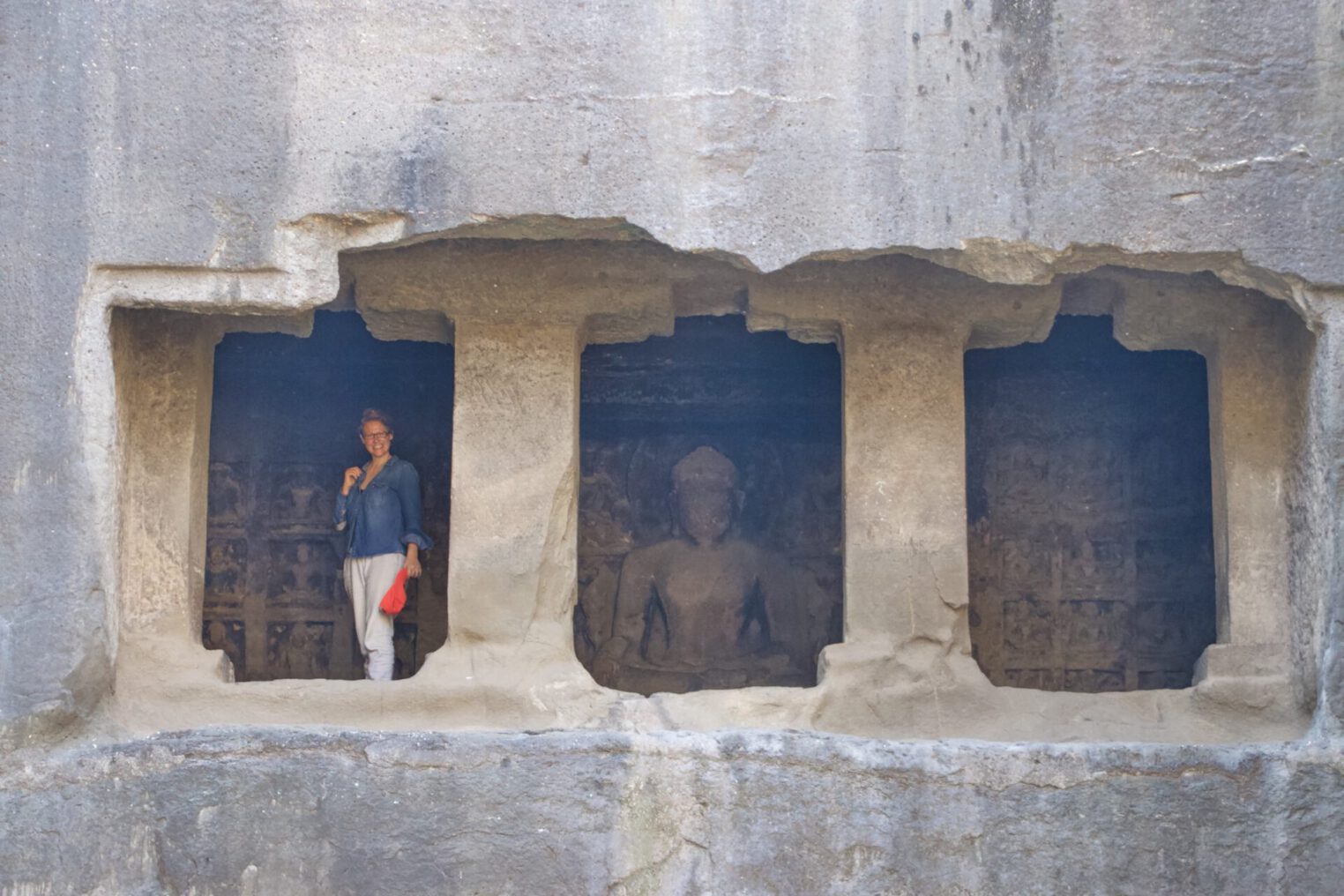
Art begins not with flesh but with the house. (Deleuze)
I now practice meditation. It took a long time to admit this to myself. Somehow I had always done it, only I did not know it. Like most people, I have phases in which I look inward, or concentrate contemplatively on something, phases in which I try to calm my mind, or find out what this I within me actually is, phases in which I try to understand what my rational mind cannot understand (infinity, for example, or the beginning of time, etc.).
I did this when I was in a crisis (whether intellectual, emotional, biographical…) or I do it when I clarify my consciousness (like clarified butter), or look at which forces are at work in me, as though large animals were pressing forward and upward inside me, as though horses and cows were restlessly trying to free themselves and striving toward the light.
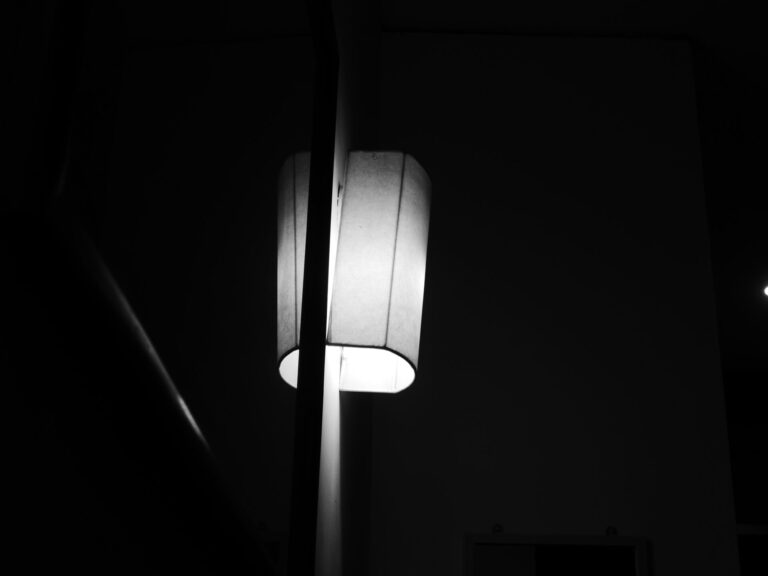
Light
In the face of the light, then, when the mind has come to rest, when the rational mind has made peace with the fact that it cannot understand everything and yet is able to grasp the world intuitively—a moment, then, of unity with the world on a level of consciousness that transcends everyday life—there is what German has no unburdened words for: rapture, blessedness, in English bliss, in Sanskrit Ananda.
Yet this state always struck me as somehow uncanny. For there I would see phenomena I knew from kitschy New Age postcards, or from a roommate during my student days in London who always painted on LSD… I think I did well to be critical of these visions, for they are a somewhat showy distraction of meditative consciousness. Color, geometries, light, cosmic expanses… all these are beautiful experiences and images, but they do not lead far. They let the little ego think it is something special. These images arise easily during a longer meditation, especially in the lotus position after half an hour or so, when the legs start falling asleep. When the pain of the sitting position subsides and the endorphins no longer have to control the body’s stimuli, but can run wild and free in consciousness—it is beautiful, but, as I said, leads nowhere. So I always found it suspect.
Space
I find it more exciting when a space opens up in this consciousness and the mind’s eye begins to see clearly. With the eyes closed, consciousness meditates on itself. It detaches itself from the stimulus-response pattern, since there are actually not many stimuli left (provided the meditation takes place in a truly quiet space with few stimuli). Consciousness is now alone with itself. Where does it want to go? Into memory? Into reflection and problem-solving thought? Into contemplative beholding? Into imagination and creativity? Into feelings, the heart?
To help this a little and give it a system, there is the image of the 7 chakras (Sahasrara, Ajna, Vishuddha, Anahata, Manipura, Svadhisthana, Muladhara). I can visit these chakras in meditation and see whether one chakra or another needs a little attention. A kind of inner balance can be established in this way. Here, too, I try to avoid the kitschy circles of color. I do not find that helpful, though it may be different for others. But I am digressing; there are many such ‘techniques.’
Concept, Percept, Affect
Where does consciousness want to go? Who or what is behind consciousness, where does it come from? Is there a soul? Is it immortal? Is it part of something greater? Can I think the universe, existence in itself, with all its complexity and many facets, as a unity?
Here, with my concepts, I quickly reach the limits of the thinkable (Kant’s antinomies). My little brain—how is it supposed to approach this? As long as I hold to the idea that my consciousness consists solely of sensory impressions—percepts—generated by my body’s sense organs, I cannot leave this subjective perspective. My intuition and my creativity, however, help me further here. There are affects in my consciousness; it is affected, it acts. Precisely this acting, guided by intuition and creativity, is for me the key to a deep meditation. Concept and percept have their role and task, but their reach and capacity for understanding are limited. Affects, however, are different. An affect—what is that?
„By whom missioned falls the mind shot to its mark? By whom yoked moves the first life-breath forward on its paths? By whom impelled is this word that men speak? What god set eye and ear to their workings?
That which is hearing of our hearing, mind of our mind, speech of our speech, that too is life of our life-breath and sight of our sight. The wise are released beyond and they pass from this world and become immortal.“ (Kena Upanishad)
Who hears in hearing, who sees in seeing, who thinks in thinking? A life force, an Elan Vital, a becoming (Becoming), a change (change)? When the vibrations of the senses intermingle (intermiscence), a percept arises. When this percept wants to express itself, it does so in language, another form of vibration. A concept arises. These concepts are sometimes abstract; they may be ideas. But these ideas are part of another reality. Already in Plato, this leads to an idealism that, in Western rationalism, withers into a transcendental philosophy.
In Deleuze, however, concept, percept, and affect remain agile; they arise when the body enters into an encounter with the external world. Concept, percept, and affect change, yet remain recognizable; they form patterns. They are the basic forms of vibrations, thus energetic patterns. They can also be communicated to a limited extent. Above all, however, they form an inner space that can be experienced in meditation.
Space here is to be understood literally only to a limited extent. In meditation, the mind is free to move. Space and time are no longer limitations. Just as, when thoughts are associated, the objects of those thoughts do not move along with them, so in the space of meditation the mind can hurry freely from one beholding to the next. I think this is what is meant by the seeing of the inner eye, and what in some people is intensified into visions.
Visions
These visions, as I will call them in an old-fashioned way, give access to more than merely an inner world of experience. A house erects itself there, a city in which forces are simply forces, detached from causal chains. There may be neurochemical processes taking place when the mind is so active, and whoever wishes may carry out a reduction here. Yet that is a very daring theory, supported by nothing, pure science fiction—for at best we are dealing with correlations here; a causal relation cannot be demonstrated. We do not even know what it is that we want to place in a causal relation.
Let us simply take consciousness as what it is: consciousness. Why this reductionism? I do not reduce my life to biochemistry either.
In this consciousness, then, a space arises, that is, an architecture. In Deleuze, it sounds like this:
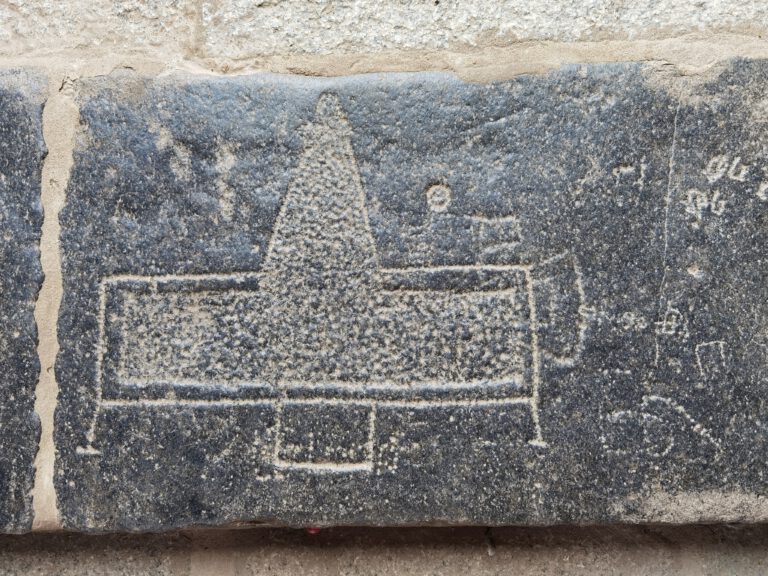
“Interlocking these frames or joining up all these planes wall section, window section, floor section, slope section- is a composite system rich in points and counterpoints. The frames and their joins hold the compounds of sensations, hold up figures, and intermingle with their upholding, with their own appearance. These are the faces of a dice of sensation. Frames or sections are not coordinates; they belong to compounds of sensations whose faces, whose interfaces, they constitute. But however extendable this system may be, it still needs a vast plane of composition that carries out a kind of deframing following lines of flight that pass through the territory only in order to open it onto the universe, that go from house-territory to town-cosmos, and that now dissolve the identity of the place through variation of the earth, a town having not so much a place as vectors folding the abstract line of relief. On this plane of composition, as on “an abstract vectorial space,” geometrical figures are laid out cone, prism, dihe-dron, simple plane-which are no more than cosmic forces capable of merging, being transformed, confronting each other, and alternating; world before man yet produced by man. The planes must now be taken apart in order to relate them to their intervals rather than to one another and in order to create new affects. We have seen that painting pursued the same movement.” (Deleuze: What is Philosophy? p.187)