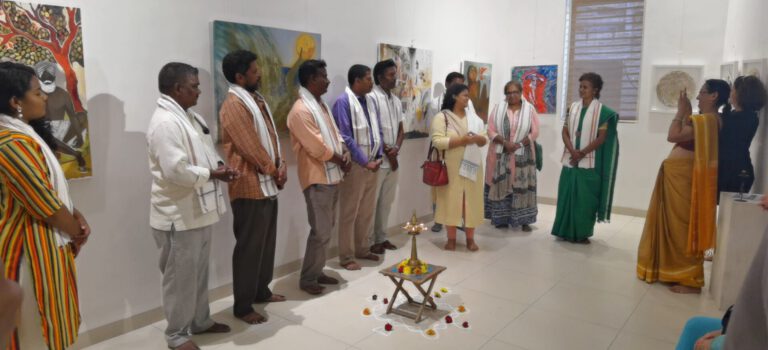
Here in Auroville, the people in charge of Bharat Nivas recently removed a play from the program. The reason given was that some in the community had taken offense at it, even before it was performed. This raises questions. What may art do, when is a ban justified? Bound up with this, of course, is the question: what is the task of art, what should art do? The question invites reflection on the role of art in general, here in India and in the West. And because this very fundamental question extends not only across the Indo-European sphere, but covers a whole field of the most diverse cultures, I would also like to give it a temporal dimension.
Let us start at the beginning, with the Greeks of the classical period, for example. Here, on the one hand, there is the question of the beautiful (form, function, and/or proportion), but on the other, the question of the role of art within philosophy (techne, mimesis, aisthesis). At the heart of this constellation of concepts is the relation of the subject to the external world as object. How do people perceive the world, how and why do we imitate the world, for example in theater or sculpture? What technique, what tools do we use to shape the world, give it a function, or bring out beautiful, that is, mathematical proportions? It is therefore about the relation of human beings to their environment as a shaping relation.
Art is created, brought forth, is the expression of a subject that shapes the world of objects. In the art of the West, we see the artist and his vision. Despite all the rapid developments in European art history, this has not fundamentally changed to this day.
It is quite different in ‘Indian’ art. Classical Indian art expresses feelings that are universally valid. Spiritual feelings, human emotions, forces at work in the world. The artist is subordinate to the artwork, actually unimportant, because only what is expressed in the artwork counts, for it is an image of forces at work in the cosmos. The artist has merely made them visible. And this is where the misunderstanding arises that the art of India largely resembles the art of the European Middle Ages, since there, too, there was no artist as antiquity or the Renaissance understood him. What is the difference?
Textuality and Interpretation
There is an important difference. The Western eye, or ear, the Western mind, looks in the artwork for what can be interpreted. This may be an intrinsic quality such as beauty, or technical mastery, an iconographic reference, the genius of the artist, an object that is part of a discourse, an object of reflection, or quite ‘simply’ an image, a depiction, or a representation. The list could go on for a long time. Essentially, however, it is always about interpretation. If an artwork is the object of a differentiated interpretation, it is considered a successful, great artwork. If it is an object that gives pleasure, it comes under suspicion of being ‘merely’ design, craft, or kitsch.
In this way, the West has produced a cultural landscape based on interpretation. And interpretation is ultimately a critical analysis in the medium of language, that is, it is textual. The encounter with art is one of thinking about art. Contemplation, which is also repeatedly addressed in Western discourses on art theory, is a preliminary stage of this thinking. Contemplation is subsequently reflected upon and expressed, and thereby robbed of its force.
The Sublime
The aesthetic experience that eludes these discursive tendencies moves into the realm of the elevated, the sublime, a realm of secular transcendence, that is, to the limits of language. For even the limit of the textual is part of discourse, though as a demarcation and a reference to the unsayable. Yet Western art theory generally leaves it at this reference. Further speech about what cannot be said would be paradoxical. And so the viewer in the West goes to the temples of art, the museums and galleries, the churches and archaeological sites, urban places or nature, to interpret what presents itself there, or else fall silent before the unsayable.
In traditions based on monotheistic religions, art therefore takes on the role of storytelling, that is, the history of the religion is told. The spiritual force of art undergoes an increasing process of abstraction. Art becomes increasingly secular, materialistic, capitalist; religion, by contrast, increasingly emphatically transcendent. Religion points to a hereafter where personal life finds a continuation. This hereafter, of course, cannot be experienced here, cannot be spoken of, yet is at the same time conceived as an image of our reality, albeit an idealized one.
There are therefore different forms of representation of reality. And so art is robbed of its power of wonder. It becomes a ‘narrative culture,’ a culture of representation and the object of various cultural techniques; it becomes part of the logos. Yet there is a clear desire to approach the unsayable, the sublime. For this unsayable does not elude experience; it simply cannot be grasped by the rational mind. The problem is that the rational mind follows the logic of a systematization of the world through the logos. In the West, the prevailing idea is that the logos can explain the world, and that other ways of accessing the world are inferior to this logos and must first be systematized through it: this applies, for example, to intuition, feeling, consciousness, the experience of the Self, and the experience of what exceeds the Self. In Western culture, these phenomena are understood as unenlightened. And so a desire for the sublime arises, yet is demonized as unenlightened. Culture represses. For Freud, culture is sublimated sexuality. There is something to that as a description of the West.
Brahman
In Indian art, it seems to be almost the other way around. Indian art brings forth something that eludes language. The tradition speaks of Rasa1, a vibration in perception often translated as taste, but not in the sense of good artistic taste; rather, in the sense of a quality evoked by an artwork. This vibration in the artwork creates a vibration in the viewer and connects the viewer’s inner Self with the quality evoked in the artwork, which in turn bears witness to a force behind surface reality.
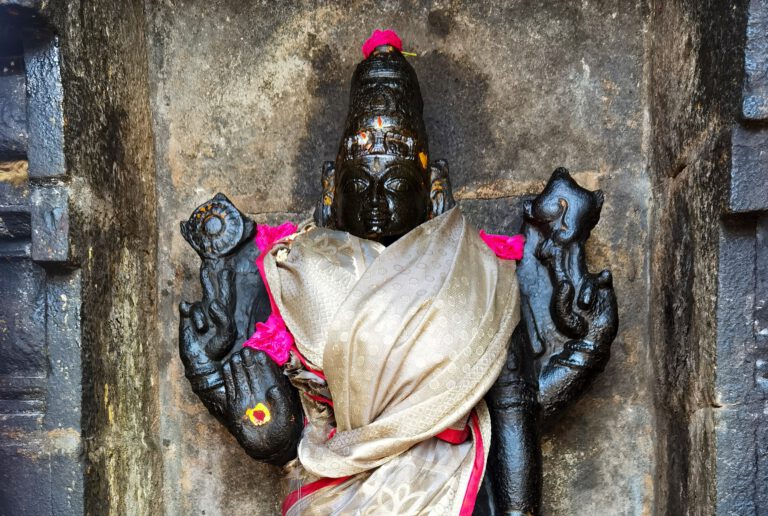
In Indian philosophy, the prevailing fundamental idea is that Brahman, the highest being, which encompasses everything, wants to experience itself. Only for this reason does Brahman emerge from perfect existence and unfold in the physical world. The cycle of the world, the world soul, individual consciousness, universal forces—all of this is Brahman experiencing itself. Brahman is therefore not thinkable for us; we are part of Brahman, Brahman is in us, everything is Brahman. Art here takes on the role of depicting some of these forces. Art allows the viewer to wonder. A quality expressed in the artwork is grasped as Rasa. It cannot be directly expressed in language. The statue of a god is the expression of a quality, a force in the cosmos, that has become experienceable (tasteable, feelable). The fact that the viewer and the artist evoke a Rasa by means of the artwork means that this perception, this consciousness, this experience, this vibration of consciousness is there.
Being-There
What does being-there mean here? Being-there should not be understood here in a dualistic sense, as though a viewer perceived a quality in an artwork, and this quality were simply there in the artwork. Rather, being-there here means that a force of the cosmos, a part of Brahman, unfolds and has become visible. Visible not in the sense that a viewer sees something in an artwork, but that a force shows itself in an artwork and evokes a Rasa in the viewer that allows him to participate in the force. This is why the statues of gods in India are alive. The gods are in them. When the forces are appeased through worship—Puja—then they are there. Devotion to the universal principle is Bhakti; it also defines an attitude in the relation between the ritual object and the faithful. The viewer does not interpret or judge an external object; rather, the soul gives itself to the gods. This devotion is facilitated through a medium, an artwork.
In India, art is still part of the cosmic cycle, part of Brahman; it is alive, just as the whole cosmos is alive. Temples, statues, poems, dance, music are part of the cosmos, part of the cosmic forces; they are part of Brahman, and they enable the viewer to see aspects of Brahman more clearly, more distinctly, more vividly. Art means being able to wonder, to taste what is otherwise hard to find—Rasa2. In Indian art, Brahman is present. The being-there of art is the presence of cosmic forces, gods as they are called here.
Back to the Opening Question: What May Art Do?
I now wonder what these reflections mean for art’s freedom of expression? In the Western tradition, it is taken for granted that the discursivity of art not only permits a culture of debate, but brings it forth and cultivates it. Criticism, disagreement, satire, censorship are part of cultural life, and exploring the limits belongs to its practice. But what role does satire, for example, play in Indian art? What aspect of Brahman is realized here? Can everything not be shown? After all, the gods, too, laugh and cry, are angry or heroic.
A question comes to me here: in the West, art is often part of political culture. Politics is brought onto the stage and art intervenes in society and politics. In the twentieth century, the demand placed on art was to assume its responsibility in society more fully and participate in political discourses. But does this also apply to art in the Indian subcontinent, battered by colonialism? India, with its many languages, cultures, religions, is such a colorful, tolerant country, nourished by a connection to spirituality, whatever form that connection may take. To date, the world’s largest democracy grants freedom of expression to a large extent. Yet when I speak with representatives of culture here, many point to tradition, to the role of art in fostering spiritual growth. Here in the countryside, I rarely hear that art has a political task.
At the same time, however, many critical voices could be heard at the Kochi Biennale, for example. A large part of the art there took a very clear political position on current issues such as the climate crisis, equality, persecution of minorities, exploitation, and corruption. The artistic language of these positions was very familiar to me; it drew on Western forms of expression.
In India, these two worlds collide. The triumphal advance of capitalism and its secular, that is, materialistic structure does not stop at India either. Whether the instruments of this culture industry help to save the victims of that very culture industry remains to be seen. Traditionalists try to protect themselves from these colonial structures by rejecting modernity. In the West, this is perceived as backward and conservative.
The culture war is also in full swing here in Auroville. When, at present, in 2023, people speak of a new global order, this culture war is also at stake.
___
1 Rasa comes from the dramatic arts, poetry, dance, and theater. But I would like to understand Rasa somewhat more broadly here.
2 In poetry, the basis of theater and dance, the Rasas are well defined: the four primary Rasas are love/eroticism (Śṛngāram), heroism (Vīram), anger (Raudram), and disgust (Bībhatsam). Derived from them are humor (Hāsyam) from love (Śṛngāram), compassion and pathos (Kāruṇyam) from anger (Raudram), wonder and magic (Adbhutam) from heroism (Vīram), and fear (Bhayānakam) from disgust (Bībhatsam). Over millennia, a highly differentiated system has developed for depicting various aspects of the human psyche and the gods with which they correlate.