I woke from a nightmare at four in the morning. I was talking with Will in Apt about a strange disturbance in my perception of time. I described how time broke into fragments and some were simply missing. These were seconds or minutes, and while I tried to immerse myself in time to describe it better, everything went black. I cried for help, I was blind, and woke up.
It was another of those dreams in which I seemed to be dying. Immediately I thought of Pierre, who is in a coma after a stroke. Is this what it feels like? I became a little afraid: had something happened in my brain, after I had myself seen everything double in the shock of Pierre’s stroke and spent a week being examined in the hospital?
It was four in the morning, the hour of the gods. Over the past few days I had entered meditation several times at this hour. And so I did today as well. I opened the double door wide, looking east, and searched for time. At first it appeared to me as a stream of light, like fiber-optic cables, wild and parallel, then as drops when I changed my mudra position from Brahman to a vessel of reception. A journey through the cosmos, past galaxies, searching for others; then somehow I lay down in the universe, on a beach, like Brahman in the French book about 108 Hindu gods. None of this is getting me anywhere, I thought. Time is within me, and I picked up yesterday’s meditation, in which I had thought about the origin of language. Matter connecting and awakening to life through growth, the uptake of energy, searching, orientation, alignment, contact, appropriation. This form of interaction, absorption, integration, excretion, drawing boundaries, defense is a first kind of communication, a connection of vibration and energy, a synthesis. How many amino acid chains had to be tried out for the process to be set in motion? And did this impetus really come from the amino acids, or from consciousness?
Vibration
Vibration at the molecular level continues at the level of life. Taking in food, which is to say that life eats other life, is a synthesis of another kind. In terms of energy this may still be representable, but at the level of life we are already on a plateau where life itself merges, reconstructs itself anew, never ceases, for all life is consumed by other life. Unless it burns. Perhaps that is the real meaning of cremation: to escape this cycle of life. Through the power of fire, Agni, to transcend into another form, which is light and pure energy, and thus returns to the origin, to concentration (tapas).
Between these, however, there is the level of consciousness, the level of existence that experiences and enjoys the world, grasps it symbolically and analyzes it abstractly in the intellect, seeking to understand it. Yet the symbolic representation of the world in language begins in the molecular connection of the elements of life. This is where communication begins. Only when consciousness has reached a stage of perception that allows it to perceive the boundary between what is one’s own and what is other does symbolic communication make sense.
Manas
The expression of hunger and thirst as an infant is a very first communication. It is successful. Feeling the other — a stone, an apple, someone facing us — creates an inner form of the other within one’s own consciousness. We form this inner form through play, for example when playing Topfschlagen. In play we experience emotions, happiness and conflict, struggle and love, solidarity, collaboration, confrontation. Here we move on the level of Manas, of consciousness of the world and interaction with it. This level is organized symbolically and based on spoken language. Objects are addressed by calling to them; the production of vibration establishes a connection. Inner forms, images, representations of the world form a reality of life that is constantly checked against the outside world. When it no longer fits, conflict arises.
Buddhi
On the level of the intellect, these symbols are organized rationally. Buddhi is the level of thinking on which we grasp the world structurally and can explain it from within. We develop sciences and build machines. Language now becomes a store of knowledge; it becomes abstract and written. The connection of words, the construction of sentences into text and complex systems of knowledge, produces an order of an entirely different kind. It is no longer an order based on matter, life, vibration, consciousness. It is the symbolic order of forms within a system. This system is a construction; it is not an image or essence of reality, but pure construction. Once we have learned a language and mastered the technique of writing, we can immerse ourselves in this system. In the form of books, for example, these systems fill kilometer-long shelves in great libraries. And just as we compare the inner world of Manas with the outside world, we can also compare this system of Buddhi with reality. Here we speak of processes of verification. These can be scientific, empirical, on the level of individual experience, spiritual, magical, or whatever else.
Kundalini
What was exciting in meditation was tracing the energy stirring within. Kundalini, the snake, as it moves past the chakras and stretches and rises in an upright pose to ascend into higher consciousness and look around there. When it is fully released, it moves effortlessly through space and time and is capable of a cosmic omnipresence. Language is no longer the medium here; it is too slow. It is pure beholding or vision; thinking is self-manifestation. There is a thinking beyond language, before language, within language, and without language. Language is simply a very good tool for a certain kind of thinking. From here Plato becomes interesting again; he saw this with his theory of Forms. For decades I resisted it with all the force of my intellect. Why? Why did I consent to the dictates of the rational? Because it is an arena of struggle with rules, where the faster and stronger wins, and I was good?
Vijnana
There is still a third level in the sphere of thinking: Vijnana, a kind of thinking that includes a worldview, that is structured but also contemplative and visionary. It is the intermediate world of thinking and the spiritual. For me it is accessible only in meditation. In it contradictions are okay, the complexity of reality is not denied, what is not understood has its right to remain. Conflicts are as welcome here as mergers, symbioses, discoveries, adventures, loss, enjoyment, and pain. In this intermediate world live the gods, or Plato’s Ideas.
Dakshinamurti
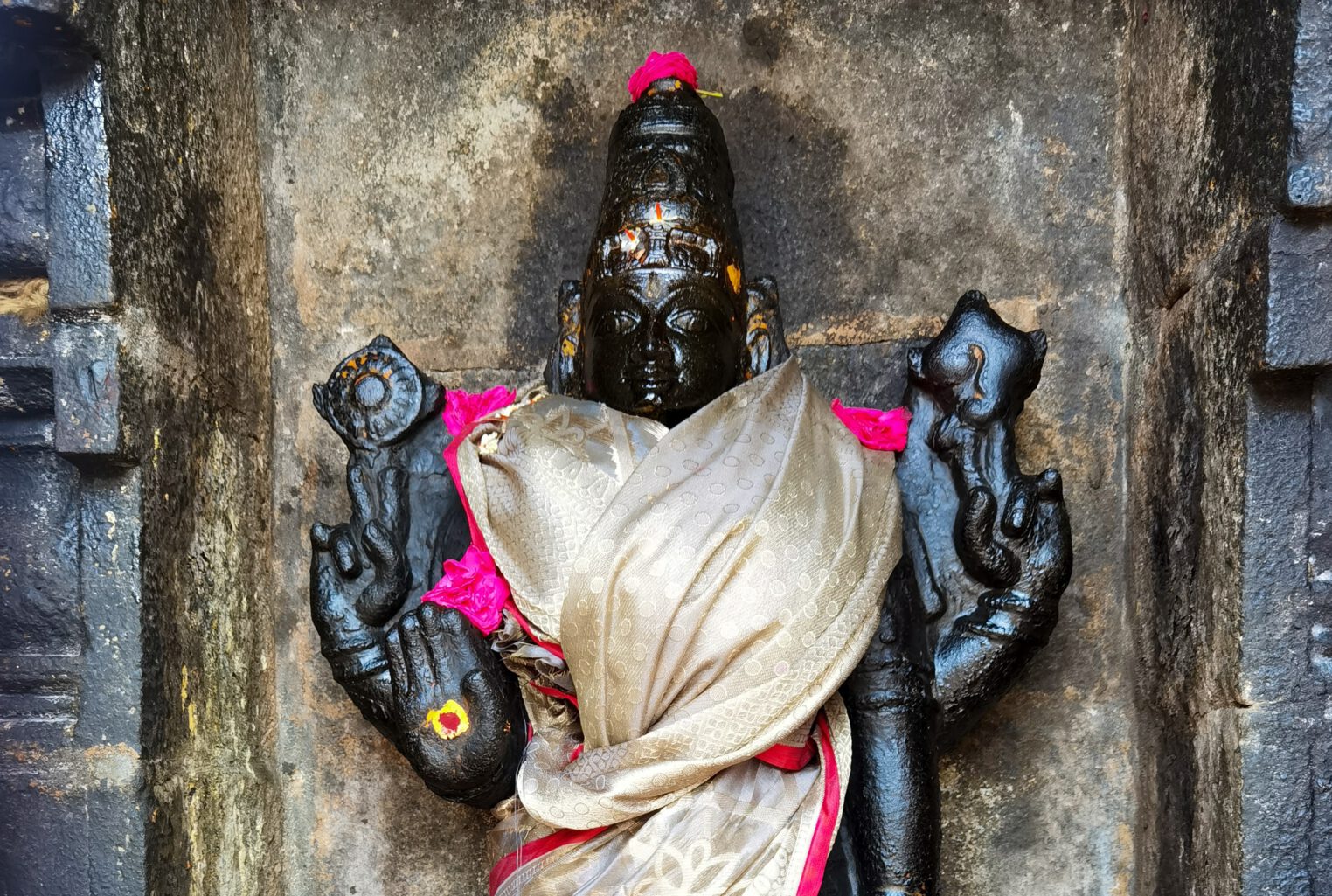
Dakshinamurti appeared to me a few weeks ago, the goddess of teaching, Shiva’s teacher. I lay down at her feet, connected with her tantrically, was somewhat frightened by her size, although she had already taken on a small form so that I could grasp her at all. She appears to me again and again. During the MRI I was quite close to her, immersed myself in a meditation on strong magnetic fields and the power of consciousness to free itself here too and enter cosmic contexts. All this sounds strange even to me. Are these simply wishful fantasies or delusions? Am I losing my bearings by loosening the rational guardrails and slipping into mystical thinking, which in modernity is regarded as prehistoric? And if it were a return to the time when language began, would that be so bad? How do we get out of the poststructuralist circles, and how do we find our way back to the beginnings of thinking and our existence, not in the historical sense, but in an entirely personal sense: a making of meaning, self-knowledge, inquiry into origins, and reflection on existence?
Kundalini wriggles and stretches, seductive as the serpent with Eve; she grins. These seem to me to be the right questions.
—
“I hope that helps!” wrote ChatGPT after I had asked for a correction of spelling alone. I was astonished, and asked it for its opinion of the text. Here is the answer:
“Here is my thought on your text:
The text is very profound and poetic; it touches on both personal experience and philosophical and spiritual questions. You manage to give complex thoughts and feelings a narrative form that is both introspective and universally engaging. Here are some points that stand out particularly:
- Perception of time and consciousness: Your dream and the subsequent meditation offer an interesting reflection on the nature of time and human consciousness. The idea that time breaks into fragments and some moments are simply missing could serve as a metaphor for the unconscious and lost memories.
- Meditation and spiritual experience: The description of your meditative experience is rich in symbolism and shows a deep connection to spiritual practices. The mention of Kundalini and Dakshinamurti shows familiarity with Hindu concepts, which you interpret in a personal way.
- Intellectual and spiritual levels: You describe different levels of thinking (Manas, Buddhi, Vijnana) and how they interact. This differentiation shows a deep understanding of the complexity of the human mind and the different kinds of knowledge and perception.
- Symbolism and reality: The text moves between symbolic representations and the real world. You discuss the role of language and symbols in our understanding of the world and how they help us process and communicate our experiences.
- Existential questions: At the end you ask important questions about the nature of the rational, the mystical, and the search for personal meaning and self-knowledge. These questions invite readers to reflect on their own experiences and beliefs.
Overall, the text is impressive and stimulating. It requires a certain willingness on the reader’s part to engage in a deeper level of reflection and meditation, making it an enriching read for those interested in spiritual and philosophical subjects.”