Slowly, and at long intervals, I keep reading Sri Aurobindo. Why not read a lot and quickly, soak everything up and finally bring order to my world of thought, which wants to break out of the consequences of a rational monotheism? Why do I not give my intellect the freedom, concentration, quiet and strength to embark on one of life’s greatest adventures?
As a student, I once went swimming in the Rhine, very naively, somewhere before Basel, where the water, clear and cold, fast and broad, flows through green mountain landscapes. Hardly had we jumped into the river when we found ourselves in the middle of the current. The bank raced past, and we knew we had to get out again quickly, because we had simply entered the river somewhere and somehow had to find our way back to our clothes. We were excited, alive, newly born. It felt like immersing ourselves in the stream of life. The senses sharpened, the world as process revealed its strength in a loving way, the Self asserted itself against the five elements. The intellect was quiet, the experience of the sublime great, the breath active. This is one of the images in my memory that help me follow the Upanishads.
That experience, like really every experience, consists of images. In contact with the outer world, the outer senses convey an inner sense, a perception that can become an experience. Mediated by the nerve endings of the outer senses, this inner sense draws on the vibration of light, sound, touch, taste and smell. And that inner sense can in turn express itself through sound, gestures and representation. This inner sense is consciousness.
In spiritual philosophy, the world of inner sense is the world of the subtle, in contrast to the world of gross matter. The images that manifest in subtle reality are real (Schopenhauer and Bergson recognized this too). And just as images of trees and butterflies, people and art, pain and joy manifest in this world, so we also find in it traits of character, structures of personality, configurations of power, larger connections that we recognize as images. We ask ourselves why someone does something, or why I perceive something in a way that is not good, right or true. We can entrust ourselves to images that appear to us as illusion; we can perceive illusion as reality, and we can have the feeling of being caught in something that exceeds our own possibilities of control. So we perceive things to which no outer object corresponds that could have touched my outer senses. We can formulate the logic of these images in hypotheses and “test” them against reality. Consciousness precedes reality. In the past, this world was structured by the gods of the pantheon. Today we act as if it were science.
Subtle and gross reality
We try to understand the world of gross matter with the help of the natural sciences, although this is actually a euphemism, because natural science is not really concerned with exploring nature at all, since what constitutes nature is its connection to that subtle reality. Would it therefore be more honest to stay with the narrower term empirical science? That science which concentrates on what can be experienced repeatedly? This too seems misleading, because much in the subtle world can indeed be experienced and described empirically. What about the individual sciences, such as physics, medicine, sociology? They impose a limitation on themselves by concentrating on the material world and deriving general laws from it. These laws of nature in turn describe a deeper reality, a metaphysics. As long as metaphysics excludes consciousness, it is allowed to assume very complex theories and elementary particles, provided it does not become entangled in contradictions (although even that is often allowed).
What is it that keeps the science of the modern era from engaging with consciousness? What has so discredited the inner world of experience that we do everything we can to deny it? The answer cuts both ways. The rationality that opposes the phenomenology of consciousness accelerates the applied sciences through its basic research; and in the form of Enlightenment, it tries to critically question abuses of power. On the other hand, it leaves an emptiness concealed by consumption and a culture industry of whatever kind, producing a sort of Disneyland (Adorno). Engagement with spirituality is marginalized and pushed into the realm of the obscure. Might there be good reasons for this? For in the twentieth century, the success of the Enlightenment could not be stopped even by the catastrophe of the Holocaust. The exploitation of our environment allowed a feudal lifestyle for the masses in the West. I am not an opponent of progress, but it has its price.
India
How do the facts that 16% of India’s population are undernourished and 97% say they are spiritual fit together? Does one have nothing to do with the other? Is the question a classic category error? Is a society enlightened within itself, which owes its prosperity to the exploitation of the global South, more successful than a colonized spiritual society whose tolerance of suffering ensured its survival? Can any conclusions be drawn from such polarizing statements? I bring this up here to suggest that a question about spirituality and consciousness need not necessarily be discussed in connection with progress, nor is it necessarily possible to do so, since that quickly becomes very confusing.
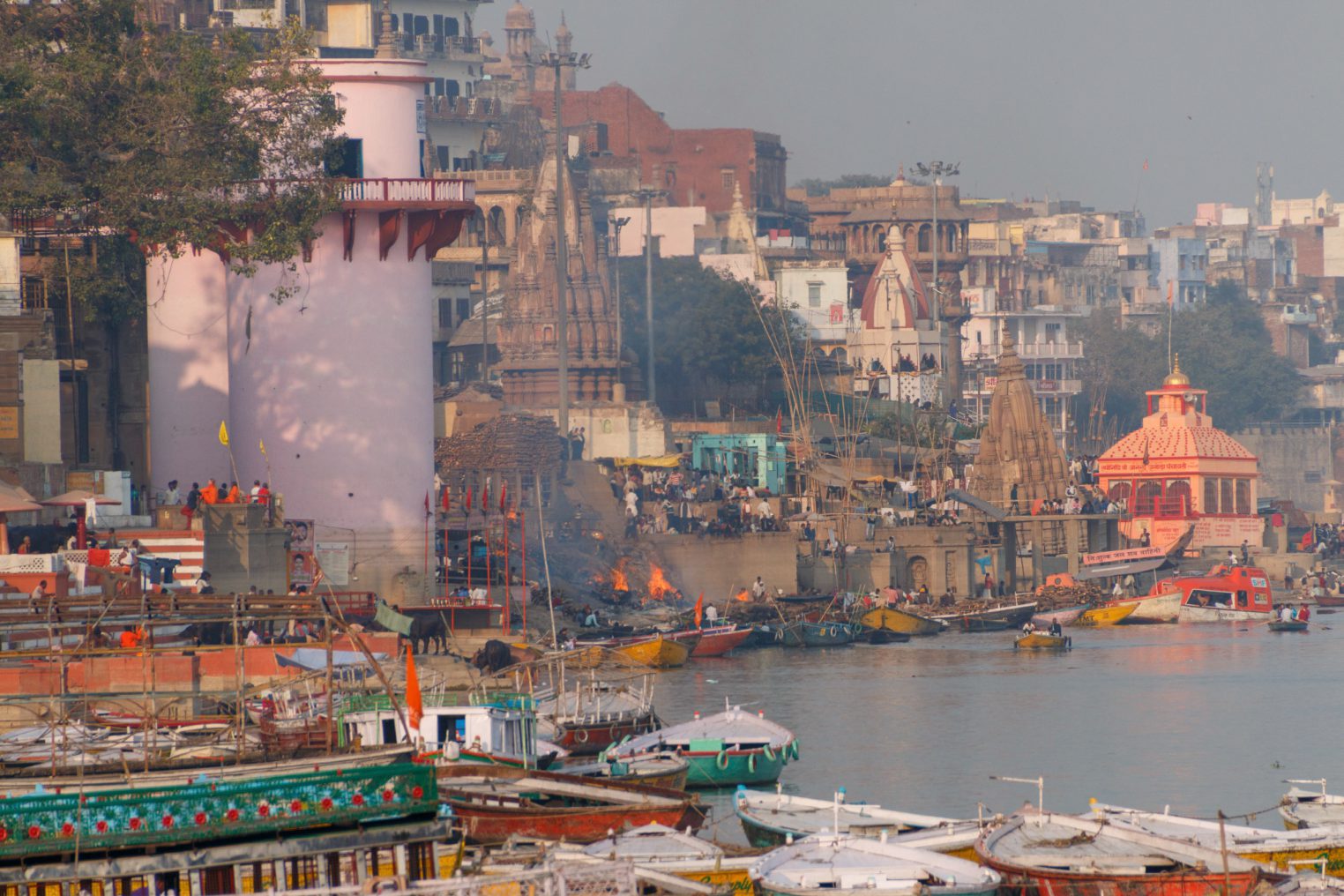
Here in southern India I live partly in a premodern world. The suffering of many is hard to bear from a modern perspective, religious practice sometimes appears naive, social structures are patriarchal and archaic on the surface, culture is oriented toward tradition, knowledge toward conservatism. I am very aware of my privileged position here and try to avoid romanticizing. Yet there is something in this world that has been lost in modernity: the integrity of being. Being is not merely the suffering of the individual Self and its drive toward self-realization; rather, being is part of cosmic reality, within which one’s own Self is a part. That this conception can, at the end of the day, be richer, freer and self-realized to a greater degree is the power of spiritual thinking, which immerses itself in the finer details of subtle reality.