Connection
Over the past two years I have immersed myself quite deeply in the Upanishads, practiced some yoga, and engaged a little with the system of yoga. I have immersed myself in my own body, my own senses, my own consciousness. Have seen that there are a great many levels, and that there is no reason at all to assume that still more levels do not exist. Just two years ago I simply denied most of what I am experiencing here. It is good to know this. The world is much larger than I always thought, much more complex, colorful, alive, deep. And this seems to be only the beginning.
A central thought of the teachings in India is letting go, not wanting to have and desire everything, or reject it. Simply taking the world as it is is the great art. Simply enjoying it as it is, even when it is not simple, is blessedness. Sinking into meditation and being one with the world. This feeling can also be carried from meditation into everyday life, for we all have to eat.
The Basic Framework of the Tattwas
The exploration of one’s own body, one’s own consciousness, one’s own life energy is systematized in the 24 Tattwas. The Self, its relation to Purusha (soul), Prakriti (primordial nature), Buddhi (intellect), Ahamkara (I-consciousness), Manas (sense-bound thinking) connects the essential cognitive and spiritual levels of experience. Yet it remains an experience left to itself; it seeks unity with the cosmos, transcends itself beyond itself, yet remains in the same existence. Dvaita-advaita, the duality of duality and nonduality, thus a complex conception of immanence sustained by pure consciousness. Its ground is Brahman, that which we cannot really think, but which is somehow accessible in spiritual experience, even though none of our organs is suited to it. Only in the synthesis of the senses, in the complex experience of pure (disinterested) enjoyment, in the sharpening of the senses, is there a path, a stony one.
But the beautiful thing in India is that it always goes further. Having arrived somewhere, the little intellect imagines it has understood something and can put it into words. Yet here, almost as in a dialectical reversal, new levels open up.
Before the 24 Tattwas come the 12 Tantra Tattwas. 5 pure (Śiva: pure consciousness, absolute; Śakti: dynamic energy, power; Sadākhya: ever-present, eternal; Iśvara: supreme lord, guide; Śuddha Vidyā: pure knowledge, clarity) and 7 semi-pure Tattwas (Māyā: illusion, cosmic veil; Kāla: time, temporal flow; Vidyā: limited knowledge, consciousness; Rāga: attachment, desire, passion; Niyati: cosmic order, fate; Kalā: creative skill, art; Purusha: individual soul, Self), which supplement the 24 impure Tattwas. The 24 Tattwas comprise the 4 Antahkarana (inner instruments): manas (mind), buddhi (intellect), ahamkara (ego), and chitta (memory or consciousness); the 5 sense organs (jñānendriya): ghrāna (nose) for smell, rasana (tongue) for taste, caksus (eye) for sight, tvāk (skin) for touch, śrotra (ear) for hearing; the 5 organs of action (karmendriya): pāyu (anus) for excretion, upasthā (sexual organ) for reproduction and sexual pleasure, pāda (leg) for locomotion, pāni (hand) for grasping and touching, vāk (mouth) for speech; the 5 subtle elements (tanmātra): gandha (smell), rasa (taste), rūpa (form), sparśa (touch), śabda (sound); the 5 gross elements (mahābhuta): prthvi (earth), jala (water), tejas (fire), vāyu (air), and ākāśa (ether or space).
What is fascinating is that the insight that the world, as it presents itself to me in everyday life, does not exist (here everyone is always saying that space and time do not exist) is described through Maya. The world exists, if at all, as will and representation (Schopenhauer). If I have recognized this and realize that I nevertheless apparently exist somehow — after all, I am thinking this right now — then there must be another way of seeing the world; the world must be constituted differently from how I think, there are possibilities in this world different from those I know.
I have already come to terms with time, knowledge, causality, my own existence being fundamentally different, with not being able to trust my senses or the systems of knowledge. The logic of the material world is simply restricted to that world; that is okay. It applies there for the most part. But what about desire? Desire for objects (food, beautiful things, pleasure), or desire for the other? Through asceticism, the world of what I desire can be reduced quite considerably. By my standards I am making good progress here, even if it can hardly be called a great leap; after all, I am sitting here at my computer …
The Other Person, the Intersubjective, or Unity with a Greater Consciousness
In the world of Tantra, objects and subjects can be seen beyond the veil of Maya, and it is possible to interact with them: this is the great art. Magical thinking, occult practices, ecstatic unions, connecting things that are not yet connected, merging, amalgamating, making gold from mercury, expanding reality and mastering its fine structure — this is the mystery of Tantra. The great masters can do unbelievable things, it is said. On a small scale, though, we too can do a great deal. For example, when we meet another person and connect with him or her. What actually happens there? The outer senses feel each other out; an idea of the other arises, an exchange begins, an attempt is made to understand the other. And when it becomes magical, when the eyes sparkle and the face smiles, when we lose ourselves in the eyes of the person before us, then we immerse ourselves in another reality, in another person. I had learned that we cannot look inside other people’s heads. This seems fundamentally wrong to me. I have always had this unease. In moments of deep friendship or being in love, we can transcend ourselves, form a unity with the person before us, unite, merge, form a symbiosis. Yet it goes beyond this as well. Within a community, together with others, one’s own consciousness becomes part of a greater one. This is probably the danger of cults; if one is not careful, brains are quickly washed and invisible military helmets put on. What I mean positively, however, is spiritual power.
At the moment I experience this in meditation nourished by the certainty of another’s existence. These days I wake at four in the morning and meditate. Decades ago I may have done this two or three times. These are special moments in which consciousness, coming directly out of sleep, enters meditation before the senses have engaged with the world. It is heavy, ponderous, and slow, yet also highly sensitized: every nerve can be experienced, every small restlessness felt, and every connection outward perceived. I realize that I am not alone in the world; the cosmos is there, the sun will soon rise … but the experience of the Other is also there, the presence of another human being’s consciousness, a deep connection beyond space and time. This kind of connection seems to me a tantric one. To perceive this connection, live it, strengthen it, and make it shine through concentration is the kindling of the inner light.
The unity of Shiva and Shakti stands for this connection. In the everyday world, with my body and social customs, this connection is extremely rare. Many may not know it at all. It is a connection that first happens in reality: drinking coffee together in the afternoon, or losing oneself in the other’s eyes, experiencing lifeworld and worldview together, shared laughter or a shared irritation at honking motorcycles. But also the certainty of the other’s existence, feeling closeness despite spatial distance, thinking of the other and bringing them into one’s own presence. The levels that connect are not only the material one, but also the lifeworld, the world of consciousness, spiritual and cosmic experience of the Self as part of the greater whole, in which there is also another.
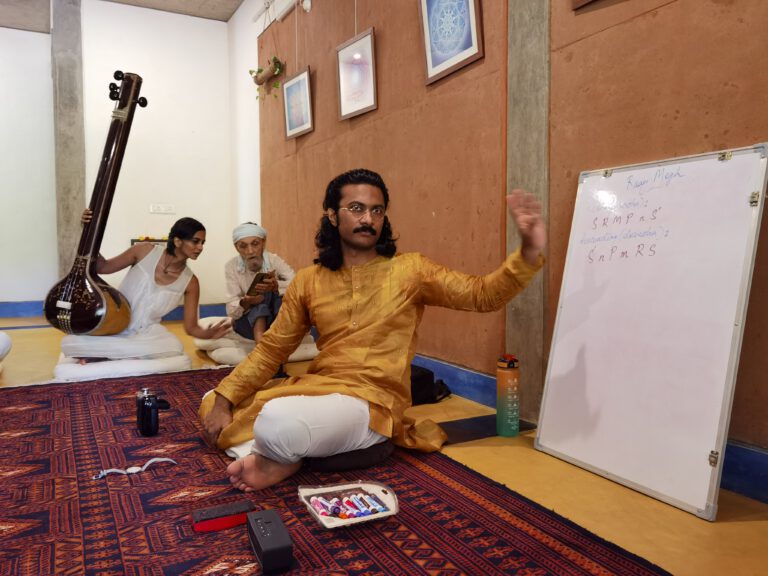
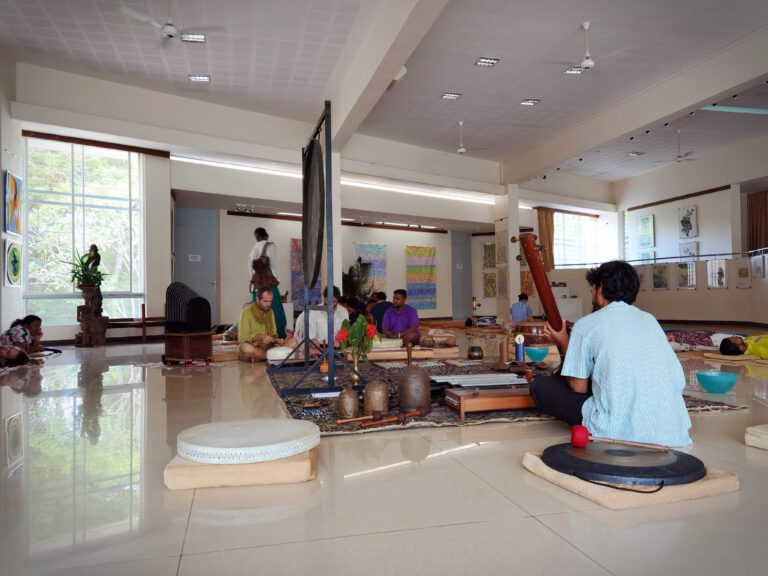
What does philosophy here in India have to say about this? Are deep compassion and merging compatible with the realization of Maya? Is tantric unity a spiritual unity? These questions arise for me while, for weeks now, I have been listening to ragas and attending to myself and the other. Ragas, to close the circle a little, are the primordial form of Indian music and derive from the system of yogas. They are spiritual experience, improvisation at the highest level of mastery; they express how sound, that is, vibration, takes form in consciousness through concentration and sensory experience, and through the body as an instrument creates that cosmic unity. Musical experience, reflection and meditation, the copresence of the other, merging and creating a shared reality that opens a new horizon of the future are profoundly tantric experiences. One need not be a grand master to experience this. A little sensitivity is probably enough.