In India, the books of the Vedas have been held in memory for 3000 years. The Rigveda (10,552 verses), Samaveda (1549 verses), Yajurveda (4001 verses) and Atharvaveda (5977 verses), as well as the Upanishads (about 1800 verses), are passed down from generation to generation. Sanskrit grammar has not changed substantially, and its pronunciation has been handed down with the greatest precision through exact phonetic description. So these texts sound the same today as they did 3000 years ago. They are written in the form of mantras, that is, in verse and committed to truth. Powers are attributed to reciting them, even to merely listening, because, according to legend, the Sanskrit language comes from Shiva: His drums produce vowels, from these arise the consonants, then grammar and finally language.
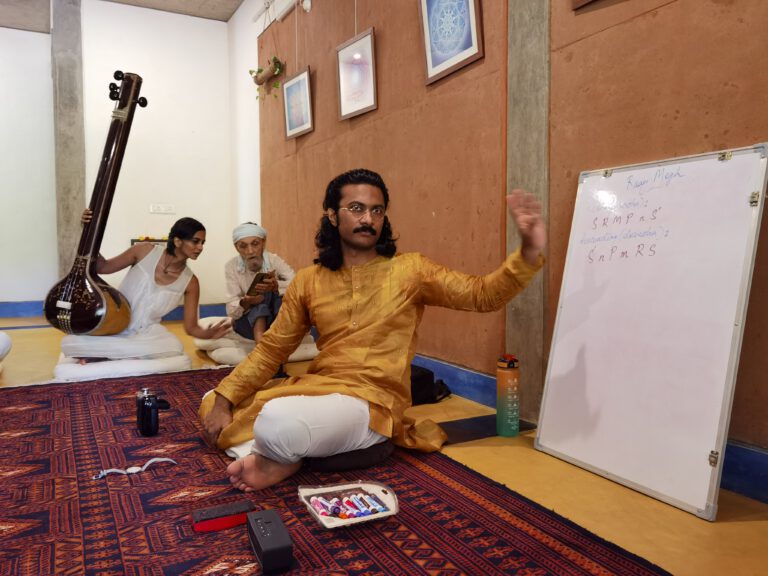
The counterpart to the language of the Vedas in music is the ragas. Yoga, too, is related to the Vedas, as are Ayurveda and Tantra. This treasure of wisdom was perceived by the Rishis through deep meditation and recorded in mantras. Its strict encoding in verse ensured transmission without error over millennia. Even today, thousands of people live in India who know the Vedas by heart and recite them regularly.
Passing on Knowledge
There are two forms of passing on this knowledge. The conventional form of learning through practice and repetition. It is necessary to begin in early youth, and it requires the devotion of an entire life to develop this ability and keep it alive. The second form is transmission from a seer to his student. This form is difficult for the rational mind to comprehend. Within weeks, the knowledge is transferred. The relationship between guru and student is, of course, a very special one. This is rare. Still more mystical transfers are also reported.
Since this is knowledge experienced in meditation, it differs from empirical knowledge gained through our outer senses, or rational knowledge gained through deduction. The Western idea that—to put it in extremely abbreviated terms—outer sensory stimuli can be inscribed in memory and retrieved through recollection does not apply here. The approaches of transcendental philosophy also fall short here, since they seek deep structures within our thinking.
The knowledge of the Vedas bears witness to a much more differentiated description of our consciousness. The generally accepted three states of matter, life and mind correspond in the Vedas, on a higher level of consciousness, to Sat-Chit-Ananda (existence, consciousness, Bliss). A seventh level—Vijnana—is the connecting link. Through this form of higher insight, Sat-Chit-Ananda is opened up. The whole is wonderfully complex, rich and beautiful, and does much greater justice to our human existence than the dominant reductionist view of the so-called Enlightenment, and is described through the 7 rivers or deep waters. Of course the gods come into this too, but that is another story for now. My concern here is memory.
The Vedas have opened up these higher levels. They are passed down orally from generation to generation. That is why they are also recognized as intangible world cultural heritage. This knowledge draws on a vision and is carried onward immaterially, like the Olympic flame. It bears witness to an origin in humanity’s oldest connected texts.
Memory and Consciousness
Just as art bears witness to an inner experience, or an invention often rests on an inspiration, our spiritual existence is connected to a vision. The question of the meaning of our life does not find its answer in causal chains or deductions. This question points to another interrelation. How is such a vision possible, and what kind of memory is needed for it? By this I do not mean the feat of memory involved in remembering about 25,000 verses, but the question of the kind of consciousness that manifests itself here.
The mind can move freely within the levels of consciousness; at almost infinite speed it can roam from one place to another, leap through time and open up new worlds—all this at least in recollection, activated memory. But it is more than merely losing oneself in recollections. The states of Sat-Chit-Ananda are real. India is full of people who have given up everything to open themselves to this gift, to attain blessedness and immortality in the here and now. Bergson distinguishes between pure memory and habit memory. Pure memory encompasses the recollections that shape us, that are unique, stand out from everyday consciousness. This leads in the right direction….
Our mind, our consciousness can participate in a greater consciousness, can actualize it. It seems to me that we misunderstand this as memory, and perhaps we also have to grow beyond our memory to attain true consciousness. Recollection is then not a search in one’s own individual memory of habit, but spiritual experience. For everything is always already there everywhere. It is only a matter of the relations of access.
Reference:
Joshi, Kireet. The Portals of Vedic Knowledge
Bergson, Henri. 1990. Matter and Memory. New York: Zone Books.