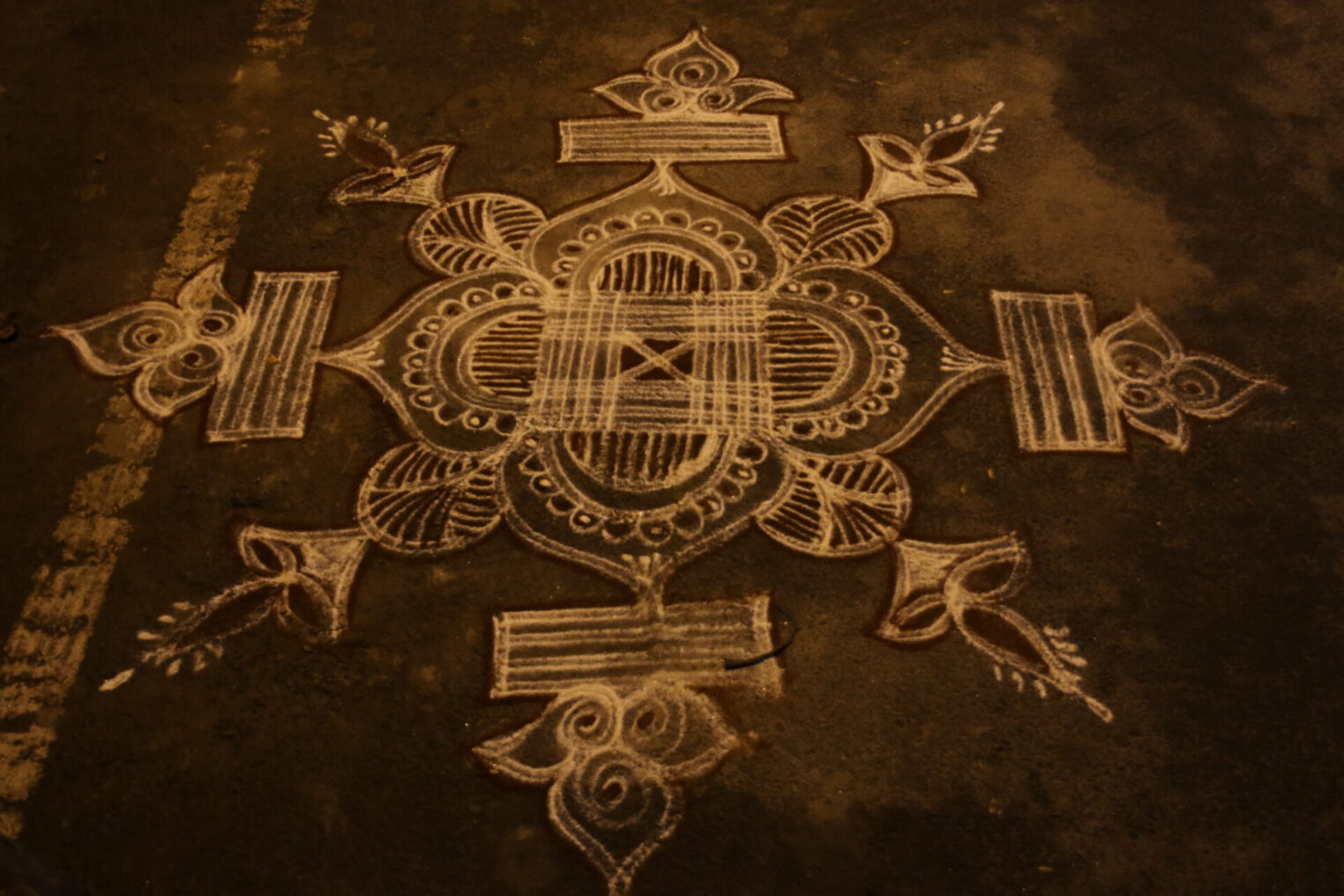
The Secret of Kolams
In the morning, before sunrise, when most animals are still asleep and even the rooster has not yet crowed, and when the men go to the temples, the women draw kolams on the street outside their front doors. In Tamil Nadu, kolams have been drawn for centuries, if not millennia. This form of meditation, art, prayer, honoring the gods, and blessing is generally practiced by women.
Traditionally, many families have had their own kolams for generations, for there are infinitely many. Some are ‘classics,’ drawn, for example, on holidays outside the house, on the street, or in the temple. Others are very individual and form part of the morning routine. At every festival in southern India, a kolam is drawn. The large kolams are difficult and require years of practice.
I have often seen the women in the villages drawing kolams early in the morning before sunrise. The street is swept and the ground prepared. They use rice flour, which they sprinkle onto the earth with their hands. This rice flour is an offering and is eaten by insects; the kolams outside the front door are stepped over and crossed throughout the day, and by the end of the day they are gone again. So that a new one can be drawn the next morning.
The basic principle of most kolams is to connect dots in a regular grid in such a way that the lines or curves do not cross without a certain symmetry; that is, dots are generally not simply connected at random across the grid. Many say that it is a language. The patterns are complex and include elements of symmetry, networks, algorithms, iterations, etc.
Kolams Are Complex
There are a whole range of levels on which kolams work:
Drawing kolams is a movement of the whole body and has elements of dance, meditation, and contemplation. Posture, sprinkling rice flour, coordinating arm, leg, breathing, eye, finger, spine, balance require coordination of the entire body. It is a practice that demands practice and belongs to a long tradition. The complexity of the kolams, the quality of their execution, and their regularity are perceived within a community and suggest conclusions about the woman who draws them.
Individual geometric patterns are associated with gods, legends, seasons, crops, stars, etc… The combination of different patterns in a kolam therefore contains a statement; they store knowledge that is passed down through generations, that is, centuries and millennia. In terms of a semiotic analysis, kolams can therefore be decoded.
The geometry of kolams can become extremely complex, overlapping with Yantras, Mandalas, and Tantras. Yet kolams are often regarded as purely decorative, ritualistic, and traditional. Yantras, Mandalas, and Tantras, by contrast, are presented as part of the highest spiritual practice. In recent decades, much research has been done to appreciate the complexity of kolams and correct this misunderstanding.
Some therefore speak of the language of kolams. Grace, an Aurovilian who grew up in the Sri Aurobindo Ashram, said recently that she spoke kolams better than Tamil. In kolams, she sees wisdom, history, spirituality, bodily mastery, science, a social function, and so on.
Kolams are complex signs that give access to a world. The world they open up is grasped as a whole. The structure of this language encompasses infinitely many symbols; within each individual kolam it has its own grammar and syntax, its rules are mathematical and its expression aesthetic. This language is anything but trivial; it is forgotten and has been undergoing analysis for several decades.
Computer Animation
These kolams make me think of John Whitney’s Cataloge from 1961. Whitney was at IBM’s research laboratory and had access to the best analog computers. He used this access to explore the artistic and aesthetic potential of computers. His documentation from 1968 is still impressive today. He sees the computer as a tool for exploring the language of art, based on graphic patterns that rotate and shift like a kaleidoscope. Much of this looks like kolams.
And so the circle closes. In the middle of the twentieth century, progress looks ahead; shaped by materialism, scientists run after a dream of explaining the universe through numbers. And in India, mathematical kolams have been drawn on the street for millennia, in an attempt to establish a connection to creation. Both are concerned with mathematical images; some come from the gods, others from the rational mind. In India, people know that the rational mind is limited and does not understand what is essential. The images here, in kolams, for example, allow a cosmic breadth of vision and circumspection that encompasses the Western idea of progress.
—
“Dr.Gift Siromoney’s Home Page.” n.d. Accessed April 20, 2023. https://www.cmi.ac.in/gift/Kolam.htm.
“KolamYoga with Grace – Www.Kolamyoga.Com.” n.d. Accessed April 22, 2023. https://www.kolamyoga.com/.
“Significance of Kolam in Tamil Culture.” n.d. Sahapedia. Accessed April 20, 2023. https://www.sahapedia.org/significance-of-kolam-tamil-culture.
“Yantra Kolam – Www.Kolamyoga.Com.” 2021. July 3, 2021. https://www.kolamyoga.com/yantra-kolam/.
Chaki, Rohini. 400 CE. “How an Ancient Indian Art Utilizes Mathematics, Mythology, and Rice.” Atlas Obscura. 08:00 400 CE. http://www.atlasobscura.com/articles/indian-rice-art-kolam.
Grace Gitadelila, dir. 2022. Kolam drawings animated by Grace Gitadelila & Sasikanth Somu. https://www.youtube.com/watch?v=sKCstot0II4.
lab, City Interaction. 2020. “Mathematics of Kolam: Folkloric Graph Theory.” Medium (blog). November 29, 2020. https://liubauer.medium.com/mathematics-of-kolam-folkloric-graph-theory-4b3acc79d5cb.
Whitney, John, dir. 1968. Experiments in Motion Graphics. IBM Corporation / IBM Direct / IBM K-12 Assist Group / IBM Publications 4800 Falls of the Neuse Rd Raleigh NC 27609 USA (800)879-2755. http://archive.org/details/experimentsinmotiongraphics.
“Yantra Kolam – Www.Kolamyoga.Com.” 2021. July 3, 2021. https://www.kolamyoga.com/yantra-kolam/.
Majumdar, Meghna. 2020. “Exploring Centuries of Kolams.” The Hindu, January 16, 2020, section History & Culture. https://www.thehindu.com/society/history-and-culture/exploring-centuries-of-indias-traditional-kolams/article30573492.ece.
YANAGISAWA, Kiwamu, and Shojiro Nagata. 2007. “Fundamental Study on Design System of Kolam Pattern,” January.