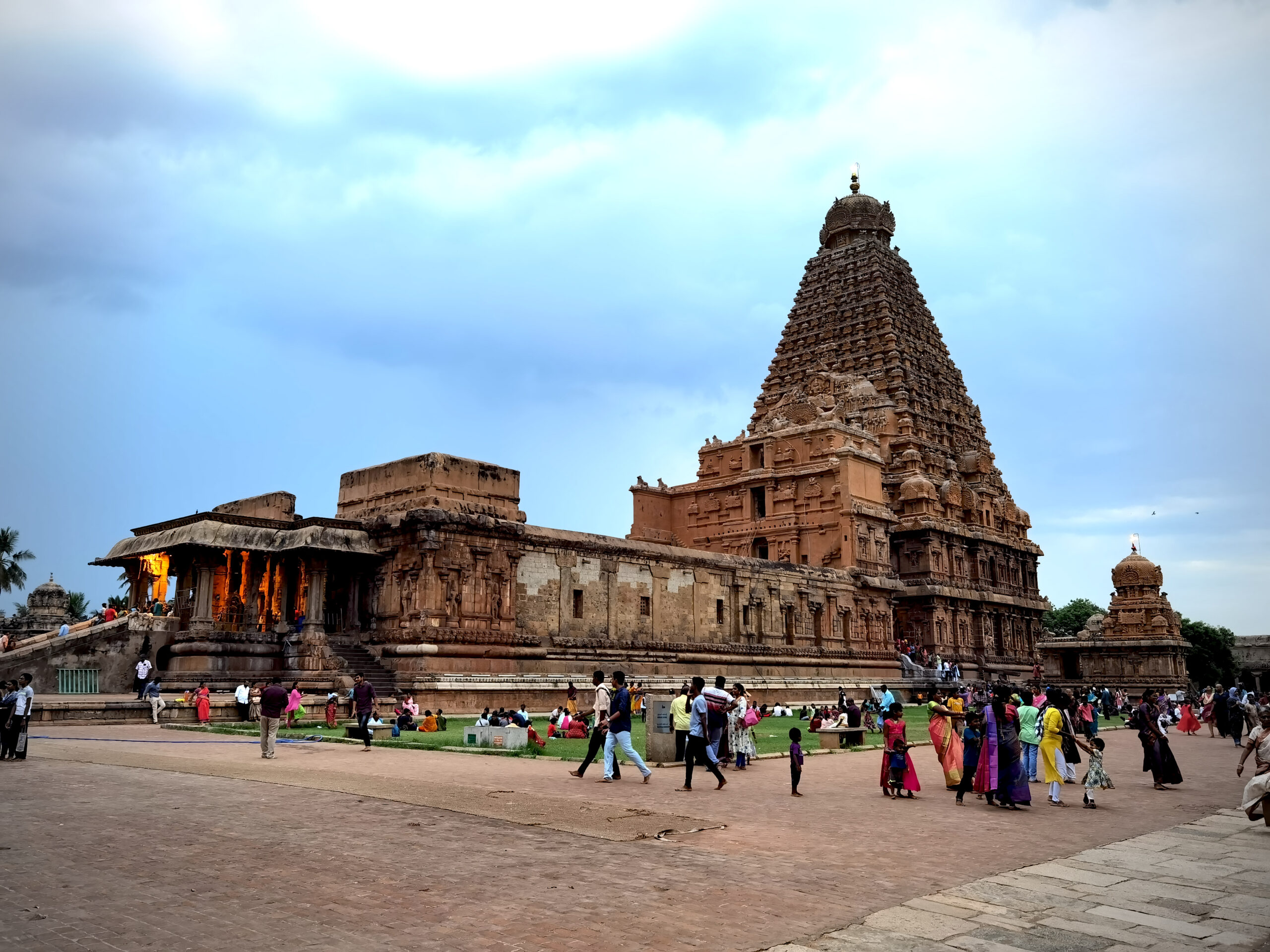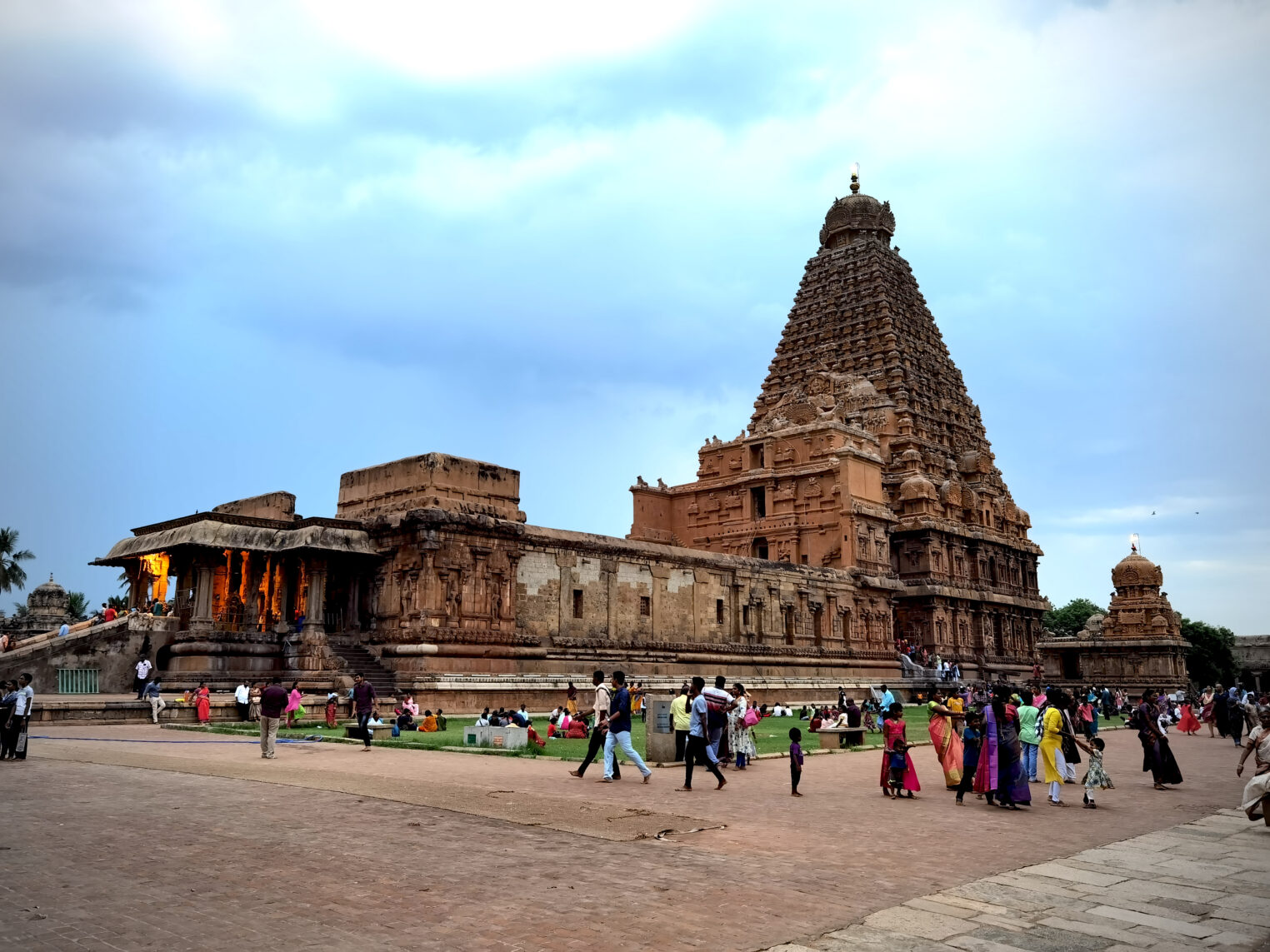
During the Chola Empire, the layout of Shiva temples became highly formalized. Based on the Agamas and Shastras, the temple was fully developed into a place in space, time, and consciousness where microcosm and macrocosm mirror one another.
Studying the Irumbai temple as a smaller temple that follows the strict rules of temple construction and serves as a temple for practitioners shows its central role in a cluster of about two dozen temples in the surrounding area. It follows the main principles of Vastu, is aligned along the Vastupurushamandala, has an enormous water tank, the usual deities are present, it follows the festival calendar, and it is aligned with the Murugan star. Even this basic description of its central elements gives us a sense of the temple’s placement within the larger cosmic context.
When a temple is built, this is never an arbitrary act. A site is selected, and it must be indicated as auspicious. An unusually friendly encounter with the animal kingdom is often such a good sign. The site must then be tested with regard to soil quality, water, energy, alignment, and slopes. A time must be chosen according to the star charts. The stars and planets determine the calendar. Rituals must be performed, construction must begin, and invocations follow. The entire process is an interplay between the cosmos, the physical site, and the inner world.
Cosmos
Our existence on this planet is embedded in a solar system, which is embedded in the Milky Way, which in turn is embedded in a cluster of galaxies, and so on. With our eyes we can see many of these elements, their movements and patterns. The recurring cycles of particular elements of light in the night sky gave life a point of reference. This applies not only to human prehistory, but also to the animal world, such as the flight patterns of birds or howling dogs. This sense of the cosmos following a beautiful, complex rhythm lets us recognize that there are forces outside us much greater than the living world around us. The sky is the seat of the gods. They look down on us and sometimes interact with us. This is the origin of almost all mythologies. Stars are often associated with gods; they come and go in cycles of days, weeks, months, years, centuries …
If we look at the earth from a distant cosmic position, we can use it as a point of reference within this complex system. We could use any cosmic object as a point of reference, but on earth we are blessed with life and consciousness and have the capacity for observation and experience. It is therefore a good starting point. Understanding that we can observe the interplay of stars and planets from earth raises the question of how these constellations affect our little planet. Is there something special about it? Are we alone? Are we a playground for a greater game?
Tattvas
Once I recognize that my existence on this planet is endowed with the gift of life and consciousness, I become aware of my body. I recognize that the body I inhabit is another level of reality. I can control it, I can use its senses, I have experiences through it, it has needs and supports my experiences and thoughts. This physical body, with arms, eyes, nose, mouth, ears, skin, hair, legs, feet, hands, organs of pleasure and organs of excretion, gives me the inner senses of touch, taste, sight, sound, speech, smell, pleasure, hunger, thirst, and pain. The mind is able to synthesize these inner senses: focus, selection, concentration, structure, thinking, meditation, experience, and communication. It is the tool that gives us access to higher levels of our existence in relation to spiritual experience. I can experience myself as Self; my existence as Self is not bound to the physical position of my body. My mind can wander, I can think about things that are present, I have memories, fantasies, and ideas. I can experience myself in relation to others and ask existential questions: Who am I? Where do I come from? Who created me? Where will I go when I die? The blueprint for exploring this world is the system of the 24 Sankhya Tattvas or the 36 Tantra Tattvas. What I have mentioned so far is organized in the Sankhya Tattvas; when we include the realm of higher spirituality, Shiva, Shakti, Purusha, Atma, and so on, we are within the 36 Tantra Tattvas.
Elements
When we recognize that the cosmos follows a great rhythmic pattern and that our body has access to a very complex system, we can go deeper and ask what all this consists of. There are five elements: water, fire, earth, ether, and air. The elements are not to be understood as chemical elements. They are regarded as primordial elements with a complex multiplicity of access. Air is in the atmosphere, but it is also the breath of life and holds the power of the wind. Fire is heat and light, knowledge and destruction. Water is fluid, consciousness and the ocean of life. Space is the cosmos, the realm of spirituality, knowledge, and sound …
Vibration
At the core of existence lies vibration. All energy in the macrocosm is ultimately vibration, all life energy is vibration, and all elements are vibration. Vibration comes from a point, the Bindu. This origin, whether the Big Bang, Shiva’s drum, or the symbol of the Bindu on the forehead, is the point where everything is held together. Here lies the origin; it gives us access to the level of immanence. It lies beyond what we can experience, beyond science and meditation; it is that of which we can be conscious but which we cannot know.
Temple
The exceptionally complex architecture of temples such as the Chola temples lies in their ability to synthesize all this in an architecture and offer a key to exploring the complexity of our existence. They are designed so openly that they allow and invite the most varied forms of spiritual practice. The core of the practice is based on the Vedas. The rituals use symbols from the Vedas to embody wisdom in daily practices.
Visiting a temple regularly creates a deep connection with the cosmic dance in which it is embedded. When thinking about the gods in the Hindu cosmos, it is important to understand that the 300 million, or however many there may be, represent a polytheistic religion only on a superficial view. The underlying thought is that Brahman, the underlying consciousness, reality, and creator in its all-encompassing existence, needs the manifestation of this reality in order to experience itself. Experience is time-based; it must pass through processes and changes and must pass through creation. This is part of everything, and everything is part of everything. If you take something out of everything that is everything, and what remains is everything, and both are everything. Here we reach the limits of our mental capacities. But from here we must understand that all gods are part of the One; they embody eternal principles, forces, properties, qualities, ideals. Unchanging, like the essence of a color perception, a feeling such as love, compassion, anger, an ideal such as beauty or heroism, or a type such as a warrior or a remover of obstacles. These principles are thought in the form of gods, since the world consists of a mixture of these principles. I have experiences of these qualities within me; I did not create them, they came together within me. Where do they come from, why do they exist, who created them? In the Upanishads we find a whole hierarchy of gods, with one kind building up another, level upon level, just as in science we have physical levels, forces, particles, and then combinations of these, elements, geology, layers, biology, vegetation, animal life, consciousness. Why should it stop there?
All these elements, if we expand our periodic table of elements — the chemical elements, the Tattwas, the pantheon of gods — describe different aspects of our experience. There can be no doubt. The question is whether one can be reduced to the other. And I have the feeling that yes, everything is Brahman. The baseline is just a little different. It is not the atom; in Western terms it is the monad. It is not Maya, the illusion of material reality, but consciousness itself. My consciousness is reducible to consciousness; it is the place where everything begins and ends.
Following this description of the extraordinary richness of the world given to us, we experience the coming together of elements and principles, qualities, properties, ideals, and so on. The image often used is that the gods embodying these elements come to earth to play, to experience themselves, to mingle and interweave, to have fun and laugh, to fight, destroy, and build. It is this cosmic dance that Shiva’s wheel turns. So if we remain within the image of the cosmic arrangement, with the stars and planets and the earth at the center as the place where consciousness is present, the descent of the gods is present. They need a place to live and rest, sleep and be accessible. This place is the temple. Looking at a statue of a god in the temple can be a deep contemplation of its qualities. Through contemplation you can establish a connection with the qualities. By thinking about it, it manifests itself. You can invite, as love is there when you love, or you can try to change. You suffer, and you seek help by thinking about what might help, and if you think about it long enough, it might manifest. A solution in thought might come, an emotion might transform, but perhaps even something in the world changes. You leave the place of contemplation, return to so-called reality, and something has happened. How, I do not know, but what is so absurd about thinking this? Here lies the core of Tantra. By changing your inner world you can change the outer world, just as the outer world changes the inner.
The temple follows a festival calendar. Great mystical transformations are celebrated during the festivals. Through elaborate Puja rituals, the qualities of the gods are invoked. They are regarded as manifested in the bronze statues that are carried ceremonially through the temple. One god is placed before another so that they can see one another, greet one another. But only after they have been gently awakened, bathed, venerated, and fed with sensory impressions such as the smell and taste of fruits and flowers. It is a festival of joy because we can witness the presence of joy. Millennia of celebrations echo from the stone walls that have absorbed the sound and rhythms. The stones have stored the memory of the feet that walked over them, and statues have collected the millions of touches of the faithful.
A key role is played by the womb chamber, the Garbha Griha. The principal deity resides here, and only the priest can have direct contact. The priest cares for the god, awakens him or her, and puts them to bed. Washing takes place in private; a curtain is drawn during this time. The offerings of the faithful are later accepted by the priest and passed on to the god through touch. Flowers are laid on the body, fragrances lit, mantras recited. Ultimately, it comes down to the synthesis of sensory impressions through vibration. All vibrations radiate from the womb chamber and are able to mix and integrate the offerings. A connection is established between the pure qualities as celestial entities, their embodiment in the temple, the priest’s rituals, the devotion of the faithful, the history and memory of the place, and the cycle in which everything is embedded.