Centre D’art “The Divine Seed” by artist Saravana Deivasegamani 6-20 January 2023
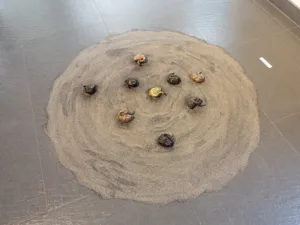
In Saravana Deivasegamani exhibition ‘Devine Seeds’ at the beginning there are 9 bronze objects on the floor. They are in the center and represent 9 grains that are just beginning to sprout. Navadhanyam is the title of this work. Hindu temples have vessels on the roof—usually made of copper—filled with seeds. Every 12 years, the seeds in these kalasams are replaced. It is there in case there is ever a severe natural disaster, and the seeds are needed for reconstruction. The 9 different seeds are called Navadhanyam. They are widely used as offerings. Saravana Deivasegamani has symbolically brought them down from the temple roof, the grains of Kalasam sprout now. We live in a time where this seems to have become necessary. At least symbolically – because our planet is not in good shape.
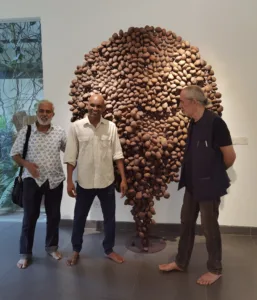
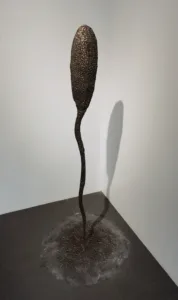
We see this in Tamil Nadu with the Palmyra palm. This palm tree, which is part of the identity of Tamil Nadu, is an endangered species in Tamil Nadu now. It grows very, very slowly and gives way to the so-called civilization. The 2.35-meter-high sculpture ‘Beginning of all Things’ is mainly made of palmyra seeds attached to an iron and copper construction. On the palm tree leaves the Tirukkural was written. This classic work of Tamil culture from the 5th or 6th century consists of 1330 double verses and contains the wisdom for the right way of life.
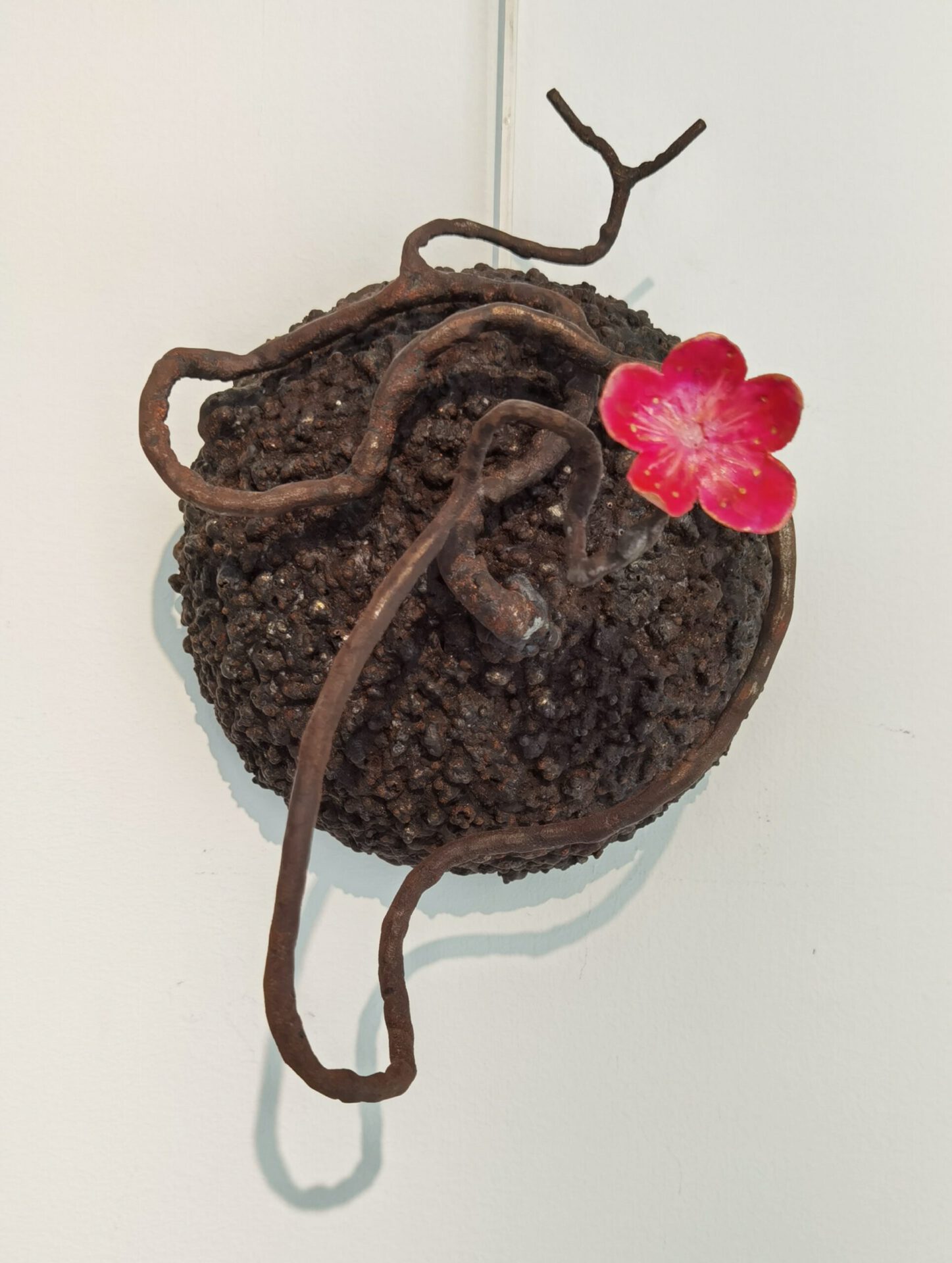
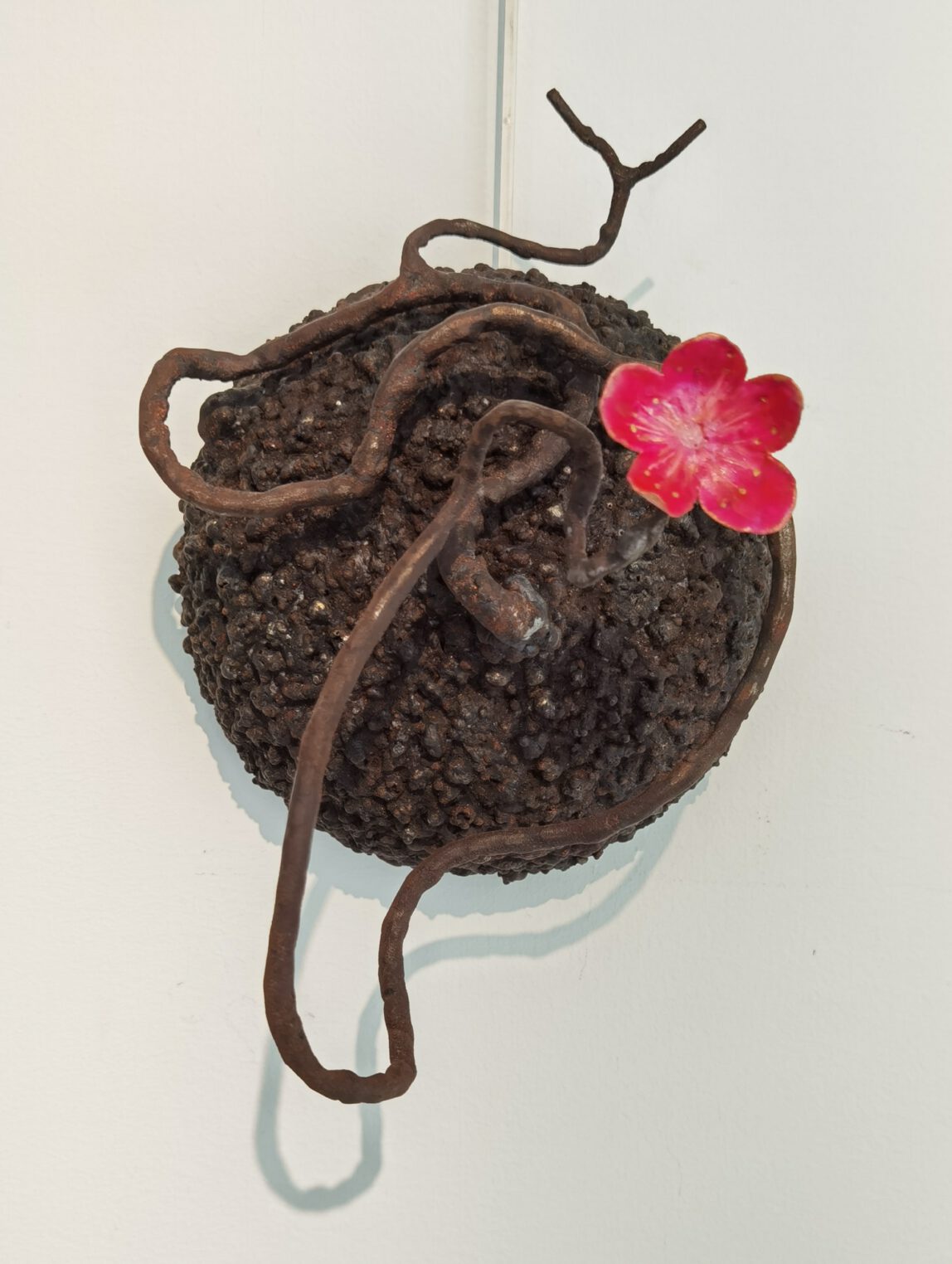
It is this vitality of tradition, wisdom and spirituality that is felt in Saravana Deivasegamani’s works. The imagery comes from a place of meditation, from the heart, a connection with nature. The sculpture ‘Beginning of Things’ is juxtaposed with ‘Outburst of Joy’. The 65 cm high sculpture stands for itself with its title, from the root grows an organic structure, symbol of life. Trees are sacred for Saravana Deivasegamani.
A few months ago, Saravana Deivasegamani bought online a pair of digital glasses for welding. These glasses go dark only for the fraction of a second it takes to set the welding point. Saravana Deivasegamani worked as a metal craftsman before coming to gallery art. The filigree works like ‘Small Joys’ or ‘Private Signs’ consist of thousands of welding points.
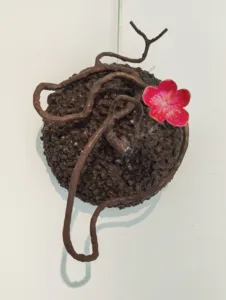
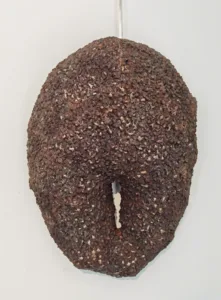
Many of his works were created without these glasses. The approach then is different. The ‘pointillistic’ welding work is created with closed eyes. You must imagine this for a moment. Every time a mark is made, the artist must close his eyes. It is the opposite of Impressionism, which was entirely devoted to vision and the theory of how light on the retina becomes a mental image, and how that mental image is then in turn put on the canvas. Saravana Deivasegamanis however does not stretch a canvas, but welds a sheet of metal onto a three-dimensional structure that serves as his base.
I do not want to stretch this parallel here, but it appears to be helpful in understanding the process better, because there are other interesting references here. Saravana Deivasegamani’s art comes from meditation and is opposed to empirical science. The sculptures, however, are additive, as is the pointillism. Saravana Deivasegamani took a long time to get the color of the metallic surface right. He tried different metals, acids, and techniques until the result was right. The objects are not painted over or alloyed. He is a purist, proud of his technique. This is also something you often see on the streets here in India. People mastering their simple tools at leaves that leave one amazed. Saravana Deivasegamani pushes this to perfection. His practice is devotion, meditation. His art sprouts and grows, leaving one to wonder and open spaces of association.
The small series of ‘Small Joys’, ‘Private Signs’, ‘Depth of Silence’ reminds me of parts of the human body. The curves and openings, the organic shape of the iron, the surface that resembles a porous skin associate discourses of the abject, something that is neither subject nor object and therefore somewhat uncanny, irritating. When I asked Saravana Deivasegamani about this body association, he laughed heartily. Yes, he would have thought of a belly button too. ‘See whatever you want’ and his eyes sparkled.
Artist’s bio
Saravana (b. Puducherry, 1984) is essentially a self-taught artist. He began his career as a metal craftsman and decorative grill designer. Over time, he honed his skills in fine art sculpting through self-study, experimentation, and vigorous practice.
His first major exhibition was held in 2016 at Gallery Square Circle, Kala Kendra (as part of a two-person show with eminent painter and fellow-Aurovilian Juergen Puetz). The same year, his sculptural installation titled ‘Creators’ made entirely of natural Palmyra seeds won the National Award of the Lalit Kala Akademi. His award-winning work was displayed at the 58th National Exhibition in the National Gallery of Modern Art, Bangalore. He was also invited to the national artists’ conclave in February – March 2017.
Since then, Saravana has participated in a number of group exhibitions, artists’ camps and workshops in Puducherry, Chennai, Bangalore, New Delhi, and Hampi. He has also conducted lecture demonstrations on how to convert scrap/found material into evocative art objects
This article is also available at https://artservice.auroville.org/category/articles/
The New Indian Express. „Once part of Tamil Nadu’s identity, Palmyra in need of saving“. accessed 12. January 2023. https://www.newindianexpress.com/cities/chennai/2018/apr/22/once-part-of-tamil-nadus-identity-palmyra-in-need-of-saving-1804734.html.