As I follow the wisdom of the Upanishads and the power of the Rigveda, many things become clearer and clearer to me. The spiritual power of the ancient scriptures in India lies in their unfiltered access to experience and intuition.
The systems of thought that I have come to know in the Western tradition basically always try to find a starting point:
- Philosophy always searches for the beginning. However, it usually does so through the mind. This leads to the question of axiomatics and ontology, i.e. the question of basic assumptions and irreducible forms of being.
- Other, more religious and mystical attempts look for an anchor in the transcendental, metaphysical or supernatural. Ultimately, in an authority that can be experienced.
- Science, with its materialistic approach to the world, looks for patterns and tries to generalize them in order to verify or falsify the theories derived from them.
What I am learning here in India is the contemplation of essence in meditation. Spirituality begins with looking inward. This inward gaze is pure and unclouded. It is like clarified butterfat – ghee.
Meditation on the self
In the Meditation The body is in a resting position and the mind lets the stimuli from the outside world fade away. As an aid at the beginning of meditation, concentration on the breath is often used. Counting one's own breaths directs consciousness to one's own body, to the life force of breath, to the relationship between the outer world and the inner world. When the mind and body have thus quieted down, the actual meditation begins. The senses, which are now largely freed from the stimulus-response pattern, are open. And this is exactly where the Upanishads begin.
The next step is not about an experience of the transcendental, the mystical, or some other kind of reality, as so many meditators believe. The Upanishads are about bringing the senses into a pure form. Seeing becomes seeing, hearing becomes hearing, thinking becomes thinking, etc. Nothing more and nothing less. Whoever succeeds in remaining on this level of consciousness perceives the basic structure of consciousness. It becomes clear that the sensory impressions, stimulated by the external sense organs, appear within consciousness, but transformed. In philosophy, many thinkers now jump too quickly to the conclusion that these are mental representations. But a lot happens before we arrive at mental images.
The Kena Upanishad asks: Who sees when seeing, who hears when hearing, who thinks when thinking etc.... This is the question of all questions. The answer is clear and pure - Simplicity is complexity resolved - the absolute self. What does that mean?
When my consciousness concentrates on one of the senses in meditation, it becomes - detached from its object of perception and equally detached from the subject of perception - a pure content of consciousness, a form that springs from a vibration. Vibration is the concept of the Upanishads; for the scientific mind we could speak of consciousness contents that accompany neuronal currents. This vibration, which is triggered by the sense organs, constitutes consciousness. Even reductionist materialists would still agree here. It is what Hegel calls sensual certainty.
But who is it that has this sensual certainty? It is not the subject that synthesizes the mental images, the representations, but it is a mixture of vibrations. Consciousness does not exist in isolation. Consciousness is a mixture of different contents of consciousness. The vibration of the senses mixes with our breath and heartbeat, with nature. In short: consciousness is bound to the life force (prakriti), to a soul (purusha) and identity (atman).
Atman and Brahman
During meditation, the blending of the senses is easy to observe. The clear consciousness becomes aware of this harmony and enjoys it. It is here that ecstasy and bliss are experienced. And here, at least for me, the self awakens in a deeper sense. For here consciousness is detached from the stimulus-response scheme. The synthesized consciousness (Atman) develops its own power of action, it becomes an agent, i.e. free. And in this very consciousness of the free self (which is a much stronger concept than the rather technical self-consciousness with its self-referential structure), the self recognizes its unity with the absolute self. Free consciousness recognizes itself as part of consciousness in general. Atman is Brahman and Brahman is Atman.
Pictures of the Rigveda
From here, images of Rigveda also become clear to me. The sacred cows that appear as rays of the sun and in other strange constellations, the horses that are harnessed and come from the cities or drive the gods, the fire that is omnipresent in various forms, sometimes smoking, sometimes clear.
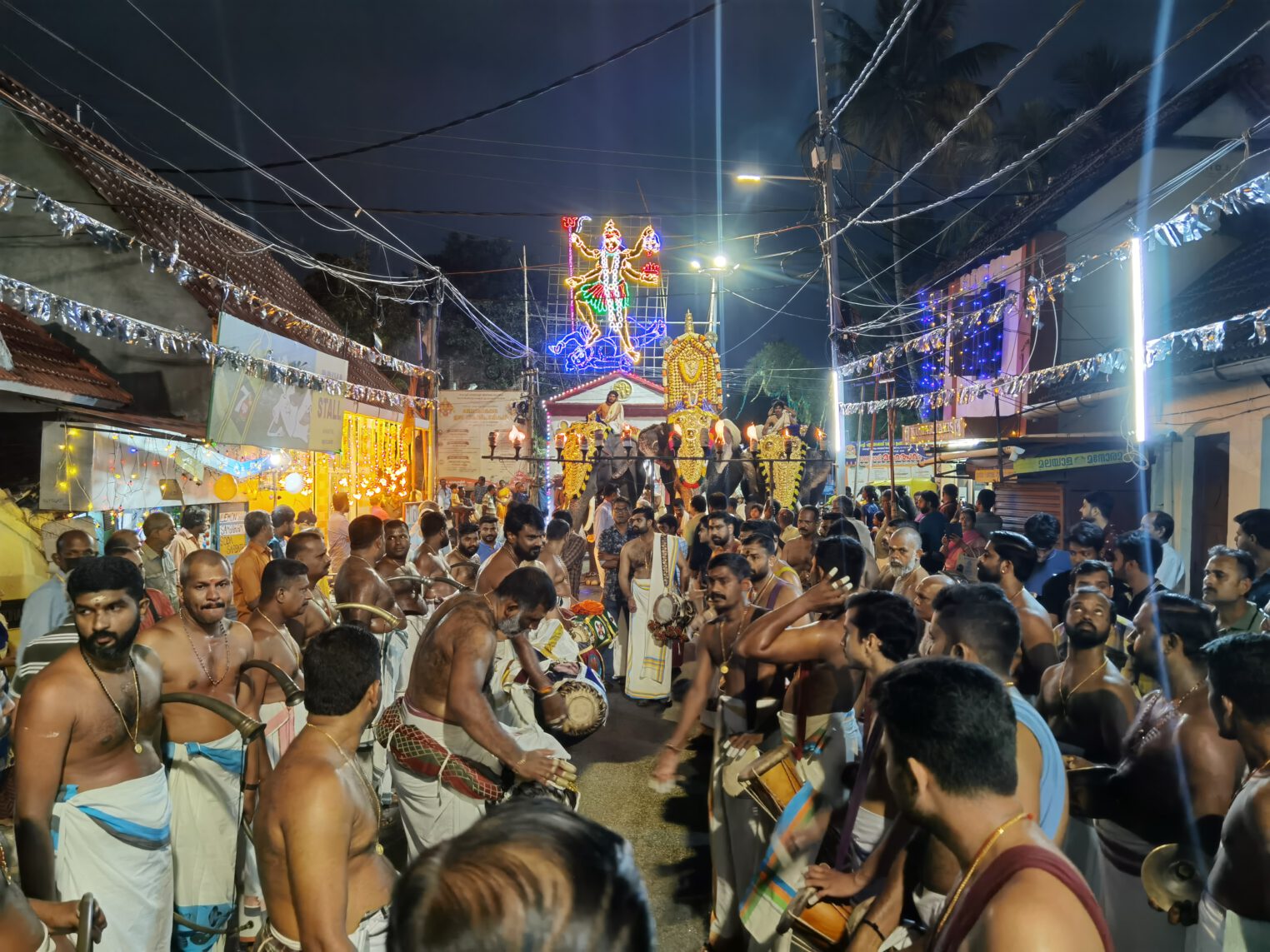
Sometimes, after a meditation, I would transport myself to a prehistoric time, a time with few tools, without writing, under the starry sky, where horses grazed in the meadow and milk was boiled over the fire and churned butter was clarified. The mystery of life and consciousness, the experience of being part of the cosmos, sitting around the campfire, or lighting the oil lamps with clarified butter for the gods, is a deep spiritual experience that can still be felt to some extent in the temples and at the festivals in India.
The clarified butter of majestic, free-range cows, which is invigorating and light-giving, the breath of snorting horses at dawn, the fire that warms and reflects in the sun and moon. These are very concrete experiences that are the central subject of spiritual meditation. The Rishis proceed very concretely from what is before them, and they reflect inwardly and describe the mystery of our existence here and now. It is not a spirituality that builds on authority or proceeds from a priori categories. This spirituality is developed from the most general world of experience; it explains who and what we are. It merely gives names to things and forces and describes them.
The gods are nothing other than the forces we see: the growth of trees in nature, the struggle and love of living beings, the forces of our subconscious, the ideals of our spirit. They are part of every culture, they are everywhere, they are real. In Hinduism, they are named forces and worshipped as gods. What is wrong with that?
We live in this world, this is where we are, and this is where our spirituality is. It is not in the hereafter, nor is it here.
 German
  English
  French
Leave a Reply