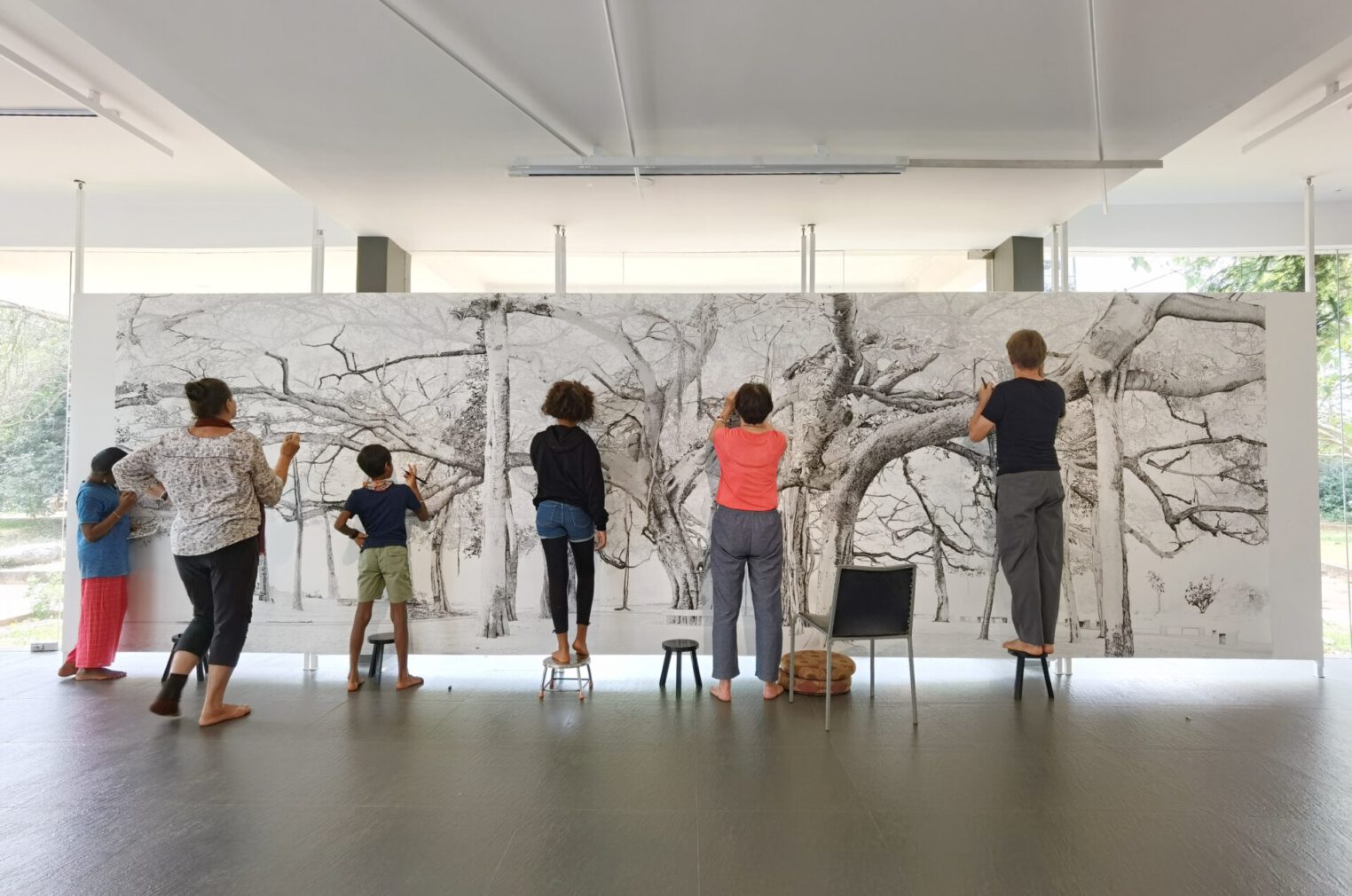
Exhibition “Roots From the Sky” by Cedric Bregnard at Centre d’Art, Auroville March 2023
Cedric Bregnard is Artist in Residence at the Centre d’Art in Auroville. Over the next 2 months, he will take a photograph of the banyan tree in the Matrimandir garden. This photograph will then be scaled to the size of a wall (approximately 3x7m) in the gallery. Residents of Auroville are invited to trace light and shadow on the bark, the leaves, the roots, in ink on the wall. What lies behind this process is complex and touches on the nature of photography, the materiality of trees, and the force of life. The tree itself is the geographical center of Auroville and represents a very special place for many people, a place of contemplation, concentration, and meditation. For many, this tree is more than just an emblem of nature, humanity, and the cosmos. It manifests something.
So what is this about? Let us start with photography, for Cedric Bregnard is a photographer. In 1998, for his final project at the Ecole de Photographie de Vevey, Bregnard photographed the deceased. He took several months to accompany four people in a palliative care clinic in Switzerland on the final stage of their lives. They agreed to let Cedric Bregnard take a photograph of them. After life had left the body, he took 3 hours to spend alone with the deceased, a kind of vigil, and then took exactly one photograph, the only photograph, of the body—a portrait. The arc drawn here is existential: what is the transition from life to death? What is a portrait? What can photography depict? What exactly happens when a photograph captures a moment—technically, temporally, metaphysically?
Photographs are technical images. In 1826, Joseph Nicéphore Niépce succeeded in making the first photograph. Louis Daguerre developed the photochemical process to the point of patentability in 1839, and it was the brothers Louis and Auguste Lumière who invented the cinematograph in 1895. This apparatus made it possible both to shoot and to project films. Life-size moving image projections displaced the magic lantern and the phantasmagorias.
In 1907, in his book Creative Evolution, Henri Bergson criticized the cinematograph as an apparatus that produces deceptive images. The succession of individual images creating the illusion of movement was ultimately a lie. Plato had already argued similarly: painting was a lie, because you could not eat a painted apple. In 1985, Deleuze ‘rescued’ cinema from the accusation of lying by arguing that the criticism was correct, but shortsighted. The filmstrip contained more than just individual images; it was not the illusion of movement but pure thought, material philosophy. Cuts and collages allowed streams of thought possible only in film. Film was not ‘truth 24 times a second’ (Godard), but pure philosophy. The Elan Vital (Bergson), that is, the life force lacking in the cinematograph, is extended by the force of thinking.
Latent Images
Cedric Bregnard’s performances implicitly engage with this discussion, though in a distinctly different tone. For the question is how photography can transcend the technical image.
So, back once more to the beginning of photographs. Light rays are captured using photochemical processes. A latent image arises, that is, there is an imprint of light in a chemical film on a supporting material. The latent image becomes visible when the transparent chemical compounds altered by the light are replaced by colored chemical compounds. With Daguerre, this was still silver on a glass plate. Kodak film, however, made working with negatives popular and inexpensive. The negatives could be efficiently enlarged in a large laboratory. We generally refer to these prints as photographs. It is therefore nature that ‘paints’ here; light is captured using an apparatus and made visible through chemistry. The photographer merely chooses the place, the time, and the framing.
In Bregnard’s process and his work, there is a quite essential shift within this ‘painting by nature.’ He, too, chooses a place, the time, and the framing—that is, an object—specifically a tree—which he photographs with a camera. Instead of using a photochemical process, however, he uses a very high-resolution digital process. The pixels, which function a little like a latent image, are made visible through a printout on paper. The mathematical description of each individual pixel is transformed into a graphic depiction using an algorithm and a printer. Most photographers working digitally take these printouts as final results. They are the equivalent of analog prints, that is, photographs.
Making Visible Together
Bregnard works a little more finely. For him, the printouts are quasi-negatives. An intermediate stage toward the final image. The print from this negative comes into being in the performance. And here it becomes a little magical.
The ‘negative’ Bregnard prints out is black and white, without shades of gray. That is, every reflection of light captured by the camera is assigned either black or white, ‘light or shadow.’ This negative serves as the basis for the performance. Anyone can now take part and trace the traces of light and shadow. The image of the tree is collectively traced in ink. A beautiful detail here is that ink is made from charcoal, which in turn is charred wood—a dead tree.
The collective tracing in ink itself is a process Bregnard ‘lets run.’ He takes himself out of it. Once again, it is nature that draws here. Nature in the sense of the opposite of technology. But it is a higher form of nature; it is consciousness in the collective. That this process is now taking place here in Auroville in relation to the banyan tree is wonderful. That it is happening at a time when Auroville’s driving force, ‘Diversity in Unity,’ is being put to a test of strength may, for some, be more than merely symbolic.
—
Bergson, Henri. Creative Evolution. New York: Henry Holt & Company, 1911.
Deleuze, Gilles. Cinema 1: The Movement-Image. 9. print. Minneapolis: University of Minnesota Press, 1986.
———. Cinema 2: The Time-Image. Minneapolis: University of Minnesota Press, 1989.
“Cedric Bregnard | Cedric Bregnard.” Accessed February 10, 2023. https://www.cedricbregnard.ch/.