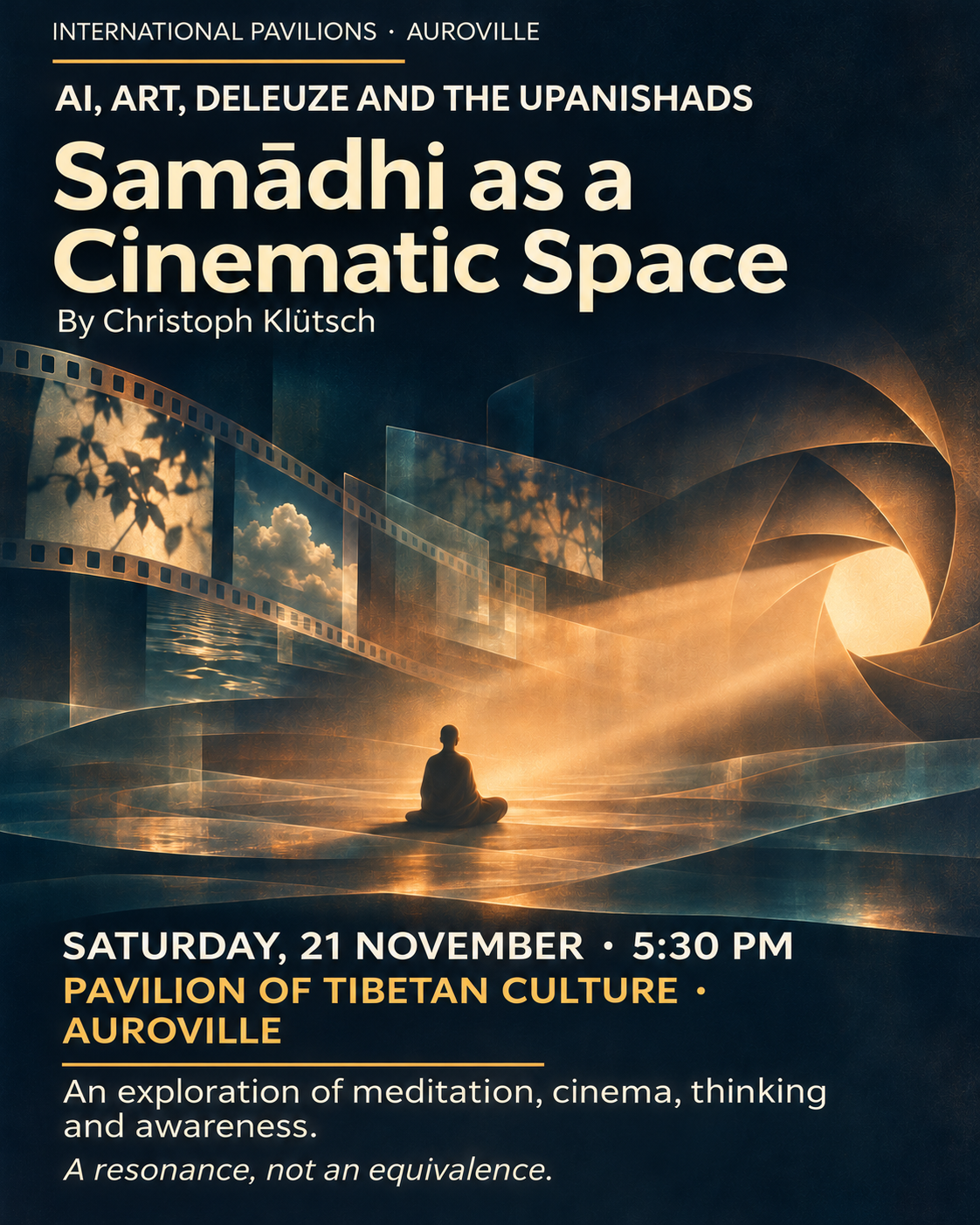
Lightly edited transcript, 21 November 2026. The accompanying presentation was used to clarify names, terminology and quoted passages. Square brackets mark wording that remains uncertain. Audience contributions are labelled without assigning identities.
Lecture
Hello, welcome. Thank you for joining me for this third lecture in the series Deleuze, AI, Art and the Upanishads. I’m trying to bridge these different areas and make connections.
Since I came to India four years ago, I’ve been writing a blog. The idea was to bridge Eastern and Western philosophical traditions. A lot of what I’m presenting here is a kind of harvesting of the writing I’ve been doing over the last couple of years.
Last time I talked about sound. Before that, I talked about words and speech. Today I want to talk about cinema.
These lectures are independent. You haven’t necessarily missed anything if you weren’t here last time. They should, in a way, be self-explanatory. Yet at the same time, I have to say, this is really an exploration of thought. I’m not going to give you a summary of a book. It’s an attempt to think through a more or less wild idea.
My name is [name unclear in transcript]. I’ve been [unclear] for four years, and I used to teach, so this is a little bit like my home area, by the way. At the end, I would like to leave room for discussion, so I’m trying to keep my talking under an hour. Hopefully.
With today’s idea, “Samadhi as cinematic space?”, I’m trying to make a loose connection between two different states of consciousness and experience, between the Upanishads and Gilles Deleuze.
Samadhi, the Upanishads, Indian spirituality—I think there’s already an intuitive understanding of that. I’ll go into it a little later. Cinematic space, I want to introduce briefly.
Gilles Deleuze wrote two books, Cinema 1 and Cinema 2, in the 1980s, and he redefined film theory. There really is a before and an after these books. His thinking is wild and exploratory. He looks at images almost as living entities, which tap into a different type of thinking when we watch them. That’s what I would like to explore today.
I want to start with a very short clip from one of my absolute favourite movies, Man with a Movie Camera, by Dziga Vertov, from 1929.
In the 1920s, there were three major films. There’s Sergei Eisenstein’s Battleship Potemkin, a revolutionary film. Its goal is to mobilise your political action. There’s Vertov’s film, which is really a reflection on film itself. And then there is Dreyer’s The Passion of Joan of Arc, a heartbreaking emotional theatre. It’s a theatre of horror, almost.
These three films from the 1920s really define three major aspects of what cinema can do.
I want to show you two minutes of Vertov’s film, starting at minute twenty. Look at what it explores in terms of cinematic means. What can cinema do? What elements does it have? How can one reflect on cinema? And what are we actually looking at when we look at cinema? Keep those questions in mind.
[A clip from Man with a Movie Camera is shown.]
What I find absolutely spectacular about that film is that it shows little shots, it shows montage, it shows the shots as still frames, and it shows how they’re put into motion. It shows the camera moving. It shows the moving camera being filmed. It shows people looking back into the camera while the camera filming them is itself being filmed. All that in about two minutes, and those are just a few things to unpack. It’s really a master reflection on the power of cinema.
Vertov’s film was part of an effort to define a universal language of images. There’s no text, no speaking; these are silent movies. The idea was to develop a visual language that was internationally valid and could be used for the communist revolution, for proletarians all around the world, so they could speak a common language in imagery.
That opens a space to reflect on what movement is, what an image is, what language is, what consciousness is, and how stories are told.
And when one reads Deleuze’s books on cinema… First, this is an example by Nam June Paik, a media artist: TV Buddha. You see a Buddha watching its own image on a screen. Who is the observer, and who is seen, when one watches oneself? What is the inner self? What is the outer self? Who is watching? Is that something external?
You could meditate on that deeply for a long time. It leads into some core elements of the Upanishads.
What I want to go into a little is the core question: what is an image?
This is one of Plato’s famous examples, the cave. Most of you are probably familiar with it. It’s an allegory about what we see. People are in a cave. They see images on the wall in front of them, and they think they’re real because they’ve spent their entire lives in that position. They’ve never looked back. They think that’s real.
What’s happening is that there’s a fire, and objects are carried in front of it. Their shadows fall onto the wall in front of these people, who are in chains. They think that’s the real thing they’re watching. They don’t know there are objects behind them. They don’t know there’s light behind them. They don’t know there’s a way out, and a reality outside that’s larger than this.
Plato says we’re stuck in that cave, and the philosopher’s role is to guide people out. These images, which we see as reality, are only shadows of what is real.
For Plato, the reality behind them is an idealistic reality. He says there are ideas. That’s a different metaphysical concept. And we know that when we go into a meditative state, we can reflect on our senses and what they’re giving us. What is our external sense? Our internal sense? What are the internal images? How real are they? How do they connect to our true self? What is moving us?
There’s a parallel to that analogy of Plato’s cave. I chose it because I’ve developed a variation of it.
We still have the shadows and the people looking at them. Instead of the objects, we can use the frames of a film. We can see the lamp behind them as the projector lamp, like the one we’re using here. And we can look at those shadows as a universe of images: media, digital images, technical images.
That theory has been dominant in much of twentieth-century film theory: these images are fake. We’re looking at images, at films. As Godard said, “truth is twenty-four frames per second.”
When you watch a movie, when you look at an image, it’s not real. Plato said art is deceiving. You can’t eat a painted apple. Artists are liars and cheaters and useless. For Plato, there’s no room for them in society because they’re lying. A lot of media criticism and media theory comes out of this.
Deleuze looked into this a little more deeply. He followed Henri Bergson’s philosophy of movement.
Bergson is a philosopher of the élan vital. He looks beyond traditional academic frameworks and asks what is moving us in the world. What is this vitality we have? What is intuition? What is sensation? What is memory? How do we construct the world from that core of our being moved? That’s the core of his philosophy.
He looks at cinema, at the cinematograph. At that time, it was a machine with which you could record, and you could use the same machine to project. Instead of light coming through the lens and hitting the film, you put the light behind the film and project it out. A little like this projector. You could record and project.
Bergson said these projectors aren’t telling the truth because they deal with static images, frames, twenty-five frames per second. They’re moved, like we saw in Vertov’s film, with a spinning wheel. You make these still images move. They become moving images. But at their core, he said, they’re dead. They’re static, dead images.
Therefore, they’re not to be looked at from a philosophical point of view. [One word unclear.] Maybe you can talk about content, storytelling and so forth, but they don’t give access to anything real and true.
Deleuze looked at this and said: true, all true. But what you’re missing is the moving part. The machine is moving those images. And what’s being moved is a film strip. On that strip, you have different shots, which we put together as a story. These sequences of shots, which are material in the film, when put into motion, are thought. It’s active thinking.
It’s not about what you see. It’s not an image, not a representation, not something showing something that’s like something else. It’s not a copy or an illustration or a fantasy. It’s thought. It’s thought in action.
Deleuze developed his theory of cinema around that idea. When you watch a film, you’re thinking because the film contains thought. But what you’re thinking is not really what you’re thinking. You didn’t make that movie; you’re watching it.
While you watch it, you have that thought of the movie in yourself, and you attach your own ideas. You have memories, associations, your own thoughts coming up. All that’s fine. But what’s moving your thought is a film put into action that contains a thought.
That’s something to hold on to for a little while, that radical idea. It puts thought outside brains, outside machines. It puts it into a medium that’s a linear arrangement of images. When we watch a film, we’re moved inside by those images. Something moves us. And what’s being moved is almost on a subconscious level.
Deleuze’s theory of cinema goes into that deeply. He talks about affects, which means I’m affected by something. Emotionally, I’m shocked. Or I’m looking at time-images: there’s a construction of time.
You can have films telling a story over a hundred years. You can condense time, go into flashbacks, create a person’s privately experienced time in relation to an external time in the film [wording unclear here], and in relation to your own lived time. You can play with time and get a different idea of how to think about it. That’s really something new. You can’t quite do that outside this medium.
Maybe with music. In music, you have a past, a future, remembering and so forth. But film is really a [word unclear] medium for this idea of playing with time.
There’s this possibility of reflecting on how my deeper consciousness is affected and reconfigured by an outside thought, which generates a thought within me, on which I can reflect. That leads into a deeper understanding of how our mind, our consciousness, works.
Sometimes, when we’re so full of our egos, we have the feeling: I’m this brilliant thinker who came up with an idea. I can explain something, understand something, I’ve discovered something. It’s my thought.
No, it’s not, right? Generally, it’s not really my thought. It’s a thought picking up something that’s moving within me. I have images, sensory experiences from my outer senses coming to my inner senses, creating this massive internal universe of sensations that become a thought. While I can reflect on it once in a while, the majority of my thinking is really not reactive thinking. It’s something in action.
That’s what film, according to Gilles Deleuze, gives us in a structured way. As a filmmaker, you have the power to work with images and create a story that makes us think outside our own thinking.
Deleuze talks about the nooshock. One short paragraph:
It is only when movement becomes automatic that the artistic essence of the image is realized: producing a shock to thought, communicating vibrations to the cortex, touching the nervous and cerebral system directly.
Because the cinematographic image itself “makes” movement, because it makes what the other arts are restricted to demanding (or to saying), it brings together what is essential in the other arts; it inherits it, it is as it were the directions for use of the other images, it converts into potential what was only possibility.
If you have images and put them together, you can create a potentiality. You can create a thought, a story, a world that’s not real, yet can be entered.
Automatic movement gives rise to a spiritual automaton in us, which reacts in turn on movement. The spiritual automaton no longer designates—as it does in classical philosophy—the logical or abstract possibility of formally deducing thoughts from each other, but the circuit into which they enter with the movement-image, the shared power of what forces thinking and what thinks under the shock; a nooshock.
A nooshock. [A brief comment following this term is unclear in the transcript.] I’ll leave that out and go to the last sentence:
It is as if cinema were telling us: with me, with the movement-image, you can’t escape the shock which arouses the thinker in you.
[Quoted wording clarified using slide 7: Gilles Deleuze, Cinema 2: The Time-Image, chapter 7, “Thought and cinema”. The speaker skips part of the displayed passage.]
That shock is crucial to cinema, to what I would call intellectually interesting cinema. I’m not talking about Netflix series, right? I’m talking about arthouse films. Those films we may all have seen at some point where something really surprises you, and you jump out of the movie and wonder: what did I just see here? Why am I so affected? Why am I so touched? How can I integrate this into my experience? Why is what I’m seeing disturbing me, inspiring me, telling me something about my condition, or making me understand something?
There’s a shock in that spiritual automaton. The spiritual automaton is what I described earlier as this layer of our consciousness. We have these images, emotions, affects, thoughts, facets. They move within us prior to my ego and create what Deleuze describes as a spiritual automaton.
If a movie uses that, tells a story and creates a thought in you, you’re thinking something different from your own thought. Once in a while, you’re shocked into something. Into a moment when you realise that what you’re watching is relevant. Relevant outside the movie, outside yourself, maybe to something deeper in yourself. It shocks you out of the illusion.
In film theory, we talk about the suspension of disbelief. When you watch a movie, you pretend the movie is real. You get some popcorn, drink some juice, and dive into it for an hour, two or three hours. Ten hours, if it’s a Netflix series. You dive into that reality. You forget you’re looking at a computer screen, which is a very boring technical [word unclear]. Suspension of disbelief.
You can be shocked out of that suspension of disbelief. But you’re not just [wording unclear] the movie. You’re shocked out into a different type of reality. You realise the internal conscious process, that thought in the film relating to your experience.
That’s where I want to make a little bridge to Sri Aurobindo. When I was reading The Synthesis of Yoga, I came to a chapter on samadhi.
The notion of samadhi relates to the four states of consciousness. Waking consciousness is the one we’re in right now. However complex it is, my eyes are open, I’m awake, I’m perceiving, I’m thinking. I can do very complex thinking. I can be creative and imaginative, go deeply into all kinds of layers of reality. That’s all part of my waking consciousness.
I can go into dream consciousness. I’m sleeping and dreaming, and the organisation of dreams is fairly random for most of us. If you remember a dream, you usually wake up and think: huh, that was interesting. I’m not quite sure what it was.
You have to think about it. You’re not sure what it means. Maybe it reminds you of something you experienced earlier. You try to figure it out, but it’s a somehow muddled, unclear sequence of thoughts on a level of consciousness that’s fairly unstructured. It’s built on internal sensations.
Reality is built on external sensations. Right now, I’m looking at you. I assume you’re real. My senses are directed towards you. Dream is only internal sensations.
Then there’s sleep, the dreamless state, when we’re in deep sleep. We’re not awake, we’re not dreaming, and we’re in a space we don’t really know. I close my eyes every night, I disappear, and the next morning I reappear. I wasn’t awake. I was somewhere.
There might have been an episode of dreaming; that’s another thing. But when I wasn’t dreaming, I was somewhere. That somewhere can be associated with a deeper reality, a consciousness, a spiritual layer I can’t access. I can’t be aware of my deep-sleep state.
We have it. Every night we go there. It’s one of the most natural places we go, yet one of the biggest mysteries we can think of. Where have I been every night? We don’t know.
And then there is… [The transition to the next state is unclear in the transcript.] Samadhi, in Sri Aurobindo’s description, is a state of trance. In that state, we can leave our self behind. We can enter our consciousness in the sense of becoming aware of what’s happening in it.
It’s not me having that idea. It’s not me thinking there. It’s not me concentrating, directing, reflecting, contemplating, even meditating. In samadhi, thought and consciousness are unfolding themselves. If I’m lucky, I’m allowed to be a little bit of a visitor. Maybe I can peek through, and my little ego can say: oh, interesting.
You can take that to different levels. I’m sure you all know there are endless levels. You can become more and more active there, more aware of what that trance state is. What you have access to is a different type of knowledge. Intuitive knowledge. You might have capacities for telepathy, out-of-body experiences or visions. A lot of different things are possible in the state of trance.
For Sri Aurobindo, that’s great. It’s wonderful if you do it, but it’s not necessary. If you go into samadhi, it’s like a booster. You run a little faster for a while, but you can do without it.
The core of samadhi in your practice, according to Sri Aurobindo, is that you should be able to bring what’s happening in trance back into your consciousness. Bring it back into this reality. Integrate it into your awareness and your thinking.
And for Sri Aurobindo, he says there’s only one way to get out of samadhi: through “a violent shock of physical appeal dangerous to the system owing to the abrupt upheaval of return.”
Once you go into that state of trance, there’s really no way out because your ego isn’t there. Not really. You’re experiencing something beyond your personal identity, and because you have no agency there, you can’t really get out. You’re a little trapped, and you need something to kick you out. Pain, perhaps. You can’t hold the posture anymore. Or something comes from your subconscious and throws you out.
That shock is necessary to come out. It might be a gentle shock, but it’s a shock. Coming out of trance is a kind of weird experience. The goal, for Sri Aurobindo, is to hold on to what was in that trance experience and bring it back, integrate it into your full existence.
That caught my interest. There’s a parallel there, and I want to linger around it a little: cinema as thought in action, operating on imagery put into motion, evoking a thought within me. And a shock that, once in a while, forces me to integrate my experience, what the film has triggered in me, into an understanding of what Deleuze would call the whole.
He would go so far as to say we experience the whole. The whole universe, or the largest whole you can think of. The whole. We have a kind of privileged access to it through cinema. It connects us with a thought outside, with our deep structure, with our reaction to it: a shock, an integration. Suddenly I turn around and feel: where am I? What am I watching here?
Some films can be disorientating, and that shock has the capacity for philosophical reflection. Similarly, I think—maybe, that’s really the question—there’s something in samadhi when we’re shocked out of it and have the task of holding on to what we experienced in trance, bringing it into our reality and integrating it. Maybe we’re shocked into what Aurobindo would call an integral synthesis, a more conscious, reflective state of ourselves.
There’s a similarity between samadhi and cinematic space. That’s really the core idea I wanted to explore with you.
Shock and spiritual automation. In samadhi as well as in cinema, we’re in a state of trance. When we’re watching a movie, we’re also outside ourselves. I’m not present when I’m watching a movie. If I become hungry or need to go to the bathroom, then my ego comes up. We like to stay in these states.
Both are spaces without an ego. There’s no thinker. It’s a motion of thoughts, sensations, awareness: spiritual automation. We need a shock to get out into thinking. That’s really something quite beautiful.
If we look at the constitution of our existence in the framework of Indian philosophy, we have our chakras, our koshas, our different levels of thinking, Sachchidananda. All these layers through which we can see ourselves. Thinking is, in a way, the least interesting part. It’s what we’re feeding our ego with. We’re nourished by our thinking because we feel good when we think. I feel good when I’m talking now.
But it’s only something running superficially on our deeper levels, which we usually access through deeper states of consciousness. Yet we can be shocked into a different type of thinking, an integrated thinking.
To connect this with what I showed earlier, Nam June Paik: remember the Buddha looking at its own image, being surveyed by a camera. Who is observing? Who is the observer? What is the [wording unclear] making that interaction possible?
There’s the famous image from the Upanishads, which I’ve mentioned a few times: the two birds. One eats, one watches. Who is the observer? Most of us are probably familiar with that image.
I’m an enjoyer. I’m exploring the world, and there’s something in me enjoying me, enjoying me as a higher self. That relation is complicated and might imply a third self, a different layer of consciousness.
This is Sri Aurobindo, the observer. [The connection between this phrase and the displayed material is unclear.]
Towards the end of Man with a Movie Camera, there’s a scene where all these crazy images swirl around. You see a cinema situation. On the screen, you have normal images, and suddenly there’s a tornado of black and white turning around. That image is an image by Kazimir Malevich, a contemporary of Dziga Vertov and one of the great masters of abstract art.
He’s even more famous for his White on White, which contains all images. You can see its emptiness, a deep sense of emptiness that’s potentiality. White on White allows your imagination to do whatever you want. It’s the reduction of the image to its very core, the canvas, the black canvas [word uncertain] on which you start and into which you can collapse all images if you want.
This idea of a deeper state of emptiness underlying even these layers of cinematic space and trance, or our consciousness being operated by an automaton, a spiritual automaton, a machine. Or, in a trance state, something moving me, a deeper, higher existence that I can then unfold. It’s held somewhere. It’s held in a state of immanence.
That’s the notion I keep bringing up in these lectures. I think it’s very relevant to my way of connecting Gilles Deleuze and the Upanishads, because both are nondualistic approaches. The way I want to read the Upanishads is nondualistic.
That leads to the idea of the world as immanent. There’s complexity in one layer, and you have different configurations of it. You can connect things, fold things, create inclusions. When you fold something, there’s something inside the fold and something outside. You have inside and outside. You can have layers, fold it over and over, have strata, have depths. You can connect things [one term unclear], a root structure.
You can connect thoughts to other thoughts, thoughts to objects, objects to emotions, emotions to institutions, institutions to libraries, libraries to cars. I’m sure it’s possible. You can connect anything to anything, but it’s all one type. It’s one consciousness, ultimately.
For Deleuze and the Upanishads, I think it’s the primacy of consciousness.
Over the last couple of centuries in the Western tradition, we have a tendency to reduce, to be reductionistic. Whatever we want to understand, we create a science, a scientia, which means we’re cutting things apart. When we cut them apart, we want to understand how they relate. Once we’ve put everything into its atomic elements, we put them back together and feel: now I understand.
But we all know that if you dissect a frog, you have to kill it. You won’t bring it back to life by stitching it together. You might understand the heart, the liver, the skin. You might understand anatomy and biology. You learn a lot by dissecting a frog, but you won’t put it back together. Something’s missing.
That scientific approach to thinking is misleading because it goes back to the assumption that matter has primacy in reality. Everything is made of matter, atoms ultimately, quarks, however deeply you want to go into quantum physics. Things. Things are states of energy. That reductionistic model loses the core.
Henri Bergson, whom I mentioned earlier, described the cinematograph as a machine capturing only dead images. He compared this with Zeno’s paradoxes, from the fifth century BC, around the time of Plato.
Zeno’s paradoxes are paradoxes of time. He gives the example of a tortoise and a runner, Achilles, the fastest runner on the planet at the time. Think about it. Achilles wants to race the tortoise, and because he’s so fast, he gives it a head start.
“Tortoise, you go. I’ll give you ten minutes. I’ll catch you later.”
The tortoise walks for ten minutes. Then Achilles runs, and it takes him some time to get to where the tortoise was. By the time he reaches that point, the tortoise has already moved forward. A little, but still. Achilles keeps running, probably just one step, but in that time the tortoise has kept moving.
The intervals become smaller and smaller and smaller, but Achilles will never be able to overtake the tortoise. That’s a scientifically precise, flawless description of what’s happening. It’s clearly wrong. And there’s no way out. Since 500 BC, we haven’t figured it out. Science has no answer to that paradox. Some of the most brilliant people are cracking their heads over it. What’s wrong with it? Mathematicians, [word unclear]…
You can also do it with an arrow. When you shoot an arrow, it’s an object. It’s here and here and here and here. But if you look at it as static objects, there’s no movement. That’s another paradox, but at its core is time.
Time. Movement is time. There’s no movement without time, and time is something we can’t fix. We can’t really grasp it. We experience it. I can’t be outside time. I can’t really describe it. Augustine said everybody talks about time, everybody knows what it is…
I didn’t really want to go there. But this idea that we’re living in a reductionist worldview, where the dissected frog can’t be brought back to life, where we can’t understand Zeno’s paradoxes, where we can understand our deepest reality in samadhi or in cinematic space. We can be shocked into thinking that goes beyond my little ego, through different means of affection and movement.
To me, that only makes sense in this kind of confessional belief. I can’t really convince you about it. But it’s immanent. It’s one reality. Here you call it Brahman. One reality experiencing itself. It unfolds. We’re here because Brahman wants to figure out what it is. That’s it.
Brahman isn’t a table of atoms. It’s probably closer to what we experience as consciousness, yet certainly also different. But it’s not matter. Most likely, I think, it’s not matter.
So, White on White. If you go beyond representation, beyond imagery, beyond internal representations, sensations of external sensations, memories, emotions, whatever it is, they can all end in emptiness. That emptiness, of course, isn’t necessarily empty. Here, with Malevich, most people think they’re looking at a white canvas.
I think it’s potentiality. This canvas can be anything. And that potentiality is real.
Then Deleuze talks about the virtual and the actual. The actual is what we have here. The actual also contains weird things. People share experiences that aren’t explicable through traditional science, but they have those experiences. That’s part of the actual. The actual is what’s actually here.
Then there’s the virtual. The virtual isn’t the virtual reality of AI. It’s the potentiality of now. We’re here now, and in a second it’s different. We have the capacity to change it. We could jump up and dance. Something could happen from outside. We could go into collective meditation and explore deeper states of consciousness. All that’s virtual right now, and it can be actualised. Not everything virtual will be actualised, but it can be.
When I look at White on White, the canvas, there’s this virtual potentiality of what the image can be.
I want to get to the endpoint here and bridge this a little to AI, because that’s always part of these lectures. When we talk about virtual reality, AI is now capable of generating movies. You give it a prompt, press a button, wait five minutes, and the outcomes are mesmerising, fantastic.
Right now, a computer game was just released yesterday [title not given]. The whole world is playing and ordering food on Uber Eats. They’re all stuck in this virtual reality.
But I think that kind of virtual reality is, at least for now, something different. It’s not a potentiality, not something that can be realised. It’s not a rich philosophical experience of what the world can be, what I can be, what we can collectively be.
AI produces, through algorithms and large language models, predictions based on my input that I like. It’s feeding my desire. They’re almost desiring-machines. I want something. I want an answer, a distraction. I want to explore something, feel something, hide, disappear.
We go into these virtual realities of computer machines, but they don’t offer us anything profound. They offer what I showed earlier in Plato: behind the wall of images, that universe of technical images.
It’s a distraction. A useful distraction. It does a lot of good. We learn a lot, build a lot. We can make the world a better place; we can destroy it. Right now, we don’t know where we’re going. Both are on the table.
But it’s not a space I enter like a cinematic space or a samadhi. If I play a computer game, I’m not anywhere relevant, if I may be so arrogant.
Discussion
Audience: Is it all right for me to…?
Speaker: Sure. I’m here to [wording unclear].
Audience: I might push back a bit and say you’re leading into dualisms here, with a quite stark distinction between what’s relevant and what isn’t, or what has real potential and what potential isn’t so important.
I’m curious: if AI can produce something very beautiful that provides a shock to the witness, and comes out of deep reflection or a brilliant artistic vision, what makes it less real, less important, less relevant? Would it have less relevant potential than animating by hand, or any other way of making something?
Speaker: Good question. I don’t think there’s a simple answer. I can see your point. AI-generated content can shock me into a cinematic space, or part of it, just like a movie by [name unclear], or another filmmaker. It can do that.
Yet what it’s operating on is digitally generated, algorithmically generated chains of [wording unclear]. They may be brilliantly done, but they don’t correspond to anything outside. They trigger.
I’m not sure. I really don’t know. I’d have to follow that up at some point.
Audience: Since we’re open to this, you’re using the best cinema for the best state of human consciousness: samadhi, [terms unclear]. What about the lower states, cheap cinema meant to manipulate [wording unclear], and our lower levels of operation?
For example, in Tamil Nadu, we have a history of electing cinema stars to government as leaders. We project some power onto them, some qualifications and everything. At some level, people are being manipulated by cinema, and they’re acting on that.
Speaker: If you’re part of this low-level, extreme manipulation of images, it’s propaganda, right?
Audience: Yes. Low-level propaganda. Then we act on that, and we get addicted. [Part of the question is unclear.] It’s going to be very hard to come out of that constant stimulation into good cinema and samadhi states.
Speaker: I hadn’t really thought about that for today, but it’s a good point to reflect on. Cinema can clearly be propaganda. It can be manipulative for bad reasons, also for good reasons, but it can be used for bad reasons.
Audience: That’s like Plato’s cave. You didn’t mention something there: the ascent and return. How do we break out of those chains and make the ascent?
Speaker: You need Plato to do it for you.
Audience: And why do we return? If we’re in cheap cinema, that part of breaking out of the chains is what interests me.
Speaker: If you think cinema is ultimately a lie, like the painted apple you can’t eat, then you need to leave the cave. I don’t think Deleuze is so committed to that thought. He’s very critical of film, certainly, and very aware of propaganda. But he says you can stay in the cave for a little while and have something. It can be good.
For Plato, the people chained there aren’t awakened. Plato needs to come and bring them out. Outside, there’s light. There are the ideas, there’s reality. There’s green, there are others, there’s the state. If you walk out of the cave, you walk into the city, the Republic, and there you can build a society. There you can develop ideas. Get out of the cave. Turn off your mobile phone. Do something.
Audience: I was thinking about this picture of the light. The fire, which represents light, is at the back. During the ascent, the sun is in front. Here, the fire, the light, is behind, and there it’s in front. There’s an image, a reflection in the water [wording unclear], casting a shadow. But it’s seeing light in front rather than in the background.
Speaker: Right.
Audience: That’s right, coming into light. And of course we come back into [word unclear].
[A short passage is inaudible in the transcript.]
Audience: I think the premise of your perspective is that the subject is affected by the shock, which moves the subject from a temporal space so they can see or experience internal states of movement. If AI can produce this effect in a human, is AI also going through internal states of movement?
Speaker: Are the people in The Matrix, floating in the tanks, in samadhi? I don’t know.
Audience: Because it’s coming from that premise of being affected. I’m able to see a place where time dissolves, and then there’s a cinemascope of how things are. If AI can create these effects, does it mean those AI algorithms are also experiencing samadhi?
Speaker: I would say it’s being shocked out of a state into a deeper realisation. When you’re shocked out, you’re walking out, integrating and reflecting.
If you watch a movie, a good movie, you can look into the actors, the scripting, the history. You can do film history and all those things. It might give you another layer. Maybe the production of something real gives you another layer of realness.
But why not simulate all this with AI? You create an agent producing the movie. You have superstar agents acting. You have 3D scans of actors, digitise the voice… You can simulate all those things. When do we know we’re in a simulation? I think that’s…
Audience: One director who comes to mind is Tarkovsky. It’s the poetics of… I don’t know. It’s not the frame; it’s something just beyond the frame that draws you into a space you can only experience.
Maybe it’s a human embodiment. Some intelligence goes through the observer, and the director creates these ways of awareness in the viewer through the lens. For me, Tarkovsky is able to [wording unclear], and I can see something emerging out of this, especially in Solaris and [film title unclear], as well as some of the other things.
[A brief intervening phrase is unclear.]
Audience: I want to clarify something. You were drawing an equivalence between cinema putting you into a trance state and samadhi, a similar kind of trance. You also talked about cinema jerking you out of that state, giving you the shock that makes you think. Which is it? Is cinema the instrument that puts you into the state, or jerks you out of it?
Speaker: There’s a famous example by Jean-Luc Godard, a French Nouvelle Vague filmmaker. He made Pierrot le Fou, a road movie. Jean-Paul Belmondo and a sexy woman drive through the world and do their road-movie thing.
At some point, Belmondo breaks the fourth wall. Any projection creates a space behind that wall. That’s where the film happens in our perception. This is the fourth wall, and usually you don’t look back. That’s the number-one rule in film. When you study film, the first thing you learn is: don’t break the fourth wall.
Godard breaks it. Jean-Paul Belmondo turns around, like: how are you all doing?
You’re really shocked out of your seat. What’s happening? The suspension of disbelief, the trance state of cinematic experience, breaks down. Suddenly you realise something isn’t right here. I’m sitting here, there’s a wall, I’m pretending there’s something behind the wall, I’m behind the wall, yet something turns around, and I don’t believe it. What’s going on? What is real? What isn’t real?
I think that’s a moment of shock, and it allows me to get a deeper understanding of my existence.
It’s moments like that. It’s not necessarily the raw violence of a movie, or being shocked in the sense of: how dare they show this? It can be. But the shock is something that, deep down, makes me question something.
Audience: I find the parallels with cinema very interesting. My first thought was: why not other creative expressions, for example theatre? There’s Brecht, who also has this moment when the fourth wall is broken, so the audience isn’t just a passive receiver. They actively need to think, to get the kind of shock you’re talking about.
I was also trying to remember other creative arts where you go into a kind of trance, like writing. There’s a moment when you lose yourself. Or painting. But those others don’t have the other. That’s the component in cinema when you’re watching. You’re an outside person. I think that’s why you’re making this specific example: you’re not thinking, you’re immersed in something. You could also be immersed in theatre. Then something comes and brings you out.
Maybe this other component, in a good movie, is connected to the artist’s experience of something other. The artist has had that experience and expresses it through art, and that allows you to be touched by it.
That’s the difference with AI, which doesn’t have this experience with another. It’s an internal system of data, very clever at [wording unclear] images. Maybe it’s hard for AI to touch that spot, because this divine reconnection, this shock, this coming into something bigger, needs a connection with another [end of sentence unclear].
Audience: Can I add something? I was wondering the same thing. AI constructs from known elements. When a person creates art, there’s a moment when it’s like a channel through.
One is the creation of spirit, the expression of spirit. What entity is behind AI? What spirit, I don’t know, helps AI create? Does it depend on the spirit of the person giving the prompt? What is this element?
Speaker: There’s an essay by Walter Benjamin, The Work of Art in the Age of Mechanical Reproduction. He goes into the notion of aura. What makes an artwork unique if you have a copy next to it that you can’t distinguish from it?
There’s something, an aura. We go to the Louvre to see the Mona Lisa, although you see much more if you open it on your screen. There’s an aura there. Something has been touched by the artist, and we value that. That’s very deep in us because we feel we’re touched by the genius behind it.
Walter Benjamin is a little critical. He says maybe we’re liberated from that notion through film. He’s heavily misunderstood, but he asks what happens in films when you no longer need the theatrical performance.
You can do shots. You don’t have to be on the spot for a Shakespeare performance for three hours without making a mistake. In film, you make a mistake and shoot it again and again. In the cutting room, it gets edited and becomes something different.
There’s a liberation of emotions, because you don’t have to go into the false sensation of me being King Lear. I’m not an actor. But if I go into a movie, I can generate these emotions, put them together frame by frame, create a story, create a thought, move the audience through the mechanics of imagery, tapping into my subconscious.
I have much more refined and powerful control compared with being an actor, where you’re manifesting something. Yet what you lose is aura. What you lose is presence, and what you might lose is being touched by the other.
Another voice: Can we all thank you, and then whoever wants can remain for questions?
Speaker: Yes, I think we’re over time. No? Okay, thank you.
Audience: I wanted to mention the context of the Ashram. As soon as the younger generation came into the Ashram, the Mother used film every week as part of the process of sadhana. It’s interesting to look at. We had some very interesting [wording and dates unclear], specialists who also worked with the meaning of why she was doing it.
Everybody in the Ashram went to the Friday evening film shows. The whole community. She selected the films. I’m not sure whether she used them, as you said, as a shock between different stages of consciousness. But she definitely speaks about a leap, an insight, a breakthrough, a recognition [reference unclear].
She said that if a film was very good, one could save one incarnation, or go through the process of one incarnation [last words unclear]. In one film, one can live a whole life, if it works. That’s interesting to mention.
Speaker: Thank you. So if I’ve been on Netflix, I can go through it…
Audience: It’s still happening, actually. I’m not sure who selects the films, though.
Audience: Why use the word “shock” when the traditional word is “awake”, “awakening”? The point is to go back to our normal life. We wake up every morning.
In the film, we are the artists. That aura of the artists who communicate something extraordinary from their personal experience—we touch it because we are them. There’s no other. We’re still in this mechanical separation. We haven’t got our entanglement together enough to understand the nonduality of the situation.
[A passage referring to Sri Aurobindo and Savitri is unclear.]
Awaken. That’s the word to use. The sage asked Savitri: how did she do it? How did she travel all the worlds? How did she get enlightened? How did she overcome death? And she said [quoted words unclear]. Feel is the operative word.
When I’m sitting at the movies, I’m in a safe space, in Cinema Paradiso. I can [word unclear] through the whole movie, and nobody will disturb me. That’s the transformation. It’s me, it’s us, but the collective. We have to awaken to the collective in Auroville, the collective community trying to wake up from the tyranny and oppression of the old world, which we’re all fearing a little too much these days.
Speaker: I would totally agree. In many ways, you can replace “shock” with “awakening”. The example I gave, Pierrot le Fou, Jean-Paul Belmondo turning around and breaking the fourth wall—he’s waking you up. It’s a good word.
I think a lot of people would say their spiritual awakening came as a shock. A good shock, but you need time to process it. It’s not something where you’re just: great.
Audience: It’s natural to wake up. This is our destiny, our evolution. We align with the evolutionary force in Sri Aurobindo’s perspective, which is moving towards a new species. And what is the energy of that evolution? Of course, it’s love.
Audience: I have a little experience working with AI. Even in the most complex case, to put it simply, if I want to create something, I have to use training. I have to train it with data. Even with neural networks, where we try to emulate the neurons of the brain, we need data, training data.
As you were saying, there’s a movie made by a human, and a movie made by a human using AI. I think there’s a dissonance when we use AI. When a person makes it, it’s coming from their consciousness or subconscious, and there’s a train of thought over which they have quite a generous amount of control.
When we use AI, we give up a lot of that to the training, the data. That’s why we say aura, or we can say soul. It can shock us, but I don’t know how much it can touch our souls. There’s a dissonance, a middleman with no soul. It’s just numbers and data.
Speaker: I think we’re about to find out. Right now, that’s an open question. I wouldn’t go so far as to say AI is stupid and meaningless [wording uncertain], but I wouldn’t say there’s a soul either. There’s a potential.
Audience: I have a question. You said that when someone is [word unclear], it comes to us. It’s not ours; it has come to us. Would you say there’s no originality?
Speaker: It depends on what you mean by originality. Artists can be original in the sense that they express themselves, and there’s something original in that. But if you look more deeply at what’s moving you, the notion of originality becomes less meaningful.
I’m not a creator like [name unclear] or Shiva. I’m part of this, whatever it is. Somebody is working through me. I can be humble, and if I work really hard, I can make something that might surprise you. But that doesn’t mean I’m creating a world.
Audience: Or maybe everything is original.
Another voice: I think you should think about it.
Another voice: Nothing is original.
Audience: I think that authorises you to think it’s my work. Can I say it’s my work?
Speaker: Legally speaking, yes.
Audience: In this sort of problem, I’m wondering what art appreciation is. What does it consist of? How do we appreciate art?
If I take Van Gogh and look at his paintings, or any artist, especially Van Gogh or Salvador Dalí, I’m looking at how this person created it. What kind of mental states? What kind of life must this person have led to create something like this?
If I resonate with the art, I wonder: wow, this person has lived through the same states, seen the same silence, the same joy, all this. That’s a major part of my appreciation, of resonating with the art.
Now, [wording unclear] any other art program, sublime art. How do I appreciate it without that other component? Without thinking: this person has been through the same experiences I have, or wondering what experiences they’ve been through? Because I know this is just a game.
Even if it’s objectively the same quality, my subjective appreciation diminishes because of that. I wanted to [wording unclear] that.
Speaker: True. I think technical images don’t have an aura.
Audience: I have a question.
Speaker: Maybe we should come to an end soon.
Audience: You were talking about moving images, and through them thought is transferred to the audience. Then that illusion becomes reality in their life.
Speaker: An image is always what I make of it, right? An image outside is just stuff. Only when I see it does it become active in me. It becomes a living image through my perception, through my inner experience.
That’s very different. My seeing something is different from your seeing something. That’s why there’s no objective art appreciation. It’s me. I see.
The image itself, Leonardo’s Mona Lisa, probably has a physical weight of one and a half kilograms, maybe. That you can say. Otherwise, you know, pigment on wood.
Audience: I want to share something about my cat. There’s a TV program, a film for animals. The cat goes straight up to the screen and is very curious [a short phrase is unclear]. The next thing she does is go behind the television.
Speaker: Yes, they’re quite smart.
[A few short responses are unclear. The discussion closes because the room needs to be vacated.]
Closing fragments
Audience: [The beginning of a question is unclear.] Do you think it’s the emotions that are affected, or the attention?
[No clear answer to this question is captured.]
Another voice: Do you remember [context unclear], next to each other in the field, when you were [wording unclear] the next photo, the way you were in the room?
Another voice: Yes. We had the people who came to watch, and they identified with the images in the paper. It was wonderful.
[The context of this exchange is unclear.]
Another voice: Thank you for that. That’s really good. What you do is plant all these seeds in people to get them going. People don’t think behind the fourth wall.
Speaker: Yes.
Another voice: The guy who [description unclear] the festival made a film, I think it was [title unclear], and then he went behind. He talked to all the actors and brought the whole thing into the film. You saw that one. He was able to do that because…
[The thought breaks off.]
Summary of edits
- Kept the lecture’s sequence and exploratory argument, including its repeated returns to images, movement, thought, shock, samadhi, immanence and AI. Repetition that develops or emphasises an idea remains.
- Retained the audience discussion, including objections to the distinction between cinema and AI, questions about propaganda, the suggestion of “awakening” instead of “shock”, and the speaker’s open or uncertain answers. Informal conversation before and after the lecture is kept separately.
- Removed repeated music and silence markers, clear false starts and redundant fillers, the long loops of “Thank you” and “Yeah”, and brief room-management and event announcements. The screened film is indicated with one stage direction.
- Corrected obvious transcription errors in names and terms, including Gilles Deleuze, Dziga Vertov, Nam June Paik, Henri Bergson, Sri Aurobindo, Kazimir Malevich, waking consciousness, samadhi, Sachchidananda and Zeno. The presentation was used where it clarifies these references. Established film and essay titles were normalised where the reference is clear.
- Restored the wording of the excerpts actually read from Deleuze using slide 7, including “nooshock”, and clarified the damaged end of the Sri Aurobindo quotation using slide 8. Corrected “twenty-five” to “twenty-four” in the Godard quotation. Material displayed on slides but not spoken was not inserted into the lecture.
- Added paragraphing and punctuation, lightly repaired grammar, and marked unresolved wording in square brackets. Speaker labels indicate conversational roles, not verified identities.
Passages that remain uncertain or need the author’s review
- Personal introduction: The name is transcribed as “Christa Plisch”, followed by “I’m Christa”. “I’ve been an orator since four years” is also unclear. The presentation does not establish the intended name or wording. These have not been guessed.
- Other damaged references: The pre-lecture reference transcribed as “customary”, the Tarkovsky title transcribed as “Shakaraj”, the creator’s name transcribed as “Oahman”, the references around the Mother’s film screenings, the Savitri quotation, and the closing film reference remain unresolved. “Black canvas” has been retained but may be a transcription error for “blank canvas”. Several small phrases in the discussion also need the recording or the author’s confirmation.
- Cinema and samadhi: The transition after deep sleep is damaged. Slide 12 distinguishes waking, dreaming, deep sleep and Turīya, while the talk moves to samadhi. No equation of Turīya with samadhi has been supplied editorially.
- Sri Aurobindo quotation: The talk’s claim that there is “only one way” to leave samadhi is stronger than the displayed text. Slide 8 says the soul “can only come back by its own will or at most by a violent shock”. The speaker’s interpretation has been retained, with this discrepancy flagged. The underlying passage is in The Synthesis of Yoga, Part Two, chapter XXVI, “Samadhi”; the chapter label on slide 8 appears to be inaccurate. Source passage.
- Godard and frame rate: “Truth is twenty-five frames per second” has been corrected to “twenty-four”, following the quotation recorded by the BFI. The later twenty-five-frames-per-second projector example has been retained rather than assuming that every frame-rate reference should be changed.
- Claims retained as the speaker’s: The attribution of the swirling image in Vertov’s film to Malevich; the derivation of scientia as “cutting things apart”; the claim that science has no answer to Zeno’s paradoxes; the presentation of Deleuze in terms of the primacy of consciousness; and the broader equivalence of cinematic immersion and samadhi have not been rewritten into different arguments. They require separate checking if factual or philosophical verification is wanted.
- Audience recollections: Claims about the Mother’s film screenings, spiritual experience, aura and AI remain attributed to the contributors. The fragmentary closing question about emotion versus attention has no recoverable answer.
References used for clarification
- Author’s presentation:
cinema-meditation-integrated-artworks.pptx, slides 2–3, 7–13 and 30. Visible slide text was prioritised where speaker notes appear to refer to a different slide. The presentation was used as a reference, not as a replacement script. - Deleuze quotation: Cinema 2: The Time-Image, chapter 7, “Thought and cinema”, reproduced on slide 7. A text of the chapter was consulted to confirm the term nooshock.
- Sri Aurobindo quotation: The Synthesis of Yoga, Part Two, chapter XXVI, “Samadhi”, reproduced on slide 8; source passage.
- Godard quotation: BFI, “Where to begin with Jean-Luc Godard – the early stuff”, passage beginning “Everything Godard produces bears his signature”.