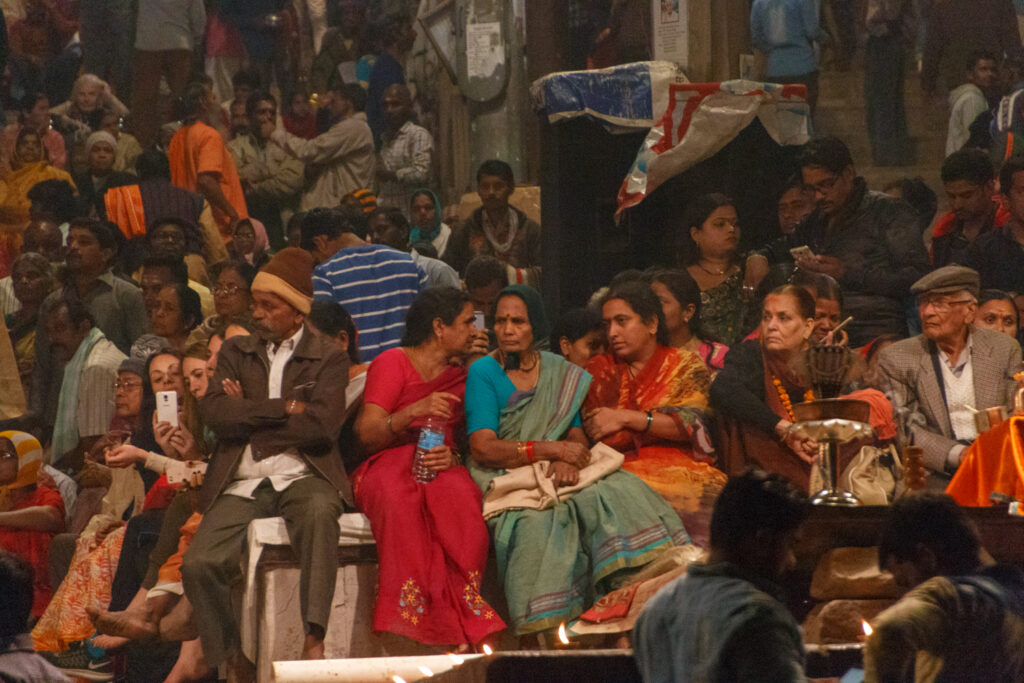
I live in a hypercomplex society. I notice this already in political and social issues, which nobody can really grasp in their complexity anymore. We can hold on to principles, such as justice, equality, freedom, consideration, sustainability, etc. But in concrete terms, things already become difficult. In a conflict, should I take one side or the other, or is there a third possibility? Which of my own ways of acting should I change, and how radically should I do so, what consequences does that have? Or how should I orient my life? What responsibility do I have, what obligation and expectation, what goals? All of this is interwoven with social and economic conditions shaped by political conditions. How are we to make real decisions in all this?
It seems to me that we are often somehow caught in a complex net. If we want to change something, it pulls here and there, and usually things settle somehow so that we do not want to, or cannot, change too much. Talking with friends helps, and with specialists too, depending on what it is about.
Listening
I listen a great deal, and generally people who speak do not really want an answer at all; they simply want to sort out their thoughts aloud. That is entirely okay too. If you listen attentively, the person facing you finds the answers themselves much more quickly. Listening to your own intuition, exploring the underlying feeling—that is often the hardest thing. Here, it is hardest to make compromises. That is why people also look there least often.
Recently, I was with a group of very different people. In the closing plenary session, it was said that this group was carried by a feeling. I cannot get this phrase out of my head: ‘to be carried by a feeling.’ Surely this is not an impulse, or a spontaneous reaction, nor a deep conflict or pain or trauma, nor a feeling of desire, or euphoria… It is something existential.
Heidegger’s Anxiety
During my studies, I read Heidegger; his mysticism of language seduced me. It was uncanny to me, but also irresistible. He answered the question of what metaphysics is with a feeling, highly reflected upon, of course. After long elaborations, he eventually asks: where do we experience nothingness? According to Heidegger, we cannot answer this positively even in purely logical terms. We can experience it only in a feeling that is not reactive, but existential. Heidegger says: in anxiety. Why anxiety? Why nothingness? Why this fixation on death? It took me a long time to forget that again. Forgetting is a difficult art. But what I have kept for myself is the insight that it is okay not to answer certain questions rationally. That was a revelation to me.
Mysticism
Mystical thinking often feels very foreign to me: the fundamental assumptions (axiomatics) are often anything but transparent, the form of argumentation irrational or rhetorical, the insights intuitive, the claim to validity far-reaching. There are, of course, countless kinds of mystical thinking. Yet at its core, it is about crossing the limits of knowledge—and they exist. Where knowledge ends, theology and mysticism begin. There we are carried by feelings. That is why these systems of thought speak so much of love and death, of limit experiences. In capitalist ‘Western culture,’ this has become a taboo. Or rather, we have simply forgotten how to do it.
Sri Aurobindo’s Savitri is a magnum opus that has crossed this limit. His philosophical work ‘The Life Divine’ attempts to answer existential questions rationally; in Savitri, he answers mystically. Apart from Spinoza perhaps, I know of no author who has attempted this so radically in both ways. The writings of his life companion Mirra Alfassa complement this.



Leave a Reply