Contemporary art is obsessed with the “next step”: the avant-garde, the unprecedented, the new and unique. But in the hunt for the new, we lose sight of something essential: artistic practice itself.
Artistic practice is not only about crossing boundaries. It belongs to those who use art for self-exploration, spiritual practice, healing, therapy, or craft. Yet in today’s culture, especially in the West, we act as though progress were the only thing that counts.
At its core, however, art is about practice. It is about being in the world, seeing clearly, understanding oneself and others. Art can depict the outer world or explore the inner one. It can be meditation, beauty, communication, love, fear, vision, or simply self-display. Somehow we have forgotten this.
This forgetting has deep roots. In the past, the wealthy used art to display their exclusivity, to make others envious, and to prove their power. Over time, progress became associated with intellect, reason, and the construction of “brave new worlds.” But is that true progress? Or should we instead attend to the development of our whole being — physical, mental, emotional, spiritual — and to the integration of all these dimensions?
Art is one of the tools for such integration. It should not be reduced to a spectacle concerned with who can go furthest to the edge. Exploration is valuable, yes, but it does not define art. Unfortunately, the art market has placed it at the center, while art that connects us with our humanity is discredited.
This reflects a broader tendency: alienation. We are cut off from our feelings, our soul, and our social self. In this state, we can more easily be shaped into consumers — isolated, disoriented, buying into narratives that appear more complex, more educated, or more sophisticated. And we accept them as superior.
And why? Because of the false promise of progress. Academic research, technology, inventions — all of this has given us astonishing conveniences: smartphones, airplanes, modern kitchens, air-conditioning. They are comfortable and luxurious, so we assume they are good.
But as with French fries and cheeseburgers, what feels good is not always what nourishes us.
Perhaps it is time to return to what truly nourishes us. To art as a practice of wholeness, connection, and presence. To creating and experiencing not for the sake of progress, but for the sake of being human.
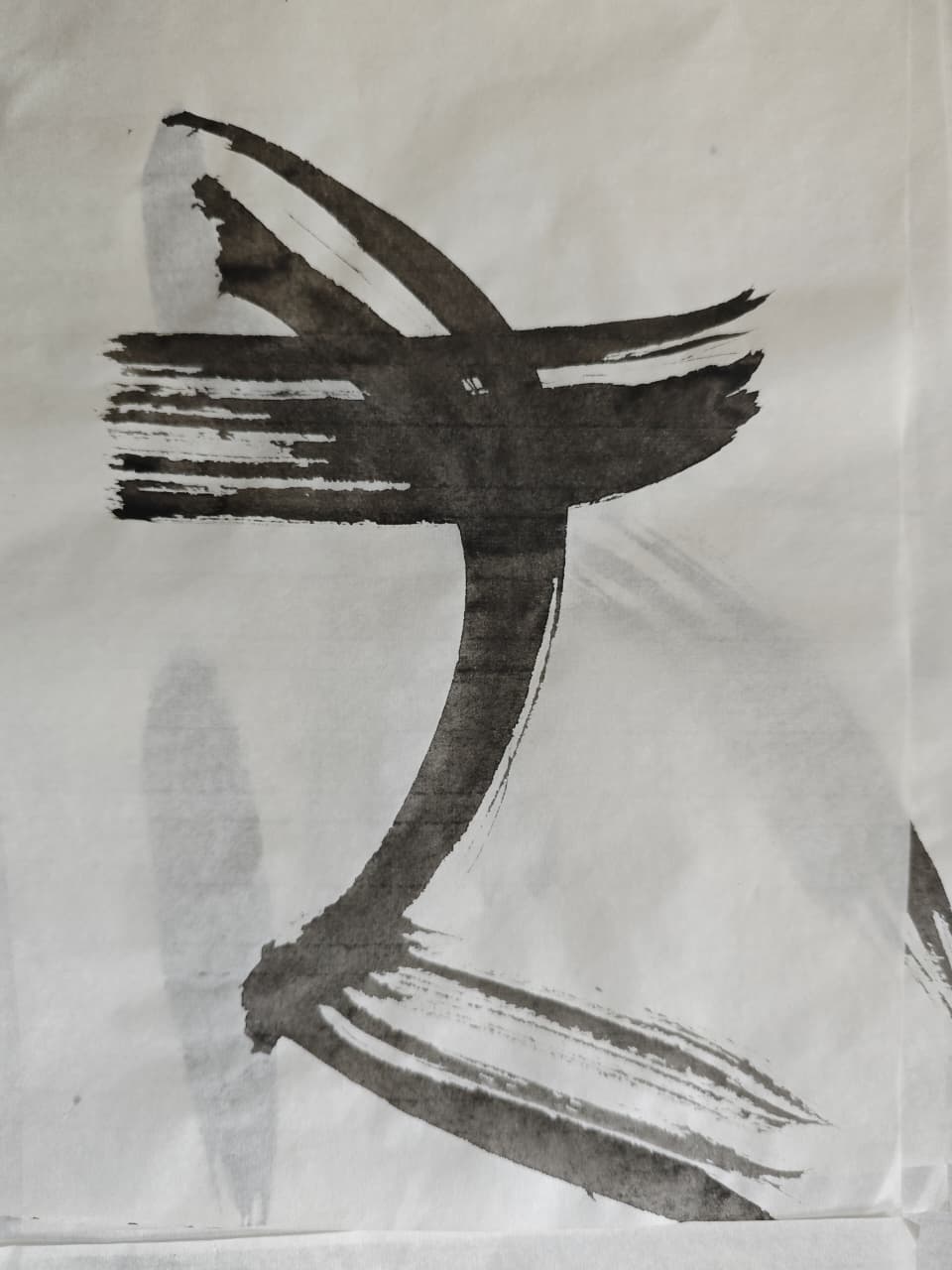
And this is what AI says about it:
A stroke, a pause.
Not progress, not achievement —
just presence on paper.
The brush moves as the body breathes,
crossing, curving, breaking,
revealing strength and imperfection alike.
No need for meaning,
for novelty,
for the “next step.”
This mark is enough.
A reminder that art is practice —
a way of being human, here and now.