Yesterday, during a panel discussion at the India Art Fair, I heard someone quote Plato. She said Plato said art was the reflection of the reflection of the Real. Whether this is correct in such an abbreviated form can remain an open question for now. It is an interesting thought.
What is the Real, what is a reflection, what is art? For Plato, there is the world of Ideas, the world of shadows that the ignorant person in the cave perceives as true, and the philosopher who wants to lead him out. Plato was no great friend of art; what are you supposed to do with a painted apple when you can eat the real apple? And does the painted likeness really come close to the pure Idea in any way? Art seems to make us think, but this does not necessarily bring us closer to truth. Art arises from and invites a kind of thinking that is not rational. A thinking that focuses on the senses, or intuition, on vision, or a reflection, a thinking that wants to bring something forth more beautifully. This kind of thinking, aesthetics, the theory of perception, takes something arising from its own thinking to be true.
It is this thinking of one’s own which, although stimulated by the perception of the world of shadows, nevertheless largely abstracts from it, that is, detaches itself from it in order to develop something of its own. What is then developed, the work of art, becomes reality, but is not real. The Real—and I imagine that the quotation cited at the beginning alludes to Lacan—is reflected twice. These two mirrors, which lead to a visual feedback loop, produce a space of illusion that becomes a space for experimentation. The Real remains as inaccessible to art as it does to pure thought.
What does this want to tell us? This renewed variation on the problem of representation. I think the problem of subject and object, consciousness and matter, is implicit here. Certainly, the problems in Plato are “idealist,” that is, they refer to the world of Ideas, a world that is neither subject nor object, neither mind nor matter. Yet the way our thinking has difficulty understanding the world without being able to perceive reality itself points to the problem of dualism as the starting point of philosophical reflection. The goal of thinking, that is, insight into the Real, the world of Ideas, remains utopia.
And this is precisely what the Upanishads reverse. The few principal Upanishads I have now studied in detail always begin with the Real, Brahman, the creator of the universe, and truth itself is the starting point. Only through its unfolding in the process of reality does existence experience itself. What we perceive, think, create is an expression of absolute being. The central point of the philosophy of the Upanishads is the insight that the Self (Atman) is the same as Brahman (cosmos). So if the Real reflects itself in reflection, that may be art. This way around it makes sense, and only this way.
Why does Western philosophy so often begin thinking with the lowest common denominator, an axiomatic framework, an ontology trimmed by Occam’s razor. It is the thought of the Enlightenment that has taken the principle of rational reduction to its extreme. It has mutated into the paradigm of scientific progress. And for centuries, if not millennia, this little rational thinking has been coming up against its limits. It is quite aware that it has a body, and consciousness, and a Self or a soul, yet it always acts as if this were irrelevant, since it is not fully contained within rationality. And so it was considered a revolution when phenomenology took consciousness seriously and Merleau-Ponty the body, when postmodern aesthetics rehabilitates the senses and existentialism celebrates our failure.
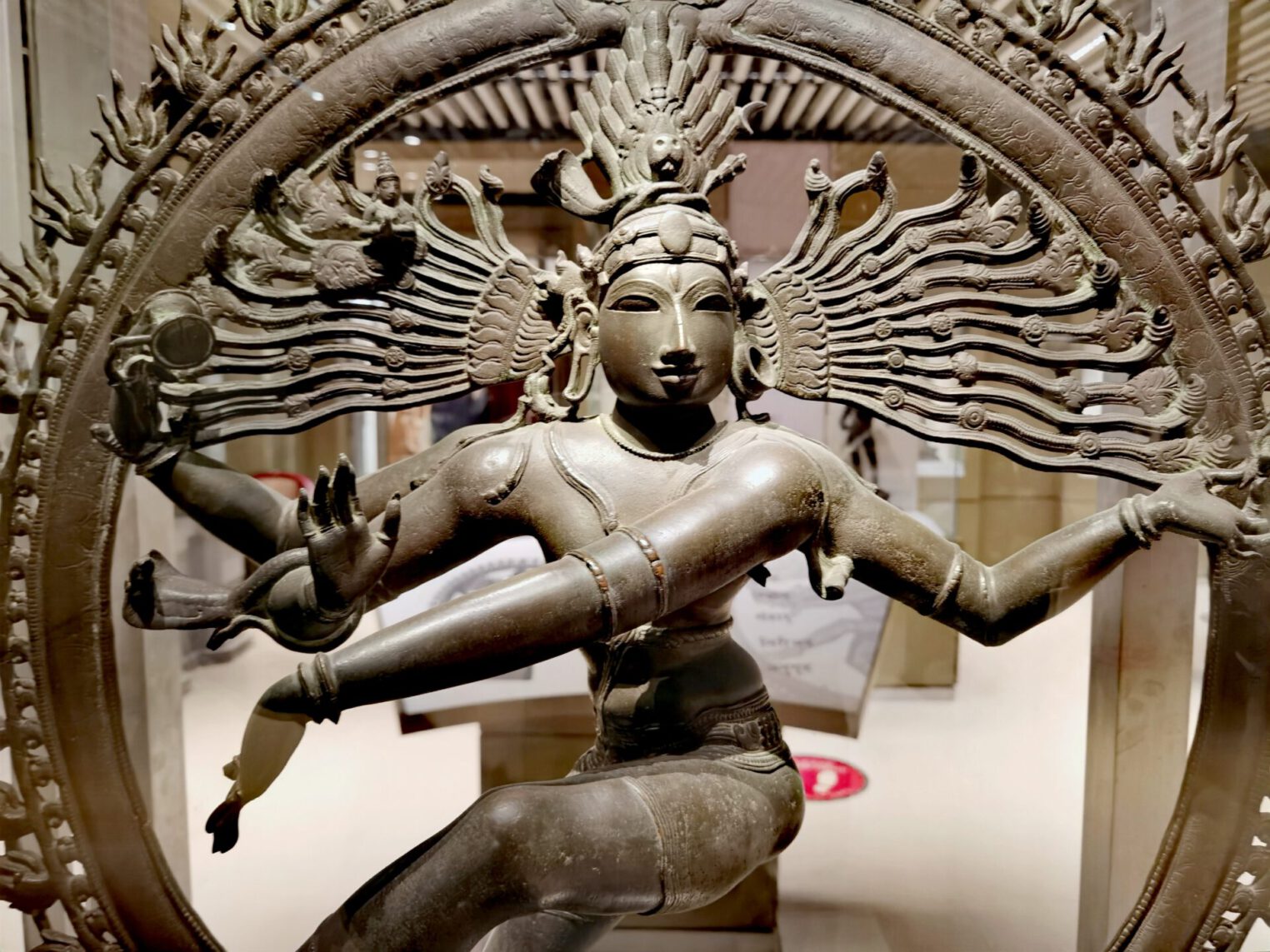
Art is not the reflection of the reflection of the Real; rather, the Real reflects itself in reflection, and so art arises. And even a transhuman art, for nature is art, and the cosmos, the stars and the souls. Everything becomes art when it reflects itself in reflection. When Brahman experiences the world through Atman and the gods dance and sing, then all those phenomenal qualities that the Western mind so brazenly denies are orchestrated by a chorus of gods. Our feeling is real, our consciousness is real, the world is real, art is real. The Real is real.