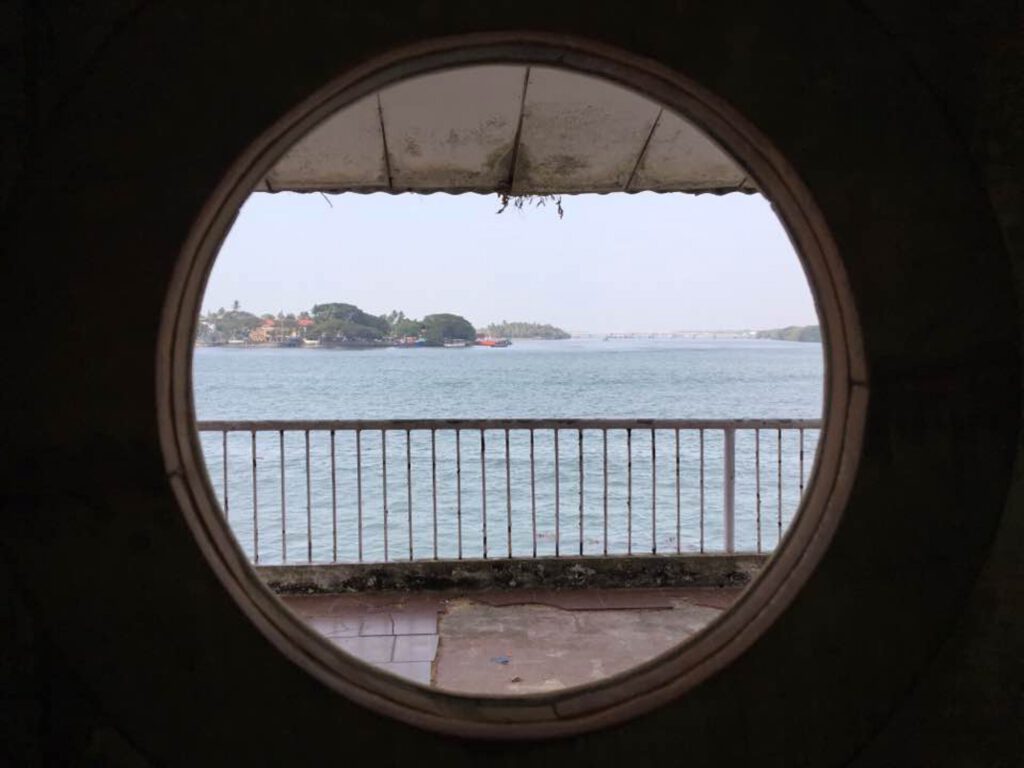
During meditation, I often watch my thinking, let thoughts come and go, and try to slow the thinking down. Thoughts come and go, and often I do not understand where they come from, and why at some point they are replaced by an entirely different thought. What chain of association is at work here? These chains of thought seem to be random, prompted by experiences that still resonate and are being processed further.
This reminds me of a philosophical thought. It begins with an observation by Henri Bergson. He describes the cinematograph, an apparatus from the late nineteenth century that can both record and play films. The cinematograph records many images per second. In film theory, people speak of 25 Frames per Second; let us use that number. So, 25 images per second. When so many images are projected one after the other, we have the illusion of movement; this is the magic of cinema. Of course, the movement is only in the gears of the cinematograph; the perceived movement of the objects on the screen is a lie. Bergson is very clear about this. Cinema cannot capture life. The Elan Vital is not found in cinema. At first, this makes sense.
Walter Benjamin
Walter Benjamin was a little more optimistic about this. The Work of Art in the Age of Its Technological Reproducibility deals with it. Photography threatens painting, perhaps… I am not so sure about that. The aura is lost in the technically reproduced image, yes, probably… but this is often where the reception of Benjamin already stops. Yet Benjamin becomes interesting after this, when he speaks of cinema. The 25 images per second free the actors from the constraints of the stage; through editing, other narratives can arise; space, time become the object of artistic shaping. Art makes creative use of the possibilities of the cinematograph.
Gilles Deleuze
Gilles Deleuze takes this, as it were, to the extreme. His books on cinema are legendarily incomprehensible. He begins with the discussion of Bergson’s cinematograph. Deleuze shares Bergson’s analysis, but Bergson’s mistake was not to have thought the thought through to its end. The individual images, which can produce movement only as an illusion, are not tasked at all with copying reality, with being alive. According to Deleuze, they are thoughts on celluloid. Cinema is pure philosophy, the filmstrip fixed thinking. Nowhere else is thinking captured so concretely as in cinema. Thinking about cinema is therefore doing philosophy. That is why Deleuze’s analyses of films are so incomprehensible. If we are looking for the story behind the film, we are entirely in the wrong place with Deleuze. But if we understand film as a philosophical medium, then Deleuze has set the bar very high.
When I meditate, I sometimes watch my thoughts. This reminds me of Deleuze’s ‘film theory’ (he probably would never have called it that). In Deleuze, there is no theory; for him, there is only thinking itself. He contributed quite a bit to it, and, as he himself says in his ABCDaire, you can count yourself very lucky if you have found a handful of new ideas in your life. The movement of thinking is an adventure; philosophy is its purest form. Theory: its death. To read Deleuze means to think him differently. To report on him might even be an insult.
In 2016, I went to India for the first time; I called the journey ReadingDeleuzeinIndia2016. I removed the year, and it became the title of this blog. Why in India? Because Deleuze’s way of thinking is ultimately deeply spiritual. He would not agree, but perhaps it would please him.


Leave a Reply