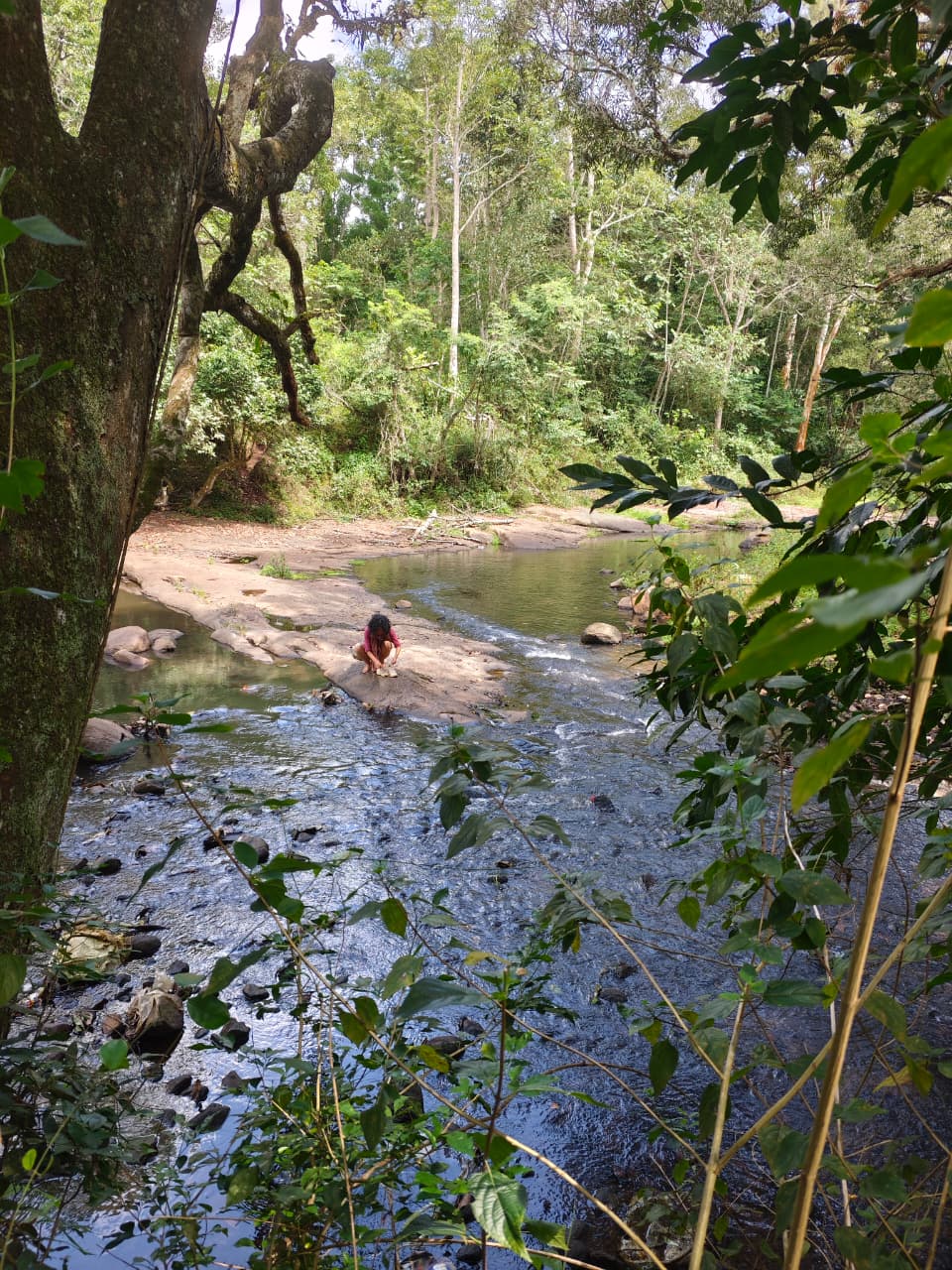
A koan, then. I had often heard of them, those mysterious riddles of Zen that are meant to lead the mind out of the purely rational and open new forms of insight. I decided not to read much about them, nor to ask others about them. I wanted to receive one from a Zen master. During Doksan he asked me a few things about myself. We closed our eyes, he smiled, and said I should imagine a forest with a small stream flowing through it. If I enter the stream, how do I make the sound of its splashing disappear? I should not think about it intellectually, but rather carry the koan with me, take it into meditation, see what happens, and come back to report on it.
The image immediately began to work in me. I saw myself in the forest, standing in the stream: the visual metaphor of the river, of a current of the cosmos; water as a primordial element; entering into the flow of things and of time; the forest as a place of peace, stability, nature. The sounds of the forest, the birds, the splashing, my own feet splashing in the water, the rush and sound of my steps. Where does my path lead? Everything is in flow; I am held in nature, I act and walk, everything changes, and yet everything remains as it is. I could think about this image for a very long time, relate it to my life, to the changes I am living through, to the question of the meaning of life and the simplicity of the answer in nature and contemplation. But this seems to me only the beginning — relating it to oneself is a first step.
Back to the question: Why should I actually try to switch off the sound? Is there anything wrong with the sound of the water, its rushing and splashing, the steps in the stream? Who says these sounds are wrong? They do not disturb, they do not distract; they belong to the walking. The sound of walking falls silent when I stand still, but the stream will continue to rush, the birds will continue to chirp, the leaves will continue to rustle in the wind. Is the question of the koan perhaps simply this banal? Or does it imply something that can be questioned? Perhaps the assumption that stillness is better should itself be questioned. Why stillness, then? Should I think about how I halt my doing and acting, enter into stillness, into meditation, and open myself to emptiness and form? There is probably already something relevant here.
So I place something against the rich metaphor of walking in a stream in a forest: an inner contemplation, a reflection on emptiness and form, a holding still and becoming conscious. The outer sounds, images, sensory impressions fade away inwardly; they are projections within a vision that does not correspond to reality at all — for I am not standing in the stream, but writing at my computer or sitting in meditation. What I have, then, is a thought-image that invites meditation, and the insight I am meant to draw from it is not one of problem-solving. I could keep walking here; I could now immerse myself in the structure of thought, of language, of images — semiotics. How does the question as a sentence relate to the image, and what kind of action does it call forth in order to produce what kind of insight? That would be a beautiful project for a seminar — spending a few weeks thinking about it in the traditions of Western philosophy. But losing myself there is surely not the meaning and purpose of the koan. The koan is meant to lead out of this labyrinth of rational thought.
That was a beautiful little excursion — the aftersound of my studies in philosophy. So I try another path: that of the Upanishads, of the deep primordial ocean into which the seven rivers of existence flow, but from which, first of all, Purusha himself draws himself forth, and from whose eyes, ears, tongue, mouth and nose, hair and joints everything first comes into being. To immerse myself, then, in the conditions of my own existence, my body, my breath, my thinking and feeling. To step into the river, to wet my feet with the water, to perceive the senses as senses, to distinguish them as outer and inner. And then, however, the task, the question: How can I bring the sound to silence? And why should I want to do that?
Why should I concern myself with such a question at all? It already serves me quite well to display my vanity, to demonstrate the schools of thought in which I move comfortably. Why have I been sitting in a Zen meditation center for two weeks, trying to open myself to Zen, to learn something from a teacher by means of a koan? What does he have to show me? Where might the path lead? Is the koan a tool for entering into dialogue, and is my attempt to approach it through writing an escape — a shy attempt to postpone the encounter?