We do, after all, live only in the moment. Often this sounds like an accusation. You should not live only in the moment; think of the future, be conscious of your responsibility. In many modern societies, living in the moment is considered a kind of dreaminess: unproductive and escapist.
For those who have time — beyond mere survival in a capitalist, socialist, or otherwise organized economy — to set aside some time for themselves, the great driving force seems to be the desire to leave something behind: documents of success, entries in libraries, engravings on public surfaces. But if we are honest, not much remains even of the Seven Wonders of the World. This desire to leave a trace in history does not serve the unfolding of one’s own life, but the productivity of a system we may understand as political or cultural. It serves a form of progress that reduces the individual Self, its soul, its life energy and spiritual depth, to its labor power or creativity.
Life in the moment, in the Now, opens spaces of existence that resist productivity, and is therefore radical. Many experience this radicality in moments of happiness, when time stands still, when the other person becomes the center of attention, or when sublime nature brings our own existence into resonance. This radicality, which often has the potential for transformation and moves us to change something, releases an energy that the systems of our societies either understand as a threat or try to capitalize on.
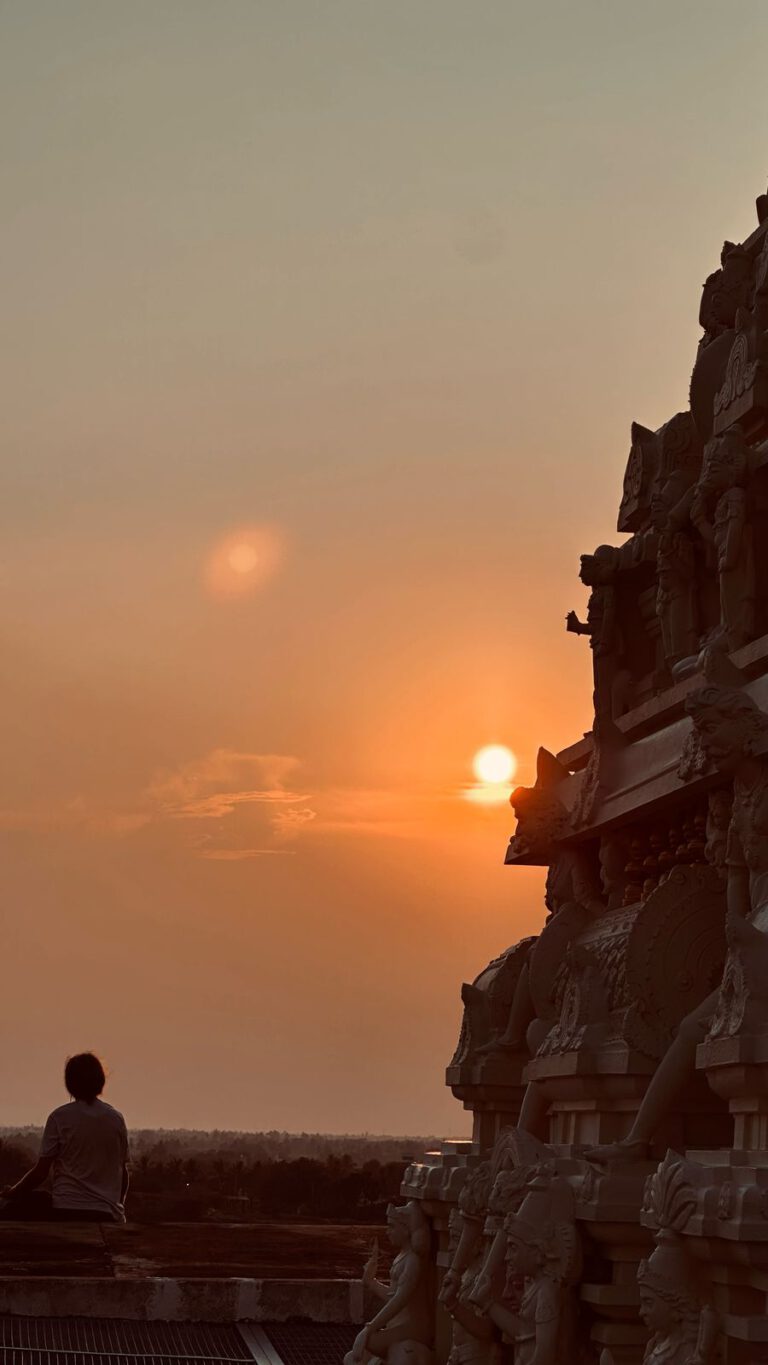
I am sitting in a meditation center and ask myself several times a day what I am doing here. I am not productive … I help a little with daily life, as everyone here does, and in my free time I work little, which means: I do things for other people. In the time I take for myself, however, I am with myself, with that stillness and emptiness in which nothingness and being are in constant play. That play which determines our existence, whose enjoyment is reserved for the soul, and which as a whole is experienced as creation.
And yet it is precisely this creation that exists only in the moment. Only through my experiencing it does it exist at all. I do not want to fall here into the trap of solipsism. Much of what exists outside my perception in this moment is coherent. Yet the world of the macrocosm only mirrors the microcosm. The deep insight of great teachings is that both cosmoses, the microcosm and the macrocosm, the outside and the inside, are identical.
We have forgotten this. We think there is so much out there that I do not know, and that so much of what I experience is not real. This division, this dissonance, defines our global situation as humanity, and little is done to harmonize it. Leibniz spoke of a pre-established harmony, Spinoza of immanence. In meditation, too, it is sometimes about experiencing this: not as philosophical insight, but as genuine being in the moment.
For only in the experience of the moment, the experience of one’s own existence as inner experience and as existence in the Now, are these deep contradictions of being harmonized. Life in the moment becomes the experience of existence; an entry in the history books is not necessary for that.
„The nonexistent did not exist, nor did the existent exist at that time. There existed neither the airy space nor heaven beyond.
What moved back and forth? From where and in whose protection? Did water exist, a deep depth?
Death did not exist nor deathlessness then. There existed no sign of night nor of day.
That One breathed without wind by its independent will. There existed nothing else beyond that.“
Rigveda X.129, Creation