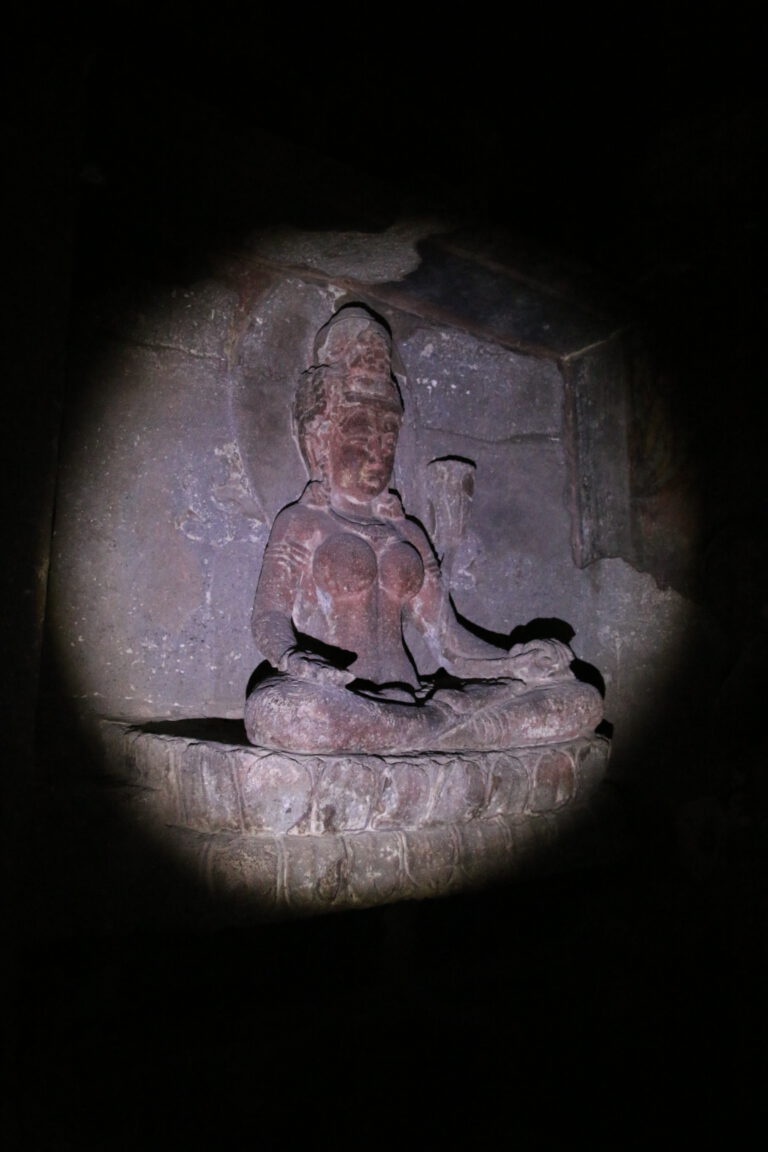
It is full moon in India. Time for self-reflection, meditation, and a turning inward. I have never really thought about death. For me, it was always a boundary, that which defines our existence negatively. Finitude throws us back upon ourselves, or so I thought. Here I agreed a little with Heidegger. To think of something beyond death always seemed arbitrary, naive, romantic, escapist, and credulous to me … Only in existential reflection did death seem meaningful to me. The dead were therefore simply dead. The thought that they somehow continue to exist after death, or had already existed before birth, seemed an important question, but answering it was pointless, since this boundary was defined as absolute. Those who reported that they had crossed it and returned could easily be dismissed as esoteric. That was not difficult for me, and it seemed right.
In meditation, however, things look quite different. In meditation, consciousness becomes clear; it detaches from the outside world and the body by bringing everything into consciousness. The senses become sensory impressions, the outside world becomes pure being, consciousness becomes consciousness itself. It recognizes that it is not a reaction to the world but its origin. It is its origin because it is identical with consciousness itself, that consciousness which is everything. There is no partial consciousness; there is only consciousness living in ignorance. When it steps out of this ignorance, Atman recognizes itself as Brahman, which is itself one with the consciousness that brought forth the universe. It cannot be otherwise. How could a few kilograms of matter produce a small part of consciousness that is unconnected with other consciousness, that is not embedded in a greater consciousness? How could these few kilograms of matter, when they decay, bury consciousness with them? What a strange idea is that? A few kilograms of brain in a biological body would simply produce consciousness, in subjective form, imperfect and isolated, incapable of merging with other consciousness, only then to vanish into nothingness?
Instead, the question now presents itself to me quite differently. If my consciousness is the ground of all existence and has always already contained everything within itself, then the path of an individual life is a way to experience precisely this. To realize this may be the core of enlightenment. But what does it mean in relation to other lives? Those with whom I share the Now, but also those who came before my time, those who departed this life during mine, and those who will come when my time here is over? In the proper sense, there is no beginning or end to a consciousness, although that consciousness is bound to life in this existence.
Consciousness exists independently of life, even of life in a rich sense: that life which does not mean merely a biological form of life, but life as a path of consciousness in a biological body. Life energy (Élan vital, Prana), the world of feelings and of the heart, the level of thinking directed toward the world (Manas), and the thinking that reflects on it, analyzes and understands it (Buddhi), as well as the thinking that contemplates the world and places it within a larger context (Vijnana), and that experience which connects us with higher consciousness (Satchitananda, those three levels which largely elude language and manifest themselves only in experience). That life which extends still further into the worlds of the yogas, of the body, the arts, architecture, of living rightly — this I can explore and illuminate. But what of the lives of others, and of those who are not in my time?
They are real, after all; they have always already existed and do not cease to exist. They merely leave this world of self-experience; they take the accumulated experiences into themselves, and when they leave this world, they go to the moon, say the Upanishads. There they can enjoy the wealth of good deeds before they are reborn, that is, before they immerse themselves again in the world of experiences. That intermediate state in the moon, deep sleep, which resembles nightly sleep only superficially, is a connection with the gods, say the Upanishads. Ultimately, it is the connection with Brahman, and that connection is deeper than being identical with Brahman, which now sounds a little contradictory only to the rational mind.