The traditional music of India, the raga, is melodic in relation to a fundamental tone. Western music is harmonic, that is, simultaneous and complex.
In the West, much thinking takes place in terms of structures; for a time, there was much talk of structuralist and poststructuralist thought. Complex systems are found everywhere: in philosophy, in canonical texts and systems of images, in technology and models that explain the world. One essential underlying idea is atomistic thinking. The idea is that the world consists of elementary parts and can be broken down into them, so that it can be put back together differently, in a more complex or functional way. The living world is dissected in order to understand it. The functioning of these dissected, lifeless parts is understood as a complex, interdependent system in order to explain life.
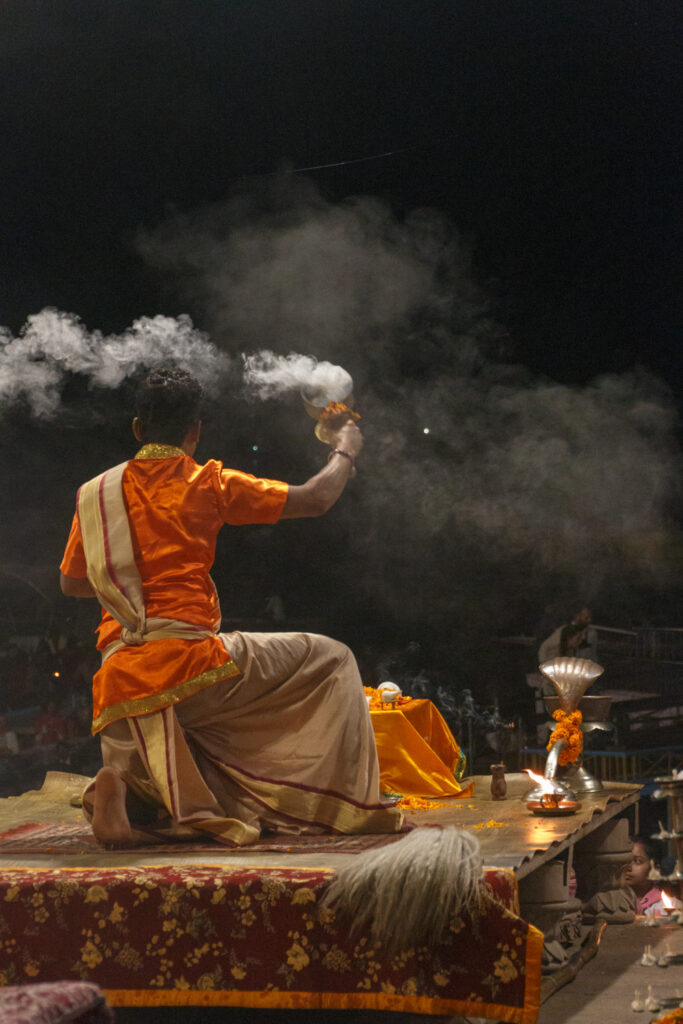
Opposed to this is a processual understanding. The world is constant change, never stands still, is in flux — panta rhei. You can never step into the same river twice. Its counterpart is fire; it is the cause. It draws its energy from the decomposition of organic compounds or the synthesis of inorganic ones. In doing so, it radiates light. In fire, matter is transformed. In the great fire, it comes into being: e=mc2.
Birth and rebirth. Death is indeed the human existential experience par excellence, but at the same time it is not what it seems to be. Like birth, it is a passage, transformation.



Leave a Reply