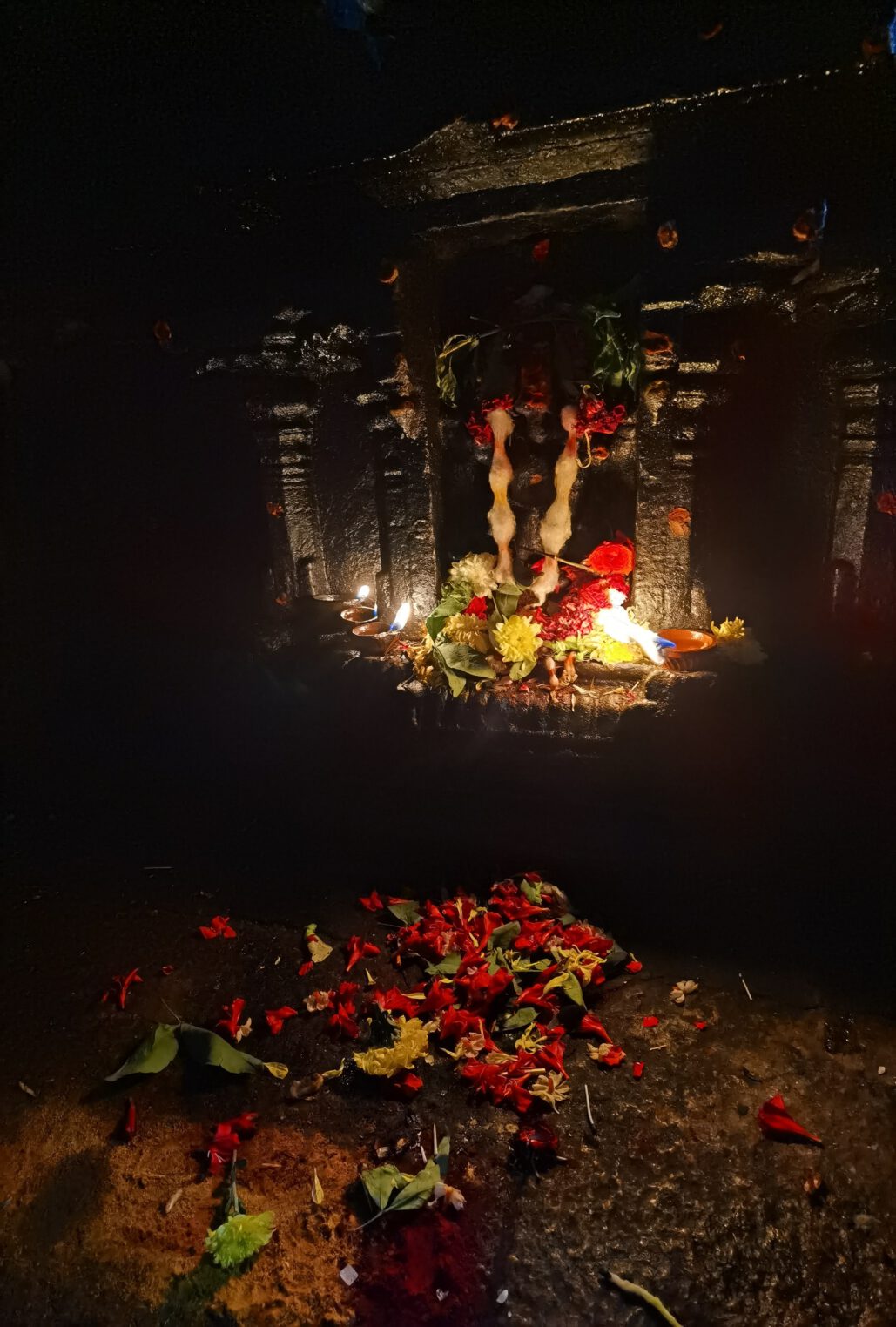
I remember that ever since childhood I have always stared into the fire in the fireplace. Many do this, I think. There is something fascinating about fire. In the Vedas, Agni is the god of fire, one of the 5 elements alongside water, air, earth and ether. These elements exist among the Greeks too. For a very long time I did not understand this and found it ‘unscientific’. I thought of the elements from the perspective of physics and chemistry, and there it makes only limited sense.
Mythology
Within mythology and spiritual insight, however, this is actually entirely plausible. In the Upanishads, different levels of being of consciousness are distinguished. General, eternal consciousness, that is, consciousness itself, formless, all-encompassing, indeterminate—Brahman. Then there are the individual forces, energy, will, love, knowledge, etc. These are conceived as forms of being, as gods, as a heaven of gods. From them, Atman, the individual Self, emerges. It dwells in us.
This sounds very strange, old, idealized, unscientific… but actually it is phenomenal, impossible to deny. We have a will, we love and hate, we know and allow ourselves to be deceived…. We cannot explain this scientifically. We try through functional models (for example, Darwinism) or reductionist models (neuroscience), or through systematic observation (social sciences). Ultimately, however, these models try to reduce what makes us who we are to a material, systemic or structural level. Our assumption is: Once we have explained it away, we have solved the “problem.” What kind of strange conception is that?
But there is actually no dispute about the existence of these phenomena. Only instead of visualizing them as computer models, the Rishi, the seers of the Vedas, gave them the names of gods. They saw their existence and accepted and named them.
Visualization
So perhaps let us stay for a moment with the images of the Rishi.
Pure existence expresses itself in order to know itself – through an act of creation. In science, we call this the Big Bang. In cosmology, we are making good progress in describing the formation of matter, galaxies, planets, etc., and much will certainly still happen here. The computer animations are inspiring, the images of space based on complicated algorithms breathtaking. The narratives about quarks and electrons, gravitational forces, strings, spacetime, the curvature of time are fascinating, and actually impossible for nonphysicists to understand. We accept the provisional stages of scientific discussion as truths that, presented in popular-science form, find enthusiasm on YouTube channels. Einstein, Hawking and others are our Rishi. The experts have understood something that we cannot follow and cannot verify. Only peers, fellow scientists, or the community of Rishi can really judge whether this is nonsense or genuine knowledge.
4000 years ago, the images were gods. Yet these thought-images of the deities are much closer to our experience than the abstract technical images. They describe our lifeworld more precisely; their insight is deeper because it draws on experience. The Vedas accept consciousness. They understand that consciousness isolated in a human existence makes no sense. Here lies the core problem in the realms of monotheistic traditions. How is the immortality of the soul to be explained?
In the Vedas, every consciousness is part of the one. Actually not so complicated, just incredibly difficult to understand, because it presupposes that we do not take ourselves so seriously, understand ourselves as part of a whole and act accordingly. Immortality lies in the insight of not understanding oneself as the center. The way there is meditation.
Experience
For me, it is important to remain on the level of experience. This does not restrict science; on the contrary, it gives it new material. I was concerned with fire, energy, the sun and the force that moves everything. That energy which annihilates and at the same time, beyond that, transforms and moves everything. An energy that feeds on sacrifice (Sacrifice), because wood, for example, burns in the fire, produces energy and leaves ash. In the temples in India, the ash is smeared on the forehead, over the third eye, the seat of insight.
When I sit before a fire, I see this energy, I feel it on my face, on my forehead. A wood fire has a brightness that does not dazzle me, but draws me under its spell. It is danger and sign, energy, force and destruction. In fire I see the primordial force of the universe, the likeness of the sun, the emblem of purity and clarity.
Om Namah Shivaya
Leave a Reply