I love complexity, but sometimes also radical simplification—to gain a little clarity. For example, the history of ideas in the visual arts. In Europe, after the great migrations, art history can be sketched in broad strokes as a history of ideas:
- In medieval art, stories were told visually – mainly the stories of the Bible. Most people could not read, after all, certainly not Latin or Greek. The wood-panel painting of the altars is therefore a kind of comic, and equally free in its spatial order, perspective, relation of objects.
- In the Renaissance, principles of construction of the understanding were applied: central perspective, color theory, visual effects such as sfumato, etc… It was about showing that artists can construct an illusion.
- In the Baroque, space was grasped. The church space was folded, the senses stimulated, painting seduced, the (art) objects stood for themselves.
- In the Rococo, the nobility were entertained. Sometimes very poor taste and interior architecture served as spectacle – courtly, decadent.
- Neoclassicism was an ethical correction. The classical values and principles of antiquity were conjured up again.
- In Realism, for the first time it was really about capturing artistically the world as we think it is. Pretty and ugly, banal and uplifting…
- Then, in Impressionism, philosophical reflection on one’s own perceptual apparatus. We can only depict what we perceive. Reality beyond our senses eludes depiction.
- In abstraction, which actually is none, it is about inner forms of the mind.
- …
An arbitrarily long list of such radical simplifications could be drawn up. Yet it is beautiful to see that there is a dialectical movement here. Something new is tried until it is recognized that a limit has been reached. The principles of shaping turn into their opposite. This is progress, we say. The ‘European elite’ becomes ever ‘better’. There may be something to this history of ideas, but what becomes visible here? What cannot be formulated at certain times, and why? Are Delacroix’s drawings not pure Impressionism? Is Grünewald’s portraiture not pure Realism? And is the formal language of medieval art not pure, concrete art?
Art theories
Who told this history? Vasari, Gombrich, Panofsky? Why was it told this way? And who had previously collected and sorted things out in the chambers of wonders and cabinets of curiosities, the private collections of castle owners and the priests of the church spaces? And what was burned in the revolutions that we never saw again afterward?
I have always had a philosophical interest in the media of art. I rarely looked at artists’ biographies. I always found the philosophical art criticism of a Roland Barthes, for example, more exciting, or philosophical theory by Danto, Deleuze or Foucault. A long list could be produced here too; here too it is not about the individual details. The perspective is important. Art arises in the viewer. For me, alongside aesthetic experience, art is also always work of thinking – or was. This has now changed for me.
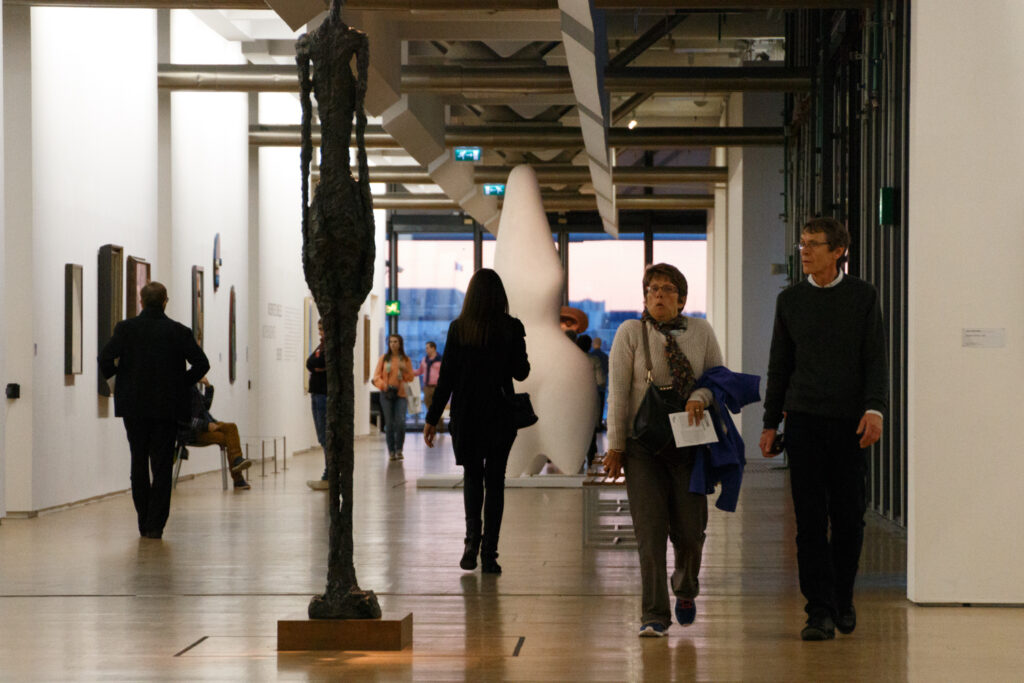
The history of progress or reflection, of expertise and contextualization, philosophical media analysis and every kind of value creation, ideological superstructure and power structure increasingly lose my interest. Art is dead, long live art. This was a popular motto not only in the time of the avant-garde. It expresses how a society deals with art. It is an object, a very interesting object, yet an object. The spiritual in art, as Kandinsky saw it, for example, is lost in the history of ideas. Museums as secular temples of art and galleries as capitalist, ideological amplifiers drive the spiritual out of art. If art lies in the viewer, then it is everywhere, but least of all in museums, galleries, churches and collections.
Expectations
But perhaps my expectation is simply too high. Art is, after all, the highest good in our culture, as I was taught. In it, human experience, knowledge and education, perfection, enjoyment and reflection meet. Art is the highest art. It deserves respect, it is inspiration, perfect in genius and beyond the grasp of ordinary citizens.
Perhaps we should take art off this pedestal again and, as handicraft, let it lose itself in arbitrariness. But perhaps we should also unmask art as what it is, always a lie too. I cannot eat a painted apple, after all. For me, however, art is above all one thing: an object of meditation. Art is concentration and openness. Art calls for interpretation through beholding. Only in this way is it alive. I can find it everywhere, even in museums, galleries, churches and collections.
Leave a Reply