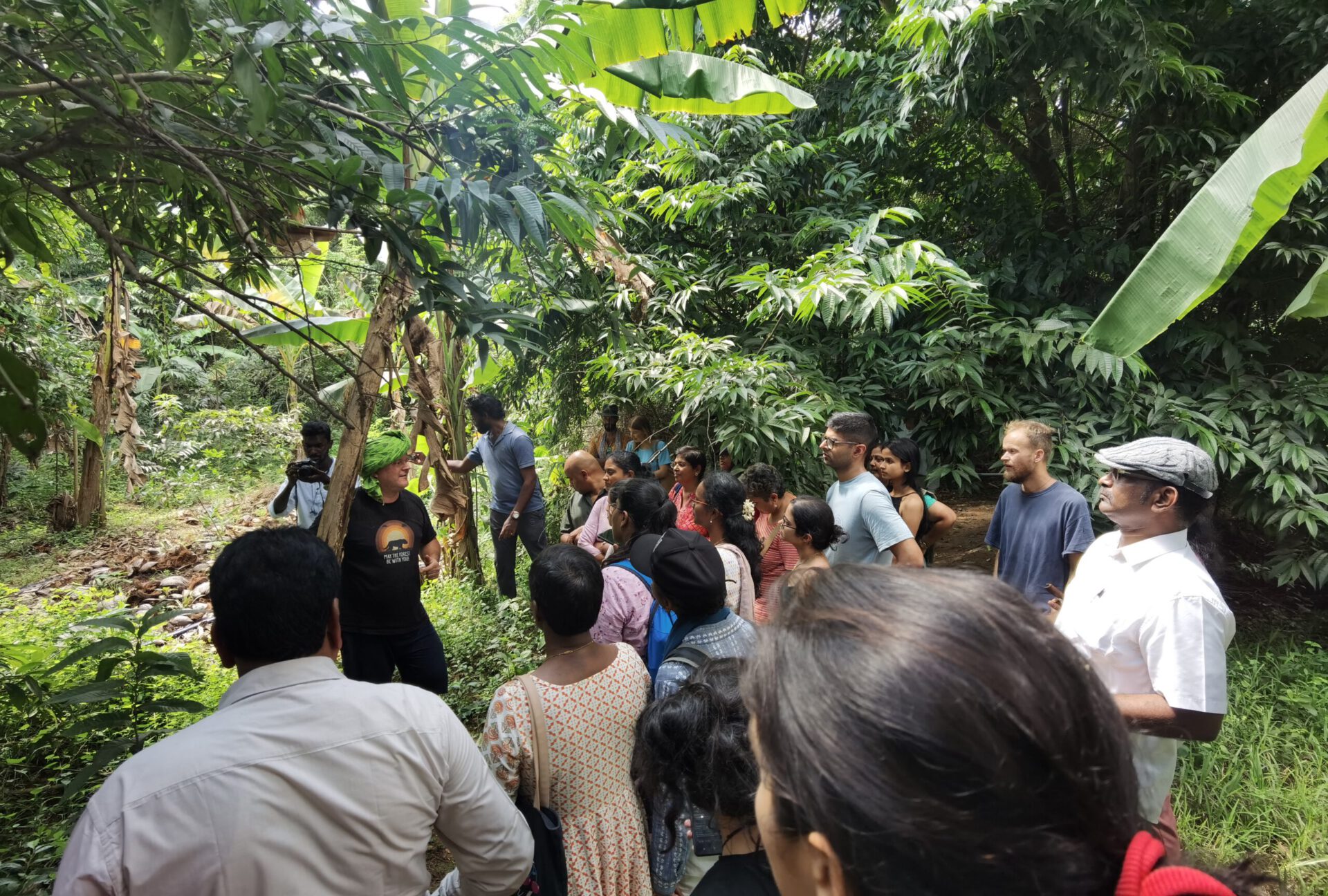
The Solitude Farm in Auroville is a ‚food forest.‘ This is one of the few English terms that is difficult to express with a compound word in German (Esswald?). We don't have anything like it, and it's difficult for us to think about it. An orchard that we would let become overgrown with other edible annual and shorter-lived plants until we have a dense jungle of edible plants... I'm looking for a word for this. It's the opposite of a ‚food desert,‘ for which we also have...
Schopenhauer, a great admirer of the Upanishads, wrote a small book „On the Fourfold Root of the Principle of Sufficient Reason“ (1847). He identifies four forms of causality, e.g., small cause – large effect, or large cause – small effect, etc. This fascinated me because it offers a broader understanding than the purely scientific model, which ultimately always follows the law of conservation of energy. For example, when someone declares a war, that is a relatively simple act (small cause) and...
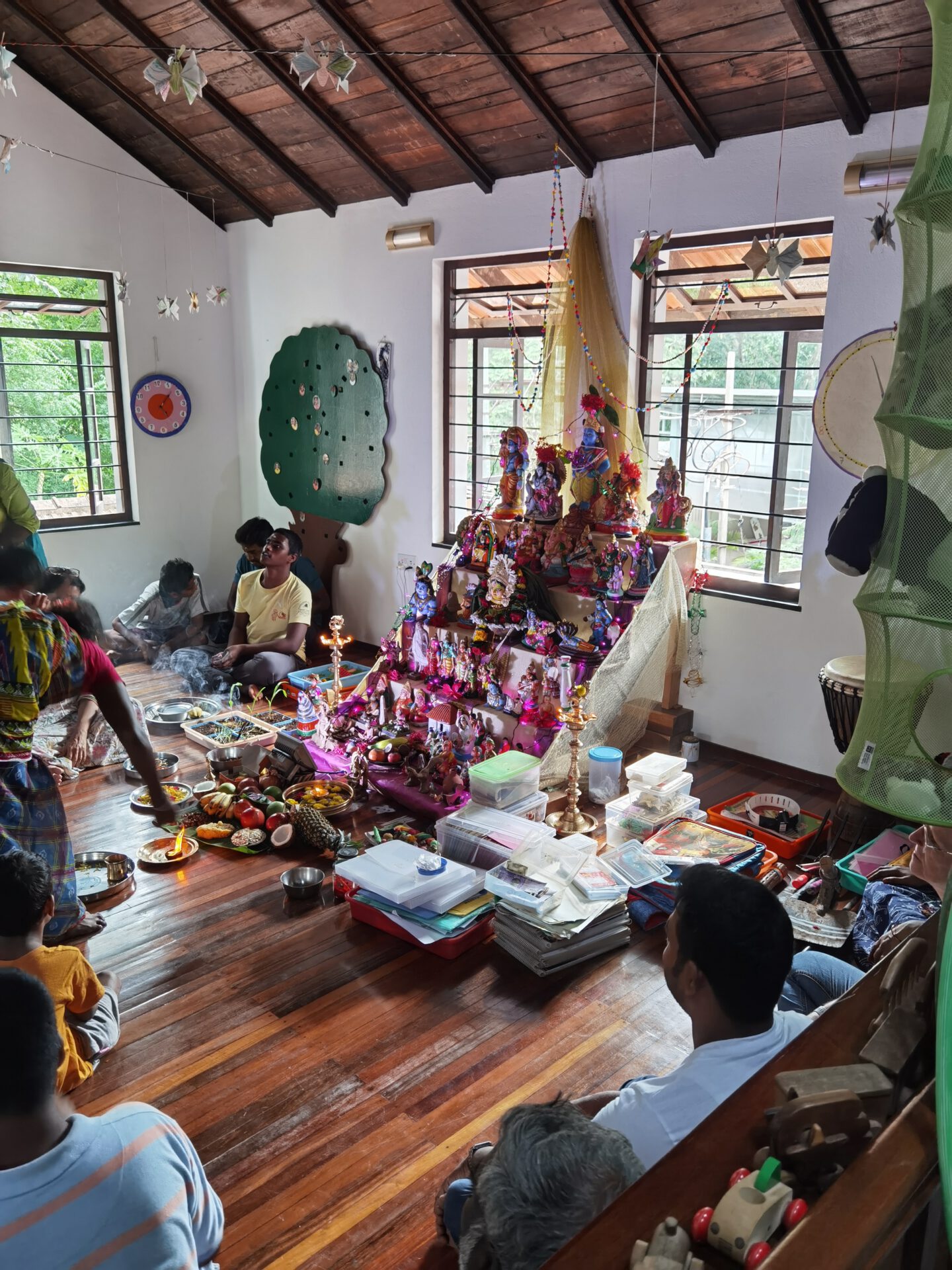
Today I visited a place for village children with special needs (Deepam). Someone from the guesthouse here had invited me to accompany them. It was a kind of ceremony as part of Navarathri in honor of the goddess Saraswathi – she represents education, prosperity, and success. In India today, the items needed for work were cleaned and consecrated as a form of thanks. Gifts were brought to them and songs were sung. At the therapy center, these included figurines, books…
There was a time in Europe when people spoke of polymaths. In Germany, that would be Alexander von Humboldt or Goethe; in France, an Enlightenment thinker; in Italy, the Renaissance man Leonardo da Vinci. In antiquity, Aristotle. Certainly, in many cultures and eras, there have been wise people whom history tells us knew everything that could have been known at the time. This is nonsense, of course. But this narrative serves a longing. We want to know everything, but we have...
I've always had stomachaches with an atomistic worldview. We learn in school that the smallest building blocks of the universe are atoms. Now, physics has advanced, and we talk about protons, electrons, positrons, quarks, and strings, etc. ... At its core, the idea remains the same: the world is composed of the smallest parts of matter. This is such a widespread idea that few people doubt it, meaning they doubt the exclusivity of this worldview. I explicitly do not want to [cover] physics, chemistry, or...
I love complexity, but sometimes also radical simplification – to get some clarity. For example, the history of ideas in visual art. In Europe, after the great migration period, art history can be sketched woodcut-style as a history of ideas: In medieval art, stories were told visually – mainly the stories from the Bible. Most people couldn't read, let alone Latin or Greek. The wood panel painting of the altars is therefore a kind of comic strip, and just as free in its spatial...
Black holes pose puzzles for us. I am not a cosmologist and approach black holes through popular science with a philosophical interest. They mark a boundary of our imagination. Gravity influences space and time, science says. Concentrated to a point, it condenses matter to its pure substance, crushing atomic nuclei and electrons together into a mass (atoms essentially consist of emptiness). This mass, with its incredible gravitational force, attracts everything and bends and distorts space and time. The black...
 German
  English
  French