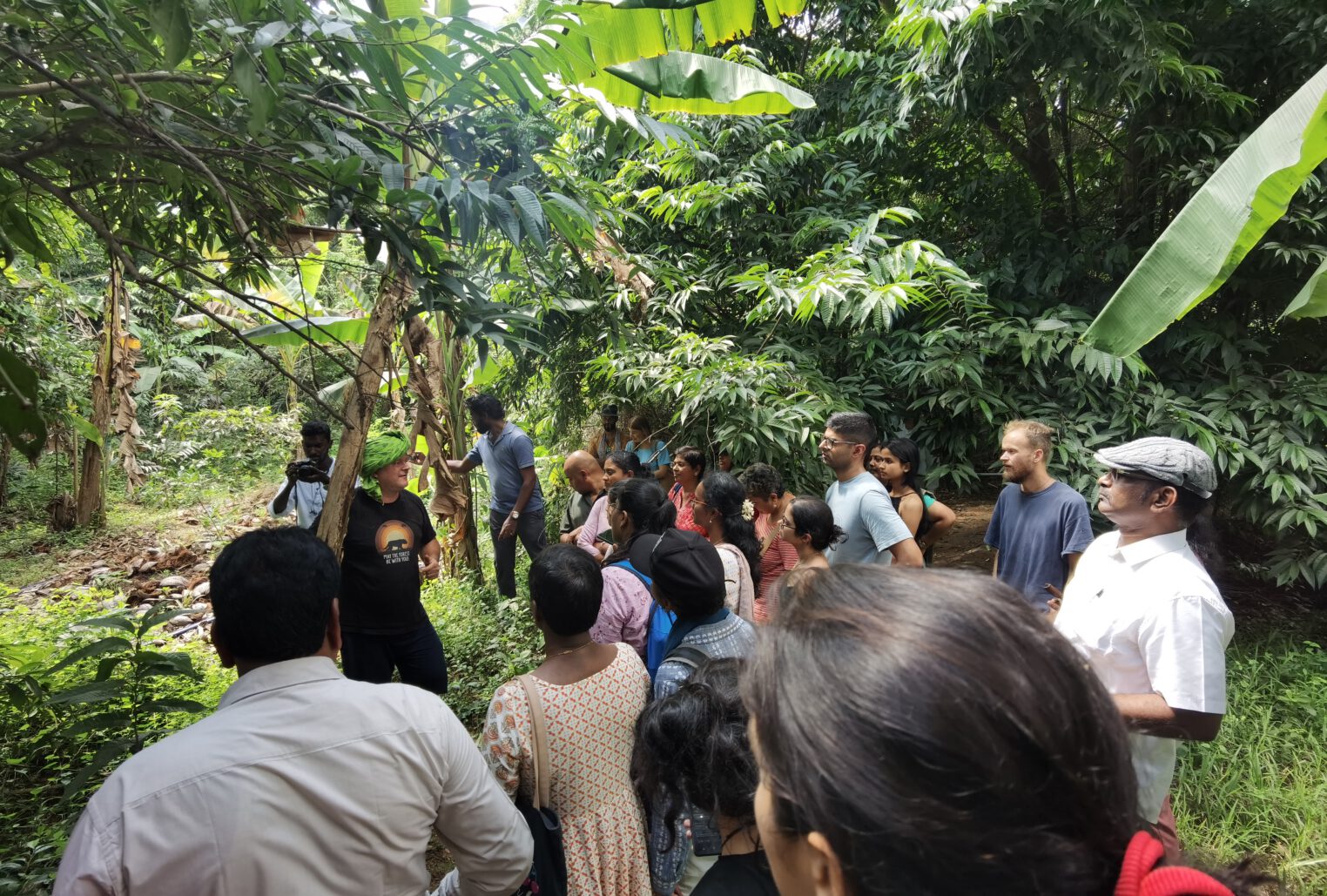
The Solitude Farm in Auroville, is a ‚food forest.‘ This is one of the few English terms that is difficult to express in German with a compound word (Esswald? - food forest?). We don't have anything like this, and it's difficult to think about it. An orchard that we would let run wild with other edible perennial plants and shorter-lived plants until we have a dense jungle of edible plants... I'm looking for a word for that. It's the opposite of a ‚food desert,‘ for which we also don't have a compound word in German; it means a city district where there are no stores selling fresh food. The only things available in urban ‚food deserts‘ are gas stations and convenience stores that sell bags of chips and candy, shelf-stable white bread, and processed cheese.
Tamil
Krishna gave a short presentation. His enthusiasm for the project, which he has been pursuing for over 20 years, was palpable and passionately felt. Krishna is from England, speaks fluent Tamil, and often had to search for English words for Tamil terms. The Tamil culture has not only captured his heart, but he seems deeply rooted in it. And that is precisely his core message. We possess millennia-old knowledge about what grows in the environment we live in, what we can eat, how we can prepare it, the nutritional value of the plants, and what healing effects can be achieved with them.
Grandmother's knowledge
Our grandmothers had this knowledge, we still have it somewhere inside us, but we have forgotten it. Nature has more to offer us than our chemical inventions, if we let it do its work and only guide it a little here and there. His core message: activate the old knowledge, let nature do its thing, handle the fruits responsibly, collectively and ecologically....
Krishna draws inspiration from Masanobu Fukuokaa pioneer of permaculture. He met him many years ago in Japan and saw his "do-nothing agriculture" with his own eyes; he carries on his spirit. You can only enter his edible forest barefoot - any child would have known that in the past. As he talks - wandering through the small forest of 1 to 2 hectares - he picks leaves, eats them and calls them by Tamil names. His voice is overflowing with enthusiasm about the richness of the small forest. Most of the plants came by themselves. He doesn't know the word weed. A friend in Auroville brought a piece of land that had been so degraded in the 20th century that it was nothing more than a stony desert into the state of an edible forest within five years. It was a lot of work, but rewarding and sustainable.
The food box principle enables farmers to live much better, and the community and nature are also better off.
Learning
A group of students from Pondicherry were there that day with their lecturer. They wanted textbook knowledge. 'Use your campus to grow vegetables for the canteen, encourage your students not to eat at the fast food chains just outside the campus, ask your grandmothers. The knowledge is there, you just have to use it,' was his answer. Otherwise, he would of course be happy to give various workshops on practical procedures.
The old woman, who was born here in the country and sat on the floor in the background, didn't understand English. She knows what to do.
 German
  English
  French
Leave a Reply