For three weeks now I have been reading in India: Deleuze, Upanishads, Sri Aurobindo. In between I sometimes meditate. The rest is still a remnant of everyday life in the New World. Reading the news, consuming entertainment media, organizing things that have no real significance here but need continuity so that they do not fall apart in old Europe and the New World. Reading, then… It seems to me that I have spent decades preparing to read here. My thinking…
Today I went to a choir session. What happened there was a very intense shared experience. I will try to describe it as objectively as possible. We (about sixty participants) began with breathing exercises, ‘warmed up’ the vocal cords, sounded four-part chords and moved through pitches. The choir director pointed out that we were not here by chance. We were in Auroville because something had drawn us here. I think most people in the room understood what he meant; for…
Schopenhauer, who was a great admirer of the Upanishads, wrote a small book, “On the Fourfold Root of the Principle of Sufficient Reason” (1847). He identifies four forms of causality, for example, small cause—large effect, or large cause—small effect, and so on… This fascinated me because it offers a broader understanding than the purely scientific model, which ultimately always follows the law of conservation of energy. When someone declares a war, for example, that is a relatively simple act (small…
I have always resisted the word meditation. Much about it was suspect to me. Yet at the same time I have always practiced my own forms of meditation, without calling them that, or without having learned them. For me, the realm of meditation includes: a) contemplation, that is, sinking into a thought and deliberately tracing impulses of thought on a subject, circling until the mental image becomes clearer and appears before the inner eye. b) Paying attention to one’s own…
Many films feature good hotels in central locations where the political, intellectual, and economic elite meet. I always perceived this as something very elitist, colonial, and power-hungry. What escaped me in the films, and probably was rarely their subject either, is the networking that takes place in such places. Now, the Center Guesthouse in Auroville can hardly be compared to a luxury hotel in a metropolis, although it is a very beautiful place, welcoming, friendly, and making life easy. Rather,…
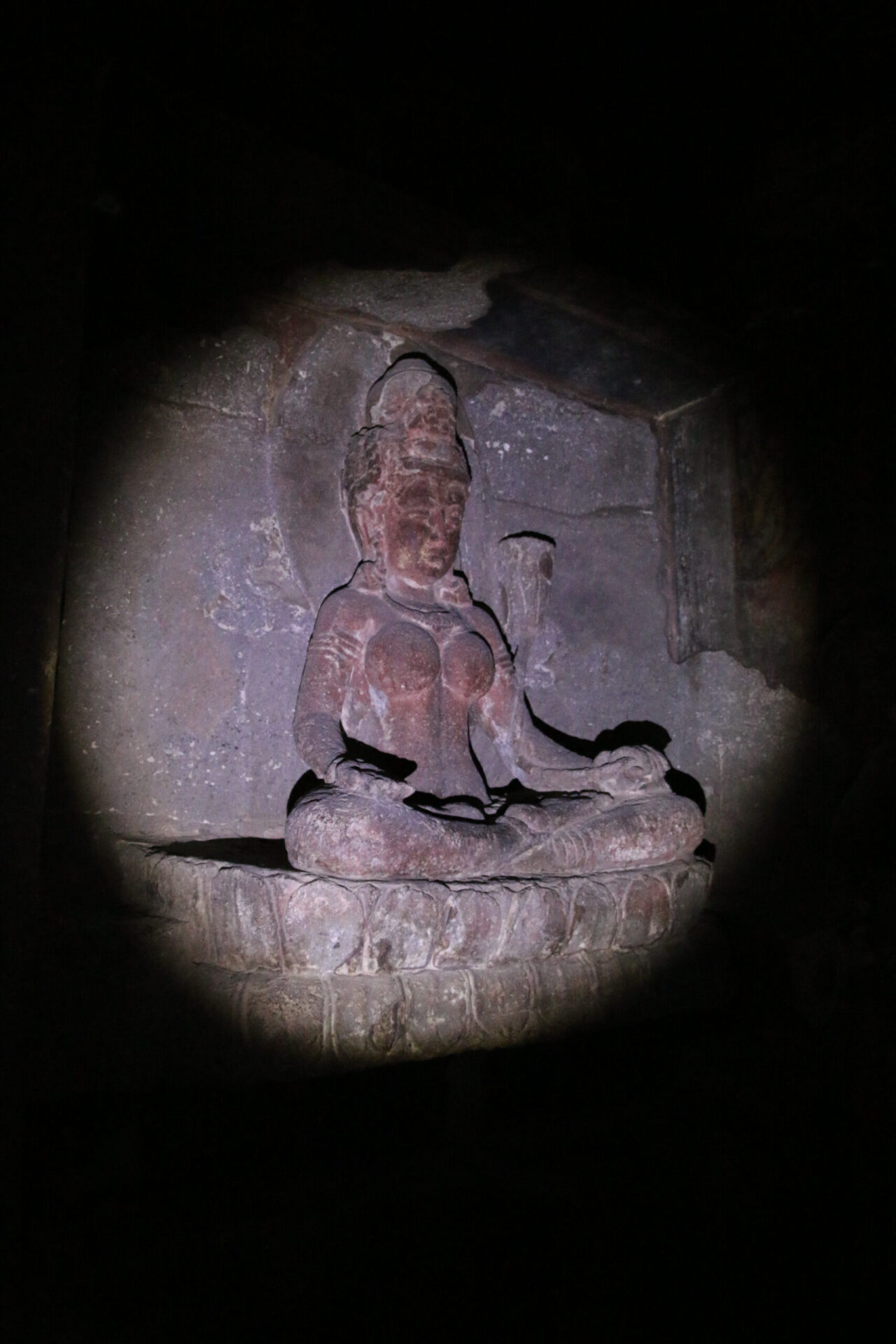
What should I take to India? I want to live a different life, in a different society, with different ideas and goals. It is warm there; life will be simple. Apart from the basics, such as a few clothes, I need my technical devices: laptop, phone, camera. And what else? A good flashlight, because the dirt roads there are not lit. And books… There will be a number of libraries there too. I have not read for ‘pleasure’ for a…
There was a time in Europe when people spoke of polymaths. In Germany, this would be Alexander von Humboldt, or Goethe; in France, an Enlightenment thinker; in Italy, the Renaissance man Leonardo da Vinci. In antiquity, Aristotle. Surely there are wise people in many cultures and epochs of whom history tells us that they knew everything one could have known at the time. Of course, that is nonsense. But this narrative serves a longing. We want to know everything, yet…
In the Kena Upanischade it is described how the Self as such does not exist. Who sees in seeing, who hears in hearing? This cannot be answered. In the Christian tradition, a Self was constructed for this. I see, I hear, cogito ergo sum, imago ergo sum… What is that supposed to be, this cogito (I think), this imago (I imagine)? That I which establishes identity, bears responsibility, acts and interacts. It seems clear that thinking, when it is conscious…