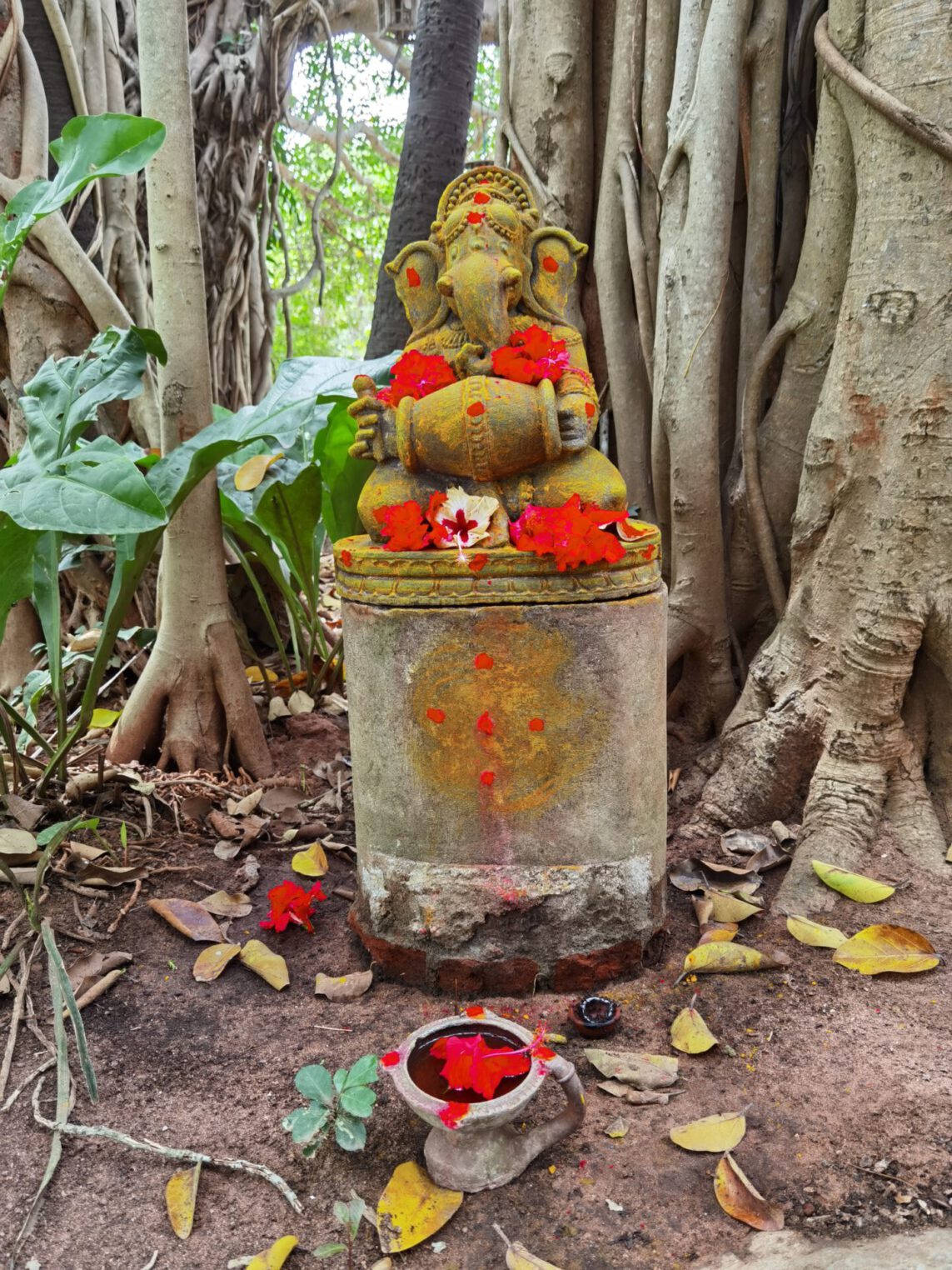
I have always resisted the word meditation. Much about it seemed suspicious to me. At the same time, I have always practiced my own forms of meditation without calling it that, or without having learned it.
For me, meditation includes: a.) contemplation, meaning to immerse oneself in a thought and to purposefully follow thought impulses on a specific topic, to circle around it until the mental image becomes clearer and appears before the inner eye. b.) paying attention to one's own breath. This makes one's own body conscious. This means that through conscious inhalation and exhalation, the body also straightens up, the spine is relieved, and one's own physical existence becomes conscious. With this awareness of existence, new levels of consciousness can then be unlocked. c.) in transcendental meditation, the self connects with the universal consciousness and can now assume almost any form. The concept of becoming is exciting in this context. The self can now merge completely with another. For example, the self can open up or mentally transport itself to another space or time. Thoughts are free. These are forms of meditation that I generally practice for half an hour.
During longer meditations in the lotus position of up to 1.5 hours, completely different things happen. This also has something to do with the pain that the sitting posture brings with it. I sit through the pain, so to speak. This leads to a kind of trance. This borderline experience transcends the separation of self and world, in it I find a reality where everything is in harmony.
India
In India, I feel like I can write this down without sounding like a dreamer. It feels natural to do this and also to talk about it. Perhaps my longing for India also has something to do with this. I have the feeling that I can give my consciousness space here without having to justify myself. These experiences are simply allowed to be and do not have to prove themselves against the reductionist constraints of a materialistic philosophy. Rather, being here allows me to explore consciousness in the first place and, from these experiences, to understand the constraints of the Trinity, capital and neurobiology as such.
I am not a machine and I don't want to be seen as one.
A beautiful description of what meditation can be can be found in the Shvetashvatara Upanishads Chapter 2. in: "The Upanishads. Introduced and translated by Eknath Easwaran" ISBN-10: 3-442-21826-8 p.294f.
 German
  English
  French
Leave a Reply